
When I wrote the article about the Sangeetha Mumoorthigal dramatic production on the lives of the Carnatic trinity, a couple of readers generously pointed out how I had missed a crucial segment and the history attached to that particular segment. It was a segment that displayed a chapter in history that rendered the traditions of classical music and dance inseparable, and I admit it was a major omission or oversight on my part to miss it. So, here is what I found out about that crucial chapter of our history that literally laid down the foundation of classical South Indian dance traditions we enjoy today.
When the play, Sangeetha Mumoorthigal, took the stage at the Sivaswamy Auditorium in Chembur, Mumbai, it did more than celebrate the remarkable coincidence of genius in a single generation that defined the most promising century of Carnatic music. It gave us a peek into a successive generation that would inherit, then multiply and define the age of Carnatic music and…(Mridangam roll please)...Bharatnatyam.
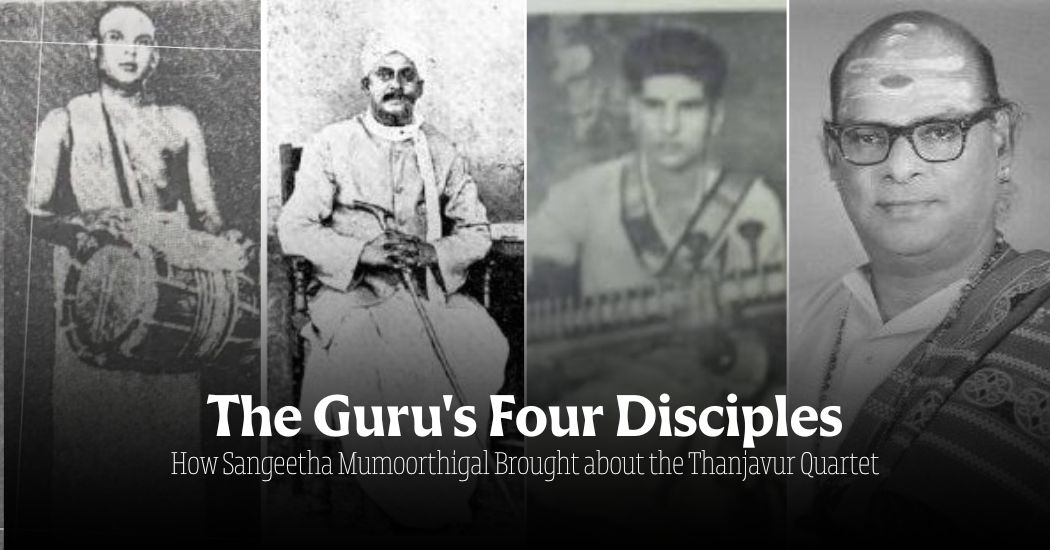
Hidden in the production were nuggets of an equally phenomenal story — that of four brothers from Thanjavur who learned everything and more at the feet of Muthuswami Dikshitar and, in doing so, changed the futures of both Carnatic music and Bharatanatyam forever. This is the story of the Thanjavur Quartet also known as the Thanjai Naalvar: Sri Chinnaiah, Sri Ponnaiah, Sri Sivanandam, and Sri Vadivelu.
The brothers were born into a family for whom dance and music were inheritance, aspiration, and worship. Their grandfather, Sri Gangaimuthu Pillai, was an accomplished Natya Acharya (Nattuvanar) and a visionary who revived and created foundational Kauthuvam dance traditions in praise of deities. Their father, Sri Subbarayan Pillai, carried that inherited legacy forward at the Thanjavur court under the patronage of Raja Thulaji Bhonsle of the Thanjavur Bhonsle dynasty. From their father and grandfather, the four brothers naturally inherited the Nattuvanar gene. But it was their formal training in Carnatic music under Sri Muthuswami Dikshitar — one of the Trinity himself — that gave voice to their inheritance. Their inheritance and musical tutelage transformed them into the pathfinders who fused the blend of ragas and talas of Carnatic music with the adavus, abhinaya, & hastas of Bharatanatyam.
Further, the brothers hailed from a family who possessed intense devotion towards Sri Brihadiswara (Lord Shiva) and Devi Brihannayaki, the presiding deities of the famous Thanjai Periya Koil (Brihadisvara Temple) in Thanjavur, where the brothers were attached as temple musicians and composed several devotional dance pieces dedicated specifically to Lord Nataraja. A prominent composition which is a staple of Bharatanatyam training even today is the Natesha Kauthuvam (or Nataraja Kauthuvam), a fast-paced, rhythmic dance piece written in praise of Shiva's Tandava.
This is the chapter that Sangeetha Mumoorthigal dramatises with such care. The play shows the brothers demonstrating the very philosophy of their guru's music that they absorbed, from its meditative style to its devotional fervour and, crucially, its openness to blend influences from beyond traditional Carnatic practice. Dikshitar himself was no traditionalist content to work within inherited forms alone.
Dikshitar himself spent years in Varanasi under his own guru, Sri Chidambaranatha Yogi, and had absorbed elements of Hindustani music and, subsequently, went further with setting Sanskrit and Telugu verses to Western melodies encountered through colonial military bands in Madras. It was a body of work that came to be known as the Nottuswara Sahitya. It is interesting that this compound term sounds rhythmically close to the pronunciation of Natya, Swara and Sahitya, which are the three pillars upon which the blend of the Bharatnatyam and Carnatic music performing arts are based!
Imagine being a composer working in the early 19th century and witnessing this striking adoption of foreign musical notes and enriching the corpus of Carnatic music with no threat of dilution. For instance, the Shakti Sahita Ganapatim, one of the famous Carnatic compositions by Sri Muthuswami Dikshitar came into existence by fusing the Western melody Voulez vous danser, with devotional Sanskrit lyrics in praise of Shakti and Maha Ganapati, is set in Sankarabharanam raga, which uses the Sapta Swaras (Sa, Re, Ga, Ma, Pa, Da, Ni). This raga is comparable to the Western C-major scale (Do-Re-Mi) and Hindustani Bilaval scale (Sa-Re-Ga). Can you see what Sri Muthuswami Dikshitar did there! It is for this reason that Carnatic music beginners are introduced to Shakti Sahita Ganapatim because of its simple note-based swaras, much like the practice of worshiping Maha Ganapati first as Pratham-Pujya ensures any new endeavour begins and proceeds without obstacles or hindrances.
It is this spirit of absorbing and synthesising diverse musical traditions that the Naalvar would inherit and apply to a completely different art form — dance.
In this production of melodies, we find the character of Sri Ponnaiah Pillai, demonstrating the family's shared mastery and contribution to Bharatanatyam and Carnatic music. It is crucial to know that Sri Ponnaiah Pillai was the brother among the four credited with the codification of dance procedures and segment order while also being the most prolific among them as a composer!
One such contribution was the Nattuvangam—the art of conducting a Bharatanatyam recital through Solkattu (rhythmic syllables) and instrumental talams (cymbals). Nattuvangam was what the Quartet structured to translate vocal Carnatic compositions into visibly embodied rhythm. In the play, Sri Ponnaiah's mastery over this art becomes the vehicle for illustrating the Margam itself, which is the very structure of a Bharatanatyam performance: beginning with the invocatory Alarippu, moving through Jatiswaram, Shabdam, and the demanding Varnam, and closing with the lighter Padam, Javali, and Tillana. Nattuvangam in Bharatanatyam adds an expressive, visual layer to Carnatic melody that might otherwise have existed only in sound.
The play delightfully showcases the rhythmic components of Bharatanatyam against melodious Carnatic compositions — allowing the audience to perceive, in real time, how a guru's musical vision was reshaped and applied by his students to a visual and physical art form.
Sri Dikshitar displayed extremely high regard for his disciples. He particularly admired Sri Vadivelu, the youngest of the four, for his rare gift: his musically eidetic memory, traditionally described as being an ekasandhagrahi.
It was his prodigious ear that created a surreal Arjuna-Dronacharya-like bond between disciple and master. And just as Dikshitar had gone beyond Carnatic orthodoxy to appropriate some Western musical elements, the tradition reveals that Sri Vadivelu followed in his guru’s footsteps by adopting the violin—an instrument that entered South Indian musical circles through contact with European bandsmen in colonial Madras—and making it the instrumental heart of Carnatic music.
Accounts differ on how the violin first entered the Carnatic tradition — some crediting Sri Dikshitar's own brother, Sri Baluswami, with learning it from a European musician, others attributing it to Sri Vadivelu's independent study of the instrument under a teacher named Schwarz. While accounts differ on its introduction, within a generation, the violin had ceased to be foreign, its assimilation into Carnatic performances rendering a concert unimaginable without one.
We read about the golden age of Carnatic music and Bharatanatyam, which would be impossible without golden-hearted patronage.
The events in the Naalvar's story read like exactly what it was: a fortunate meeting of talent, timing and treasury. The brothers began under Maharaja Serfoji II, the Maratha ruler of Thanjavur, whose court set the stage for them and whose successor continued to support them.
As their reputations grew, the brothers dispersed to different courts: Chinnaiah travelled to Mysore, composing verses in praise of Maharaja Krishnaraja Wadiyar III; Sri Vadivelu found a home in Travancore under Maharaja Swathi Tirunal, himself a master composer and one of the era's most enlightened patrons of the arts, while Sri Ponnaiah and Sri Sivanandam continued to compose and teach at the Thanjavur court.
It was under these rulers, who were connoisseurs and some practitioners themselves of the arts they patronised, that the Naalvar found the resources, security, and audiences to refine the Margam into the form still performed today.
It is poetic when we witness the Thanjai Naalvar’s journey as the confluence of two divine streams: the divine stream of fortune and the divine stream of knowledge. The Quartet received the blessings of Devi Saraswati, Goddess of learning and art, early in their lives through their family's inherited dance tradition and through the direct musical instruction received from the eminent guru, Sri Muthuswami Dikshitar. As they progressed in life, they received the blessings of Devi Lakshmi, Goddess of fortune and prosperity, through the patronage of rulers like Maharaja Serfoji II, Swathi Tirunal, and Krishnaraja Wadiyar — a generation of scholarly Indian kings whose genuine sponsoring of the arts would soon become a rare feature of a changing, colonial world. Sangeetha Mumoorthigal, in offering a preview of the collective genius of the Pillai brothers to a Chembur stage two centuries later, is itself a testament to their legacy and our inheritance. It is proof that what Sri Dikshitar taught the four brothers in Thanjavur will find its way, whether on stage through dance and music where Nataraja rules or in our hearts that beat to the talas of the Universe.
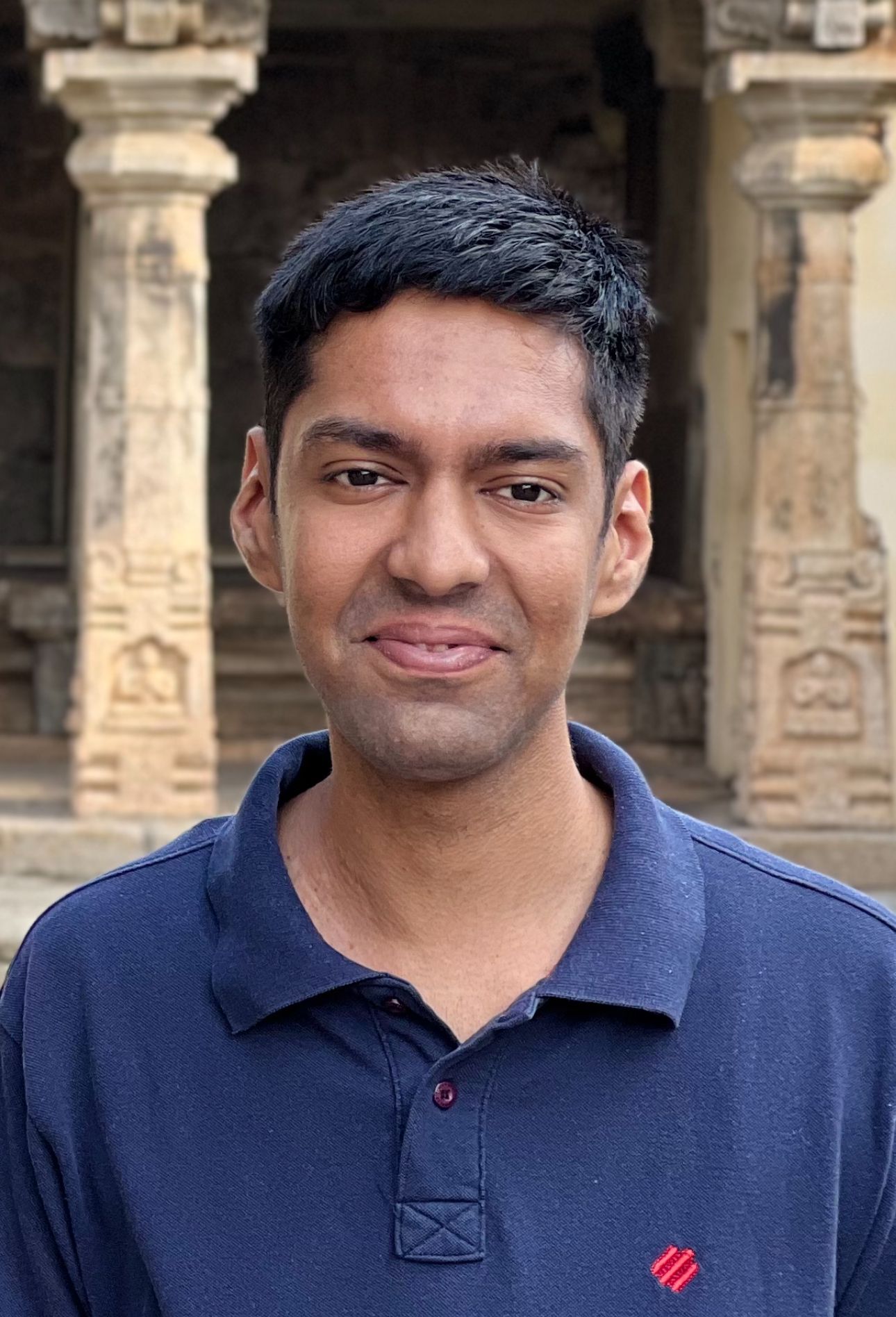 Vignesh Ganesh is a lawyer and writer. He is interested in ancient history and Itihasa and this interest culminated in his first book, "The Pallavas of Kanchipuram: Volume 1", which he co-authored with Mr. K. Ram, a fellow enthusiast of Indian history and culture.

In the lush, green heart of Kerala lived an elephant who became a living legend - a tale of an elephant turned into a bakth. His name was Keshavan, bu...
Ashadhi Ekadashi, also known as Shayani Ekadashi, falls on the 11th lunar day (Ekadashi) of the bright fortnight (Shukla Paksha) of the Hindu month of...
In the early days of cinema, both silent and talkie films thrived on puranas and ithihasas. However, as the years passed, especially by the late 1950s...
Verandah Club is an initiative by few like-minds of Coimbatore who are interested to share information on various antiquities of Bharat.
Free download our iOS & Android app
© Copyright 2026, All Rights Reserved.