
INTRODUCTION
Sanatana Dharma offers the rare knowledge to us who suffer that even Bhagwan Himself, when He chooses to walk among us, walks a path laid down with trials. We imagine divinity to be beyond a state of suffering, a higher existence beyond grief, sorrow, and loss. And yet the two figures we explore in this piece — Sri Krishna, the Avatar of Bhagwan Vishnu in the Dwapara Yuga, and Bhakht Prahalada, a mortal like us, the devotee whose faith could not be shaken by his own father's hatred — tell us a very different story from our assumptions. Both these figures were tied to death before their very birth. Both witnessed how family in whose care they should have been safe and cherished turned out to be executioners. Yet these two figures, in their own ways, teach us that it is not suffering that counts, but how we react to it that matters. Do we allow suffering to dissuade us from the path of Dharma or let it forge us into instruments of Dharmic action, in spite of the consequences?
BORN INTO DANGER: TWO CHILDHOODS SHADOWED BY DEATH
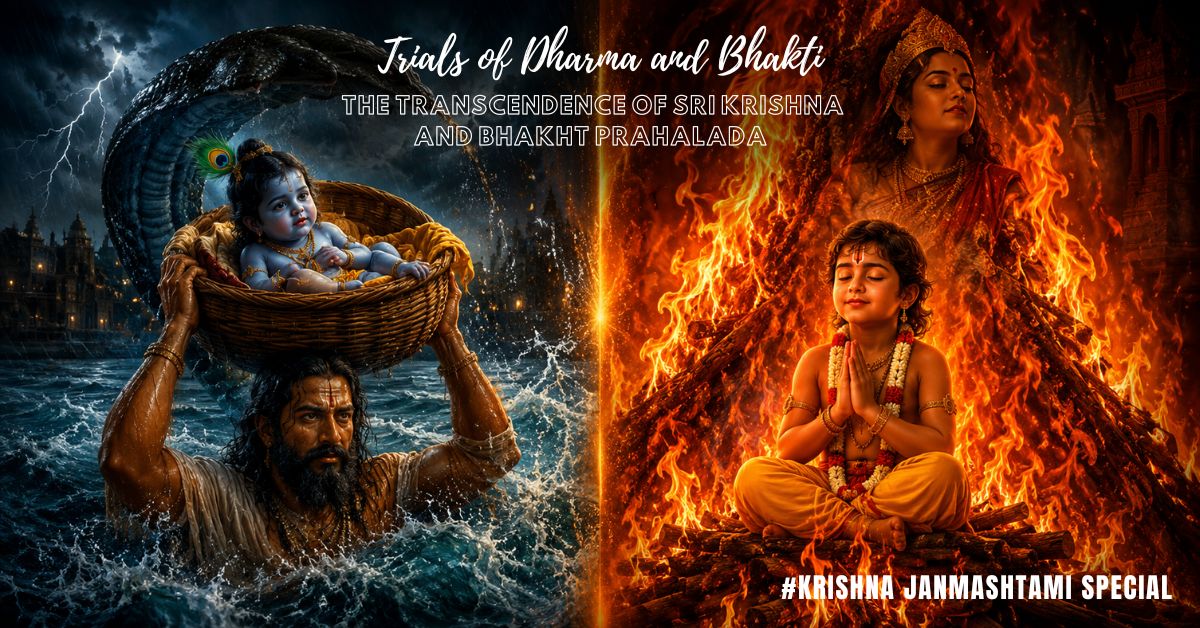
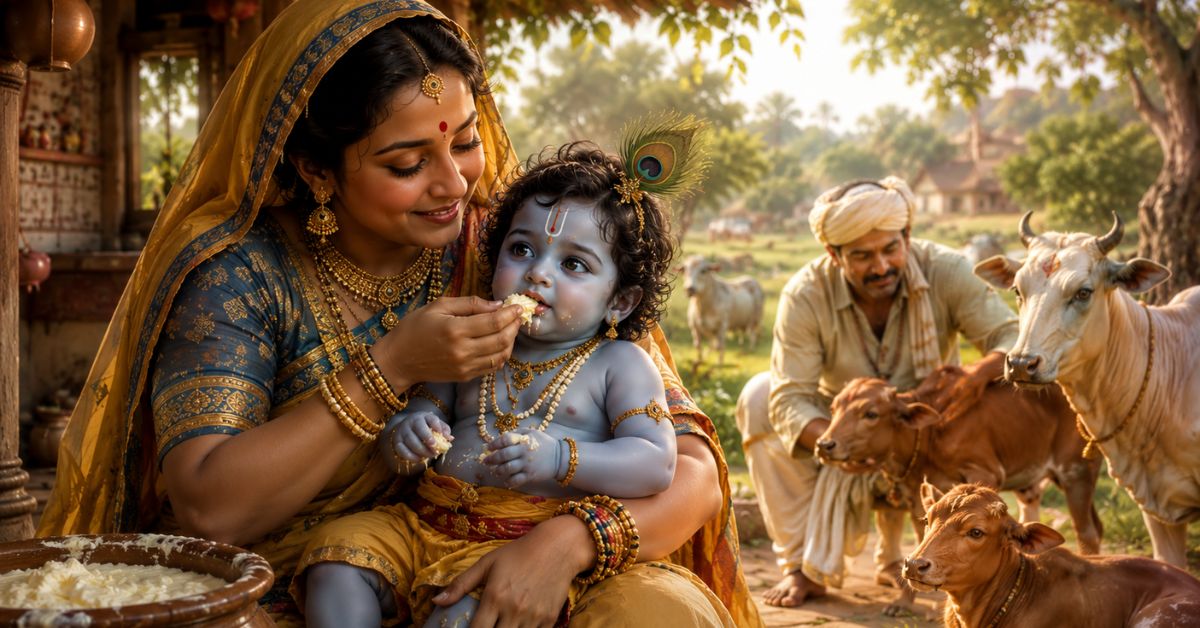
Shri Krishna's very entry into this Bhuloka was behind prison bars. Devaki and Vasudeva, his birth parents, were imprisoned by Kamsa, Devaki's own brother, after an Akashwani warned him that her eighth child would be the cause of his demise. Shri Krishna’s birth was not celebrated as the birth of a Divine Saviour. Instead, he was smuggled out in the middle of a tempestuous night, ferried across a turbulent Yamuna by his father, and exchanged with another baby, just so that he could survive the first night he drew breath, away from his uncle’s evil machinations. He grew up away from his birth parents, raised instead by Nanda and Yashoda in the pastures of Gokul and Vrindavan; his identity was kept secret and subject to later ridicule in his life.
Bhakht Prahalada's life began on a similar note, but the danger came from a closer source—his own father. Hiranyakashipu, the Daitya Raja who, on the strength of the boon secured from Bhagwan Brahma, which made him near-invincible and practically immortal, sentenced his own son to death for his unshakeable devotion towards Bhagwan Vishnu, the cosmic force that Hiranyakashipu blamed for his brother Hiranyaksha's death. Where Kamsa was paranoid about a prophecy yet to occur, Hiranyakashipu feared something already unravelling in his present. His progeny, from the womb itself had been taught only to chant Sri Hari’s names by Devarshi Narada, while his mother Kayadhu lived under the sage's protection. It was salvation for Prahalada and that devotion was unforgivable treason for Hiranyakashipu.
What is striking as a parallel between these two figures is how both were merely children endangered by their own family members—Shri Krishna by his maternal uncle and Bhakhta Prahalada by his own father. Sanatana Dharma, while showing family as the most essential social unit, doesn’t sugarcoat betrayal, and when that very family strays away from the path of Dharma, the only way to re-establish the path of Dharma is to pave it in blood.
THE ASSASSINS SENT IN CHILDHOOD
Shri Krishna's infancy and boyhood are rife with failed assassination attempts. Kamsa was unable to touch Shri Krishna directly and sent his asura and rakshasa minions to bring death to a child.
There is a modern time traveller’s dilemma that vexes moralists even today: If we could go back in time to kill a baby Hitler to prevent the atrocities of World War II, would we make that choice, or would it be too immoral and inhumane?
However, Kamsa harboured no such moral inhibitions. He was as ruthless as they came.
He sent Putana, the poison-breasted Rakshasi who came as a wet nurse; Trinavarta, the storm Asura; Aghasura and Bakasura, who tried to swallow Sri Krishna whole; Kesi, who charged at Sri Krishna as a shapeshifting horse; and Arishtasura, who attempted to kill Sri Krishna as a bull. Each attempt failed, not because the child was protected from danger by family, but because he met every single one of these terrors himself, as an infant and then as a boy, long before he ever raised a hand against Kamsa directly.
Prahalada's trials, though fewer in number, were no less harrowing. Hiranyakashipu had him thrown from mountain cliffs, trampled beneath the feet of maddened elephants, bitten by venomous serpents, and fed poison—and when none of it worked, he turned to his own sister, Holika, who possessed a boon rendering her immune to fire. She carried the child into a blazing pyre, certain she would emerge unscathed while he burnt. Instead, her boon failed her the moment it was turned against an innocent devotee, and it was Prahalada who walked out of the flames untouched while Holika was consumed—the very event Hindus commemorate each year as Holika Dahan, the eve of Holi.
Both children, then, spent their earliest years not playing in the safety of a courtyard but surviving in the shadow of murder attempts that would have broken most grown men. And in both cases, it was not brute strength that saved them, but something the assassins could never account for—divine will in Sri Krishna's case and unwavering faith in Prahalada's.
WHEN THE HAND THAT RAISED THE THREAT HAD TO FALL
Eventually, both stories arrive at a moment where the very source of the persecution had to be destroyed, and in both cases, destiny placed the innocent at the centre of that reckoning. Sri Krishna, having survived every assassin Kamsa could summon, finally returned to Mathura as a young man and slew Kamsa himself in the wrestling arena—his own maternal uncle, the brother of the mother who had borne him behind prison walls. There is no framing in the Puranas that makes this an easy or celebratory act; it is the tragic closing of a chapter that never should have needed writing.
Prahalada's story reaches its resolution differently, for he himself never raises a hand against his father. It is Bhagwan Vishnu who intervenes, emerging as Narasimha — half-man, half-lion — from a pillar that Hiranyakashipu had mockingly kicked, demanding to know if his god resided within it. Narasimha slew Hiranyakashipu at the threshold of dusk, neither day nor night, neither indoors nor outdoors, neither by weapon nor by the hand of man, animal, or god alone, fulfilling the precise conditions of the very boon that had made the asura tyrant feel untouchable. Where Sri Krishna had to become the instrument of his tormentor's end, Prahalada was spared even that burden, watching instead as Bhagwan Himself settled the score on his behalf.
SRI KRISHNA'S SUFFERING DID NOT END WITH KAMSA
Here is where the two paths diverge most sharply, for Prahalada's suffering ends with his father's death — he ascends the throne of the Asuras, rules with justice and devotion for ages, and is counted among the great Mahajanas, the exemplary devotees of Sanatana Dharma, before ultimately attaining moksha and taking his place beside Bhagwan Vishnu in Vaikuntha. Sri Krishna, despite being Bhagwan Himself, was granted no such reprieve.
No sooner had Kamsa fallen than Jarasandha, the powerful king of Magadha and Kamsa's father-in-law, launched wave after wave of assaults upon Mathura to avenge his son-in-law's death. Sri Krishna, though undefeated in these battles, chose the wisdom of strategic withdrawal over the pride of endless warfare, earning the epithet 'Ranchhodrai' — one who fled the battlefield — and leading his Yadava clan away from Mathura entirely to build the magnificent sea-girt city of Dwaraka. Even there, peace proved fleeting. Sri Krishna would go on to witness Bharatvarsha tear itself apart in the great civil war of the Mahabharata, a war fought between the Pandavas and Kauravas, both of whom were his own cousins and kin, and in which he served as charioteer and counsel to Arjuna, delivering the Bhagavad Gita even as he watched a family devour itself.
The aftermath brought no comfort either. Gandhari, having lost all hundred of her sons in the war, cursed Sri Krishna — the one being who she believed could have stopped the bloodshed but chose not to — declaring that his own Yadava clan would annihilate itself just as her sons had. Thirty-six years later, that curse came to pass at Prabhasa, where the Yadavas, driven to madness by a divine portent and drink, turned upon one another until the clan lay utterly destroyed. Sri Krishna watched his own brother Balarama withdraw into yogic meditation beneath a tree and release his mortal form, the great serpent Sheshnaga returning to the ocean from which he came. And finally, Sri Krishna himself, resting beneath a tree with his foot raised, was mistaken for a deer by the hunter Jara, whose arrow struck his heel — the one vulnerable point of his form — bringing his own avatara on earth to its close.
THE THREAD THAT BINDS THEM
What, then, do we take from placing these two lives side by side? Prahalada's suffering was intense but finite — a childhood of terror redeemed by a single, decisive divine intervention, followed by a long and peaceful reign and eventual union with Bhagwan Vishnu. Sri Krishna's suffering, by contrast, never truly ended; it simply changed shape, following him from the prison cell of his birth to the battlefield of Kurukshetra to the desolate shores where his own clan lay slain and his own brother had departed before him. Bhagwan Himself, having taken birth to restore Dharma, was not exempted from grief, betrayal, or loss — if anything, he absorbed more of it than any devotee could be asked to bear.
CONCLUSION
Perhaps this is the deepest teaching hidden within these two intertwined stories. Prahalada's life reassures the devotee that unwavering faith will eventually be rewarded, that Bhagwan will intervene when the devotee has exhausted every other resource. But Sri Krishna's life offers something rarer and, in some ways, more profound — the reminder that even Ishwara, when He walks the earth in human form, does not escape the weight of dharmic duty, karmic consequences and personal attachments. He restores Dharma not by rising above suffering, but by moving through it, again and again, with composure intact. Between the burning pyre that could not touch Prahalada and the hunter's arrow that finally found Sri Krishna's heel, Sanatana Dharma leaves us with a single, unifying truth — that divinity and devotion alike are not shields against suffering but the strength by which suffering is faced, endured, and ultimately transcended. Ultimately, Dharma demands action after careful deliberation, and Bhakhti requires total surrender.
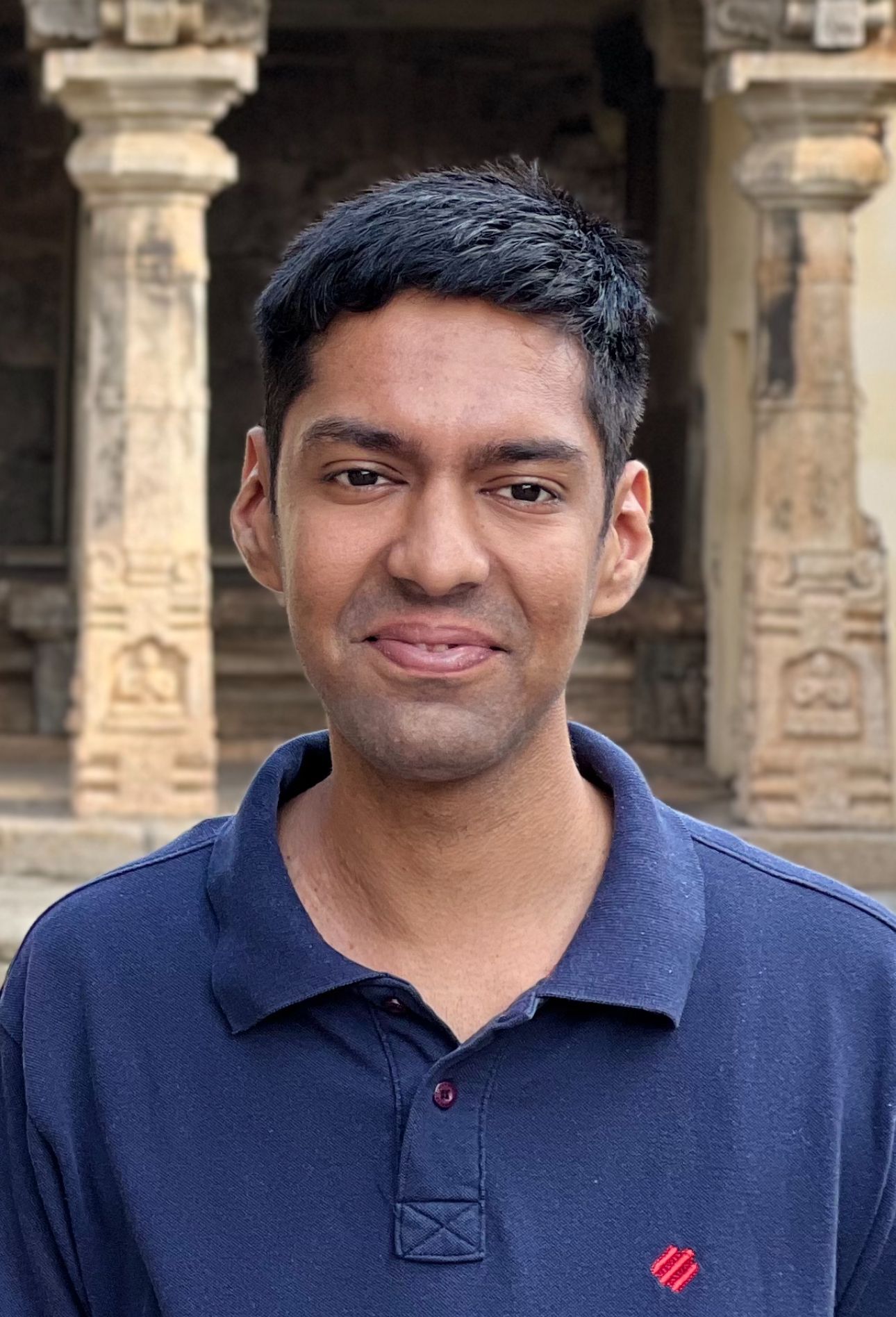 Vignesh Ganesh is a lawyer and writer. He is interested in ancient history and Itihasa and this interest culminated in his first book, "The Pallavas of Kanchipuram: Volume 1", which he co-authored with Mr. K. Ram, a fellow enthusiast of Indian history and culture.

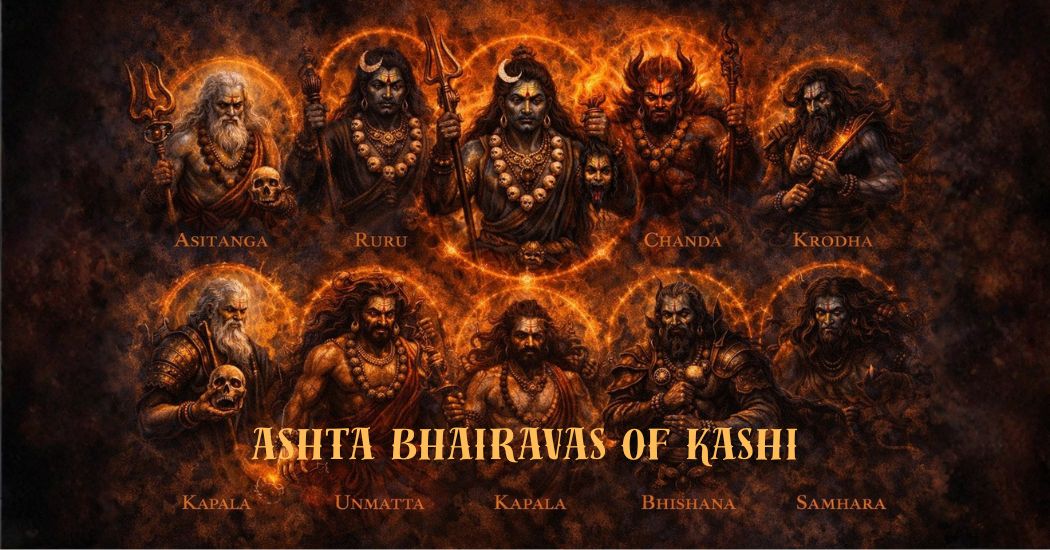
In Kashi, the night never truly belongs to darkness. It belongs to Bhairava. When the last bells fade from the ghats and the lamps of Ganga drift like...

Verandah Club is an initiative by few like-minds of Coimbatore who are interested to share information on various antiquities of Bharat.
Free download our iOS & Android app
© Copyright 2026, All Rights Reserved.