
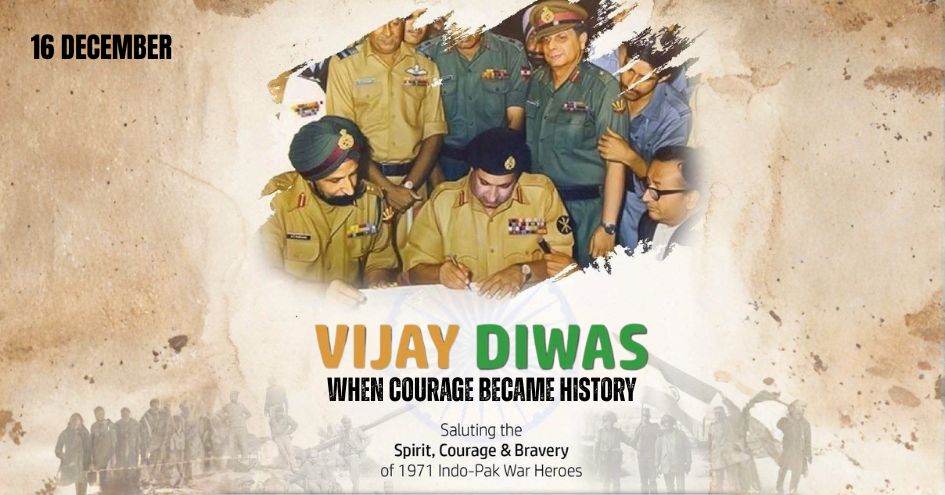
As the Tricolour rises high on 16 December, Vijay Diwas calls out to the conscience of the nation.
It reminds us of a timeless truth:
Freedom is earned, not inherited. Peace is protected, not presumed. And India endures because someone, somewhere, stands watch.
Today, we do not merely remember a victory. We salute our veterans, bow to our martyrs, and renew our pledge to the ideals they defended—unity, courage, discipline, and selfless service.
When Silence Was Not an Option
In early 1971, history knocked on India’s door in the form of millions of refugees, fleeing unspeakable horrors in East Pakistan. They carried with them stories of cruelty, injustice, and human suffering.
India faced a choice. To look away. Or to stand up.
India chose responsibility over silence. India chose humanity over hesitation. And that choice gave birth to Vijay Diwas—a solemn yet uplifting reminder of what a nation can achieve when moral clarity, courage, and leadership march together.
The Man Who Refused to Rush to War
The victory of 1971 did not begin with gunfire. It began with clarity of thought and moral courage. At its centre stood a soldier who dared to speak truth to power: General Sam Hormusji Framji Jamshedji Manekshaw—later, Field Marshal Sam Manekshaw.
As pressure mounted for immediate military action, he was asked a simple question:
“Are we ready for war?”
His answer was extraordinary.
“I will not fight until I am ready.”
Not out of fear. But out of responsibility.
He warned that the monsoon would flood rivers, cripple movement, and cost lives unnecessarily. He insisted that war must be fought to win decisively, not symbolically. And then he made a promise that echoed through history:
“Give me time—and I guarantee you victory.”
That single moment defined greatness. A commander who valued soldiers’ lives over political haste, and victory over vanity.
Forging an Unstoppable Force
What followed was preparation at the level of a master strategist. Manekshaw understood East Pakistan better than its own defenders:
He knew this war would not be about slow, grinding battles. It would be about speed, dislocation, and psychological collapse.
Jointmanship Before Its Time
Long before the term became fashionable, Manekshaw practised true joint warfare.
Not three forces.One sword. Three edges.
When the Enemy Chose the Day — and Lost the War
On 3 December 1971, Pakistan launched air strikes on Indian airfields, hoping for surprise. They got their war. What they did not get—was control. Within 72 hours, the Indian Air Force neutralised enemy air power in the East. Aircraft were destroyed on the ground. The skies belonged to India. Manekshaw rejected siege warfare. Instead, he ordered:
Indian columns surged forward like floodwaters. Pakistani defences became irrelevant. Their command structure collapsed. This was manoeuvre warfare at its finest, years before textbooks caught up.
Leadership Built on Trust
One of Manekshaw’s greatest strengths was trust. He empowered his commanders:
He gave intent, not micromanagement. His message was simple:
“Use your judgment. Move fast. Finish the war.”
That freedom unleashed brilliance—from corps commanders to young officers leading platoons across rivers under fire.
Dhaka Falls — Victory Without Vengeance
And then came 16 December 1971. That winter afternoon in Dhaka, the world witnessed a moment that still stirs every Indian heart. 93,000 Pakistani soldiers laid down their arms. The largest military surrender since the Second World War. But the true victory was not in numbers. It was in restraint. In dignity. In justice over brutality. This war was not fought for conquest. It was fought for human dignity.
Why Vijay Diwas Matters Today
Vijay Diwas is not just a date on the calendar. It is a reminder that:
When India rises, she rises together—soldiers, sailors, airmen, leaders, and citizens alike. And when India remembers 1971, she remembers not just a victory— She remembers a commander worthy of it. On this Vijay Diwas, let us honour the past, strengthen the present, and prepare for the future. Let us be worthy of the sacrifices made in our name.
Jai Hind.
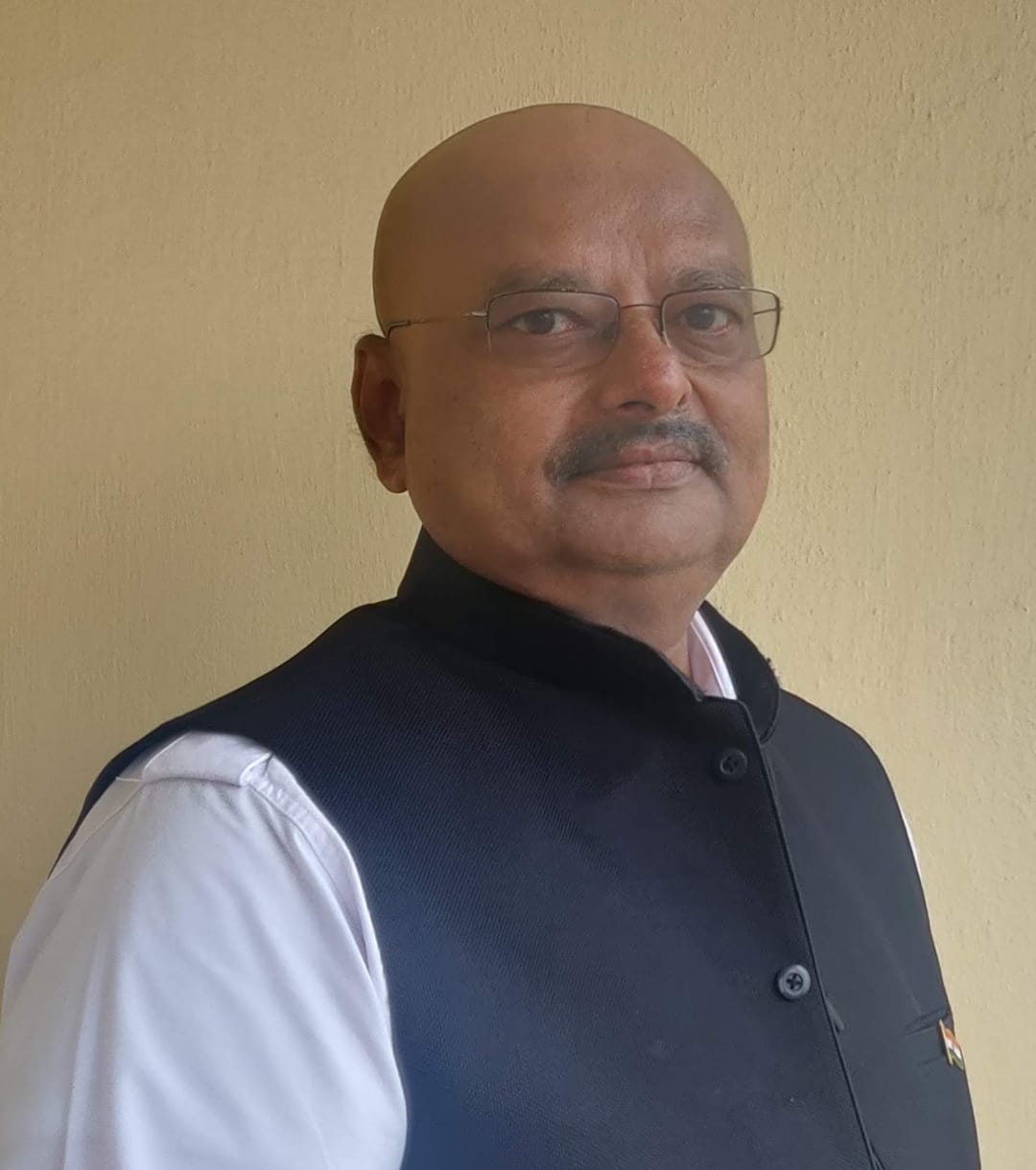 Wing Commander BS Sudarshan is a former Indian Air Force pilot with over 12,000 flying hours. He participated in Operation Pawan and Operation Cactus before he transitioned to civil aviation. A passionate writer, he has authored six books, including "Hasiru Hampe", appreciated by S L Bhyrappa, and the latest "Evergreen Hampi". He is a regular contributor to the Verandah Club.


Subramania Bharati, often referred to as Mahakavi Bharati (Great Poet Bharati), was a revolutionary poet, journalist, and social reformer whose words...
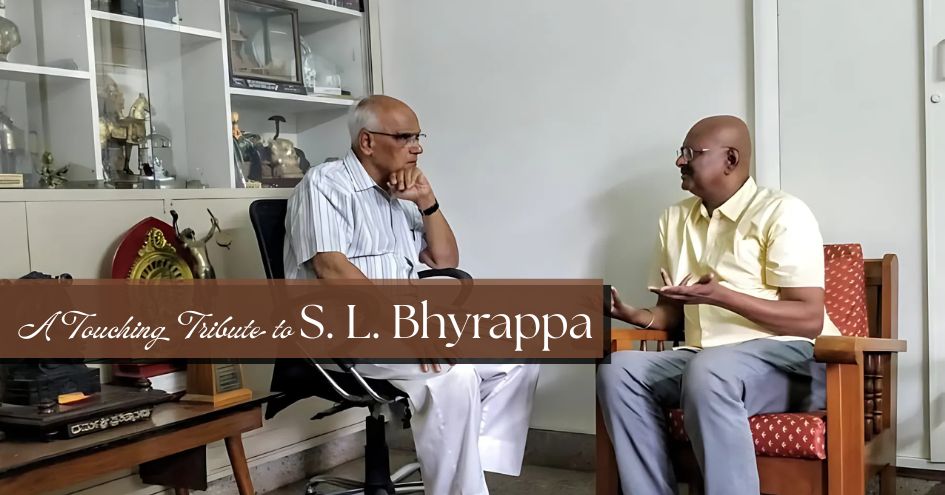
Some writers tell stories, and then there are those rare souls who hold up a mirror to our civilisation, our history, and our innermost selves. Sri Sa...

Verandah Club is an initiative by few like-minds of Coimbatore who are interested to share information on various antiquities of Bharat.
Free download our iOS & Android app
© Copyright 2026, All Rights Reserved.