

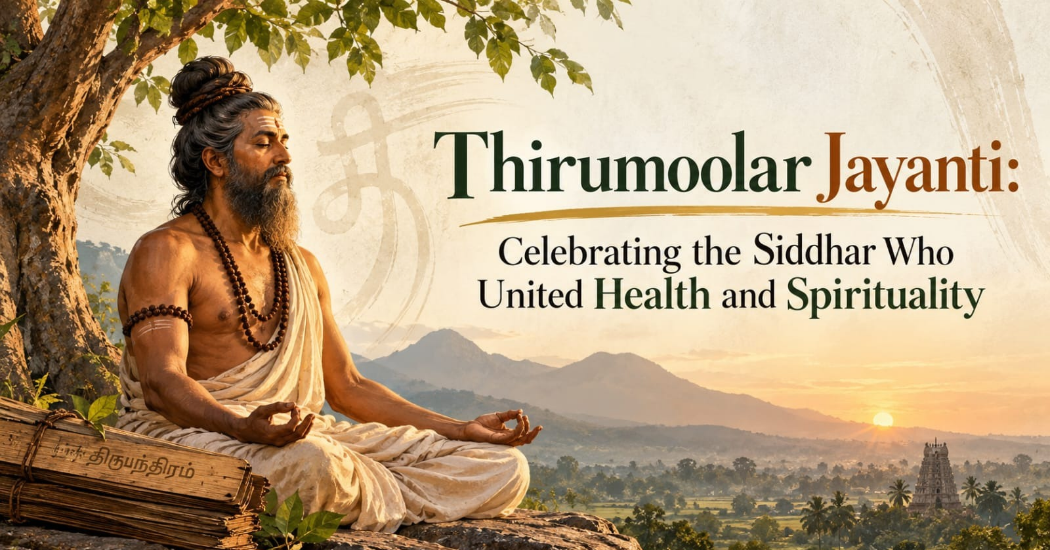
On Thirumoolar Jayanti, we revisit the timeless wisdom of a Siddhar who understood that caring for the body, cultivating the mind and realising the divine were not separate pursuits, but different dimensions of life itself.
In the long spiritual history of Bharat, there have been saints who taught us how to worship God, philosophers who questioned the nature of existence, and healers who explored the mysteries of the human body. But there were also remarkable individuals who refused to separate these pursuits. Among them stands Thirumoolar, one of the most influential Siddhars of the Tamil spiritual tradition.
His Thirumandiram, comprising approximately 3,000 verses, occupies a unique position in Tamil literature as the tenth of the twelve Thirumurais. It brings together Saiva philosophy, yoga, ethics, spiritual discipline and profound reflections on the human body.
Yet, what makes Thirumoolar particularly relevant today is not merely the antiquity of his teachings. It is the extraordinary clarity with which he understood the relationship between life, health and spiritual evolution.
The Body Is Not an Obstacle
One of Thirumoolar's most celebrated teachings is expressed in the words:
“Udambai Valarthen, Uyir Valarthen.”
I nurtured the body, and thereby nurtured life.
This seemingly simple statement contains an entire philosophy of health.
Spirituality is sometimes misunderstood as the rejection of the physical world. The body is treated as temporary, inferior or even an obstacle to spiritual progress. Thirumoolar offers a different perspective.
The body is not something to be neglected in the pursuit of higher consciousness. It is the very instrument through which that pursuit becomes possible.
A healthy body does not automatically produce a spiritually evolved person. Equally, spiritual aspiration cannot become an excuse for neglecting one's physical well-being.
"Udambaar azhiyil uyiraar azhivar
Thidampada meignaanam seravum maattaar
Udambai valarkkum ubaayam arindhe
Udambai valarththen uyir valarththene"
When the body deteriorates, life itself suffers. Without preserving the body, one cannot attain true spiritual wisdom. Having understood the means of nurturing the body, I nurtured my body and thereby nurtured my life.
Health, in this understanding, is not merely the absence of illness. It is the harmonious functioning of the individual, allowing life to express itself fully.
We often measure health through numbers, reports and diagnoses. While these have their rightful place, they do not tell us everything about the experience of being alive. A person may possess impressive medical reports yet remain restless, emotionally exhausted or disconnected from life.
Thirumoolar invites us to look beyond the isolated parts and recognise the individual as a whole.
When Love Becomes Shiva
Perhaps no teaching captures Thirumoolar's spiritual vision more beautifully than:
“Anbe Sivam.”
Love itself is Shiva.
In the Thirumandiram, Thirumoolar challenges the idea that love and Shiva are two separate realities. For him, the realisation of the divine is inseparable from the experience of love.
This transforms spirituality from an external practice into an internal quality.
Rituals, temples, prayers and disciplines have their significance. But what meaning can spiritual practice possess if it does not cultivate compassion, kindness and an awareness of the life around us?
The true measure of spiritual growth may not lie in how much one knows about God, but in how one treats another living being.
This is beautifully reflected in the traditional account of Thirumoolar's own life. According to the Periya Puranam, the sage encountered a herd of cows grieving over the death of their cowherd, Moolan. Moved by compassion, he entered the lifeless man's body through his yogic powers so that the animals might be comforted and cared for.
Whether approached as sacred history or spirituality , the message remains powerful.
Compassion preceded the teaching. Love/Bhakti preceded the philosophy.
The sage who proclaimed that love itself is Shiva is remembered as one who first demonstrated that love through action.
Health as a Way of Living
Thirumoolar's teachings also remind us that health cannot be reduced to a treatment administered after something goes wrong.
The way we eat, breathe, sleep, think, behave and relate to the world contributes to the quality of our lives.
His discussions of yogic discipline, breath regulation and the preservation of the body reflect an understanding of health as an ongoing responsibility rather than an occasional intervention.
Of course, ancient spiritual teachings and modern medical science operate through different methods of understanding. One need not force them into artificial agreement to appreciate their respective contributions.
But there is an important philosophical lesson here.
The purpose of health is not simply to extend the number of years we live, but to improve the quality and consciousness with which we live those years.
A disciplined life creates space for clarity. A balanced mind allows us to respond rather than merely react. A body cared for with attention becomes a better companion in the journey of life.
In a world that frequently celebrates excess and treats moderation as deprivation, Thirumoolar's emphasis on conscious living deserves renewed attention.
Discipline need not be punishment. It can be an expression of respect for life itself.
The Journey Within
Modern civilisation has achieved extraordinary progress in understanding the external world. We can observe distant galaxies, study microscopic structures and measure countless processes within the human body.
Yet, understanding our own minds remains one of humanity's greatest challenges.
Who are we beyond our identities, occupations, possessions and physical appearances? What is the relationship between the body that changes, the mind that experiences and the consciousness that observes?
These are questions that Thirumoolar's philosophy encourages us to explore.
His teachings do not demand that we abandon the world to discover the divine. Instead, they invite us to live within it with greater awareness.
The body must be cared for, the mind must be cultivated, and compassion must guide our actions.
On Thirumoolar Jayanti, perhaps the most meaningful tribute to this great Siddhar is not merely to remember his verses, but to examine how much of their wisdom finds expression in our everyday lives.
For Thirumoolar, health and spirituality were not competing destinations. They were interconnected aspects of the same human journey.
To nurture the body is to honour life. To cultivate awareness is to enrich life. And to live with love is to recognise the divine within life itself.
That is the enduring wisdom of Thirumoolar.
 Vigneshvaran, Senior Correspondent of TheVerandahClub.com is a second generational acupuncture practitioner, a story teller, as well as an avid independent writer driven by his passion. His literary talents extend to crafting beautiful poems and captivating short stories including the Sehwag Tales series. In addition to these creative pursuits, he has also authored a book titled "Halahala," which can be found on Wattpad.
PREVIOUS ARTICLE



Ashadhi Ekadashi, also known as Shayani Ekadashi, falls on the 11th lunar day (Ekadashi) of the bright fortnight (Shukla Paksha) of the Hindu month of...

Every year, as the monsoon rains dance on the fields of India, an ancient story unfolds in the hearts of millions. It is the story of Krishna, the bel...
Ganesh Chaturthi, also known as Vinayaka Chaturthi, is a significant Hindu festival that honors Lord Ganesha, the deity revered as the remover of obst...

Verandah Club is an initiative by few like-minds of Coimbatore who are interested to share information on various antiquities of Bharat.
Free download our iOS & Android app
© Copyright 2026, All Rights Reserved.