
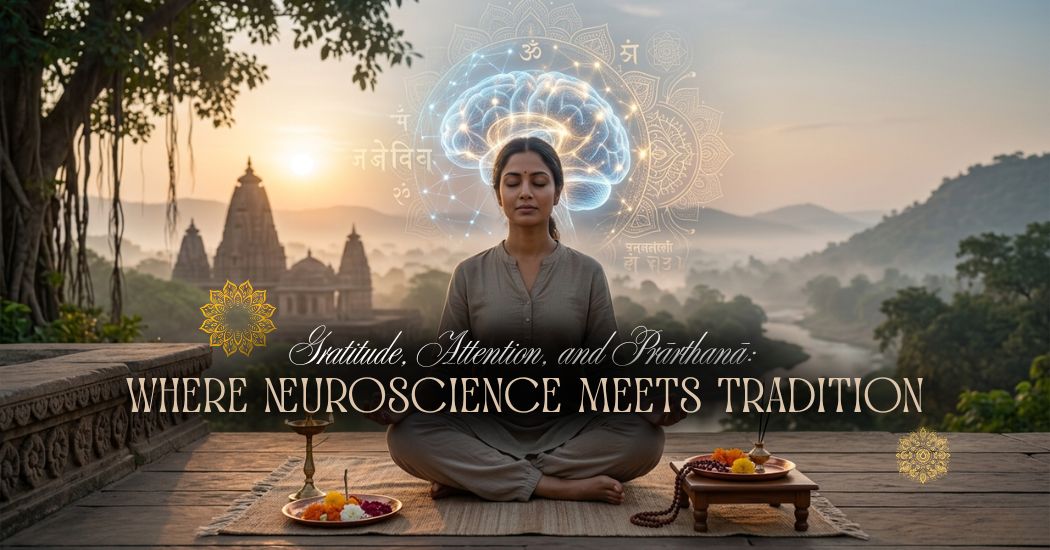
What if gratitude is more than a pleasant feeling?
What if it is a way of training attention?
Modern neuroscience suggests that the experiences we repeatedly focus on can strengthen certain neural pathways while allowing others to weaken. In simple terms, where attention goes, the brain gradually follows.
Long before the language of neuroscience existed, Indian traditions approached this challenge through a practice known as Prārthanā.
Often translated as prayer, Prārthanā is far more than asking for something. It is a deliberate pause that redirects the mind toward connection, perception, and appreciation. It invites us to step out of the narrow concerns of the moment and remember our relationship with a larger order of life.
Viewed through this lens, prayer is not merely a religious act. It is a practice of attention. And perhaps that is why it has endured across generations.
The Neuroscience of Gratitude
In recent years, researchers have become increasingly interested in the effects of gratitude on the brain.
Studies suggest that regular gratitude practices are associated with increased activity in areas of the prefrontal cortex, often referred to as ‘The thinking brain,’ involved in reflection, and emotional regulation.
Other research indicates that gratitude may reduce stress reactivity and support emotional wellbeing. Some findings also point to changes in neural networks involved in reward processing, making it easier to notice positive experiences that might otherwise be overlooked.
So, what does this mean in everyday life? Gratitude appears to train attention.
Rather than constantly scanning for problems, threats, or shortcomings, the mind becomes more capable of recognizing support, resources, and opportunities.
This does not eliminate difficulties. Challenges remain part of life. What changes is our relationship with them.
In many ways, gratitude helps shift the nervous system from a state of constant vigilance toward a state of greater balance and perspective.
Prārthanā: More Than Gratitude
Yet gratitude alone does not fully capture what the Vedic tradition means by Prārthanā.
While gratitude is certainly one expression of prayer, Prārthanā encompasses something broader. It is an act of alignment with a greater order.
When we are stressed, the mind tends to become narrow. It becomes preoccupied with control, uncertainty, fear, and personal concerns. Our field of awareness shrinks.
Prayer expands it.
Whether through gratitude, reverence, reflection, or surrender, Prārthanā gently directs attention beyond the immediate self. It reminds us that we exist within relationships—with family, community, nature, society, and ultimately with the larger order that sustains life.
This may explain why prayer traditionally appeared throughout the day.
These pauses were not interruptions to life. They were opportunities to reset attention. To remember what matters. To reconnect with something larger than immediate worries and passing concerns.
In a sense, they functioned as small acts of reorientation.
Prayer as Nervous System Regulation
One of the most interesting ways to understand prayer today is through the lens of nervous system regulation.
Most traditional prayers contain elements known to influence our physiological state:
Together, these experiences help reduce mental agitation and create conditions for greater calm and clarity.
Perhaps this is why prayer appears in cultures across the world. Human beings need transitions. We need moments that help us move from activity to reflection, from distraction to presence, from reactivity to awareness.
The prayer before a meal, for example, is not simply about the food. It marks a transition from Doing to Receiving.
A prayer before sleep helps prepare the Mind for Rest.
Prayer before study gathers Attention before Learning begins.
Seen this way, prayer functions not only as a spiritual practice but also as a subtle form of mental and emotional regulation.
Why Repetition Matters
Both neuroscience and traditional wisdom converge on an important principle: Change happens through repetition.
A single grateful thought rarely transforms a person. A daily practice can.
Neuroscientists speak about neuroplasticity, the brain's capacity to change through repeated experience.
The Yoga tradition speaks about Abhyāsa, a steady and consistent practice.
Different languages. A similar insight. What we repeatedly attend to gradually shapes us.
The qualities we revisit day after day become easier to access. The patterns we reinforce become more familiar pathways of thought and behavior.
Over time, gratitude can become more than an occasional feeling. It can become a way of seeing.
When Repetition Becomes Automatic
Yet repetition has an unintended consequence.
Anything repeated often enough can become automatic.
The words become familiar.
The mouth continues.
The mind leaves.
Most of us know this experience well. We complete a prayer and realize that our thoughts have been elsewhere the entire time.
The ritual remains.
The awareness disappears.
This is not a failure of prayer. It is simply a feature of how the brain learns.
The solution is not to abandon the practice.
The solution is to bring attention back to it.
This is where the traditional idea of Sankalpa becomes particularly relevant.
Sankalpa is often translated as intention, but it is more than a goal. It is a conscious orientation of the mind.
Before beginning a prayer, one might pause and ask:
These questions gather attention. They transform prayer from recitation into a practice.
The words may remain the same, but the quality of awareness changes.
And awareness is where transformation begins.
Conclusion
Modern neuroscience is beginning to illuminate mechanisms underlying practices that traditional cultures developed, refined, and preserved through generations of observation:
Attention shapes experience.
What we repeatedly notice influences how we think, feel, and respond to the world.
Prārthanā is one way of training that attention.
Not by denying life's challenges.
Not by pretending everything is perfect.
But by widening perspective.
By helping us remember support, connection, and meaning.
In a world that constantly directs our attention toward what is wrong, missing, or uncertain, perhaps one of the most powerful things we can do is pause.
Take a breath.
Offer a prayer.
And remember what is already sustaining us.
For gratitude is not merely an emotion.
It is a way of seeing.
And the way we see the world gradually shapes the mind with which we meet it.
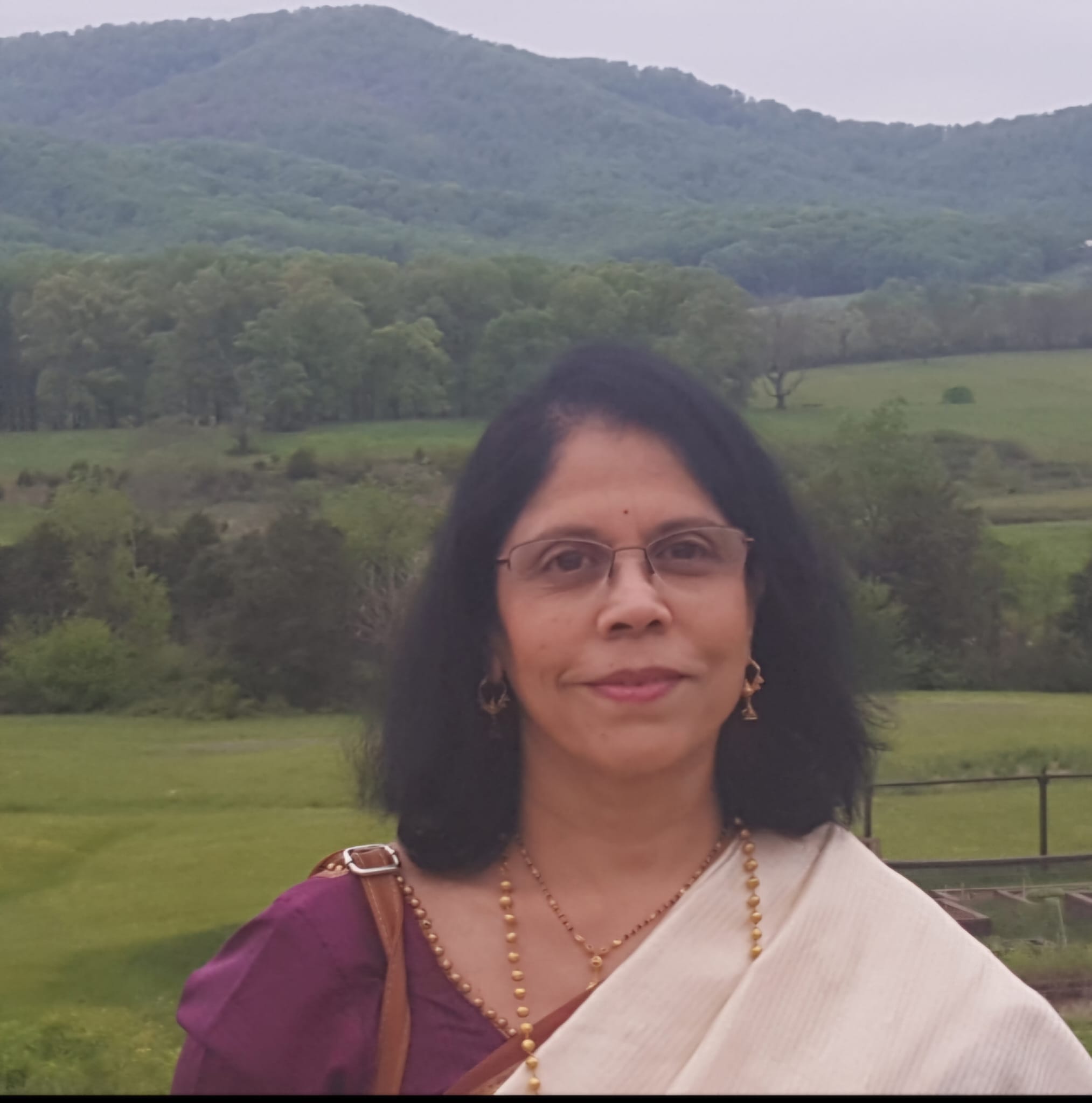 Dr. Vasantha Reddi is the founder of Svadharma Circles, an educational initiative that explores the intersection of child development, neuroscience, psychology, and Sanatana Dharma. She is the creator of the emerging framework of Svadharma Neurodevelopment, which integrates developmental science with insights from Indian wisdom traditions. Trained as a scientist with a PhD in Zoology, she has worked as a clinical research professional, medical writer, and educator. Through her writing, she explores the developmental wisdom embedded in rituals, storytelling, and everyday cultural practices, and their relevance to modern life and to raising children in an age of constant information, stimulation, and change.
PREVIOUS ARTICLE

In the lush, green heart of Kerala lived an elephant who became a living legend - a tale of an elephant turned into a bakth. His name was Keshavan, bu...

Bharat has exploded onto the world scene and made global news with its hard-hitting “Operation Sindoor” that struck at the heart of terrorism and laun...

In the bustling age of global trade, Boston—a thriving port city on America’s eastern coast—stood tall as a beacon of commerce. In the early 18th cent...

Verandah Club is an initiative by few like-minds of Coimbatore who are interested to share information on various antiquities of Bharat.
Free download our iOS & Android app
© Copyright 2026, All Rights Reserved.