
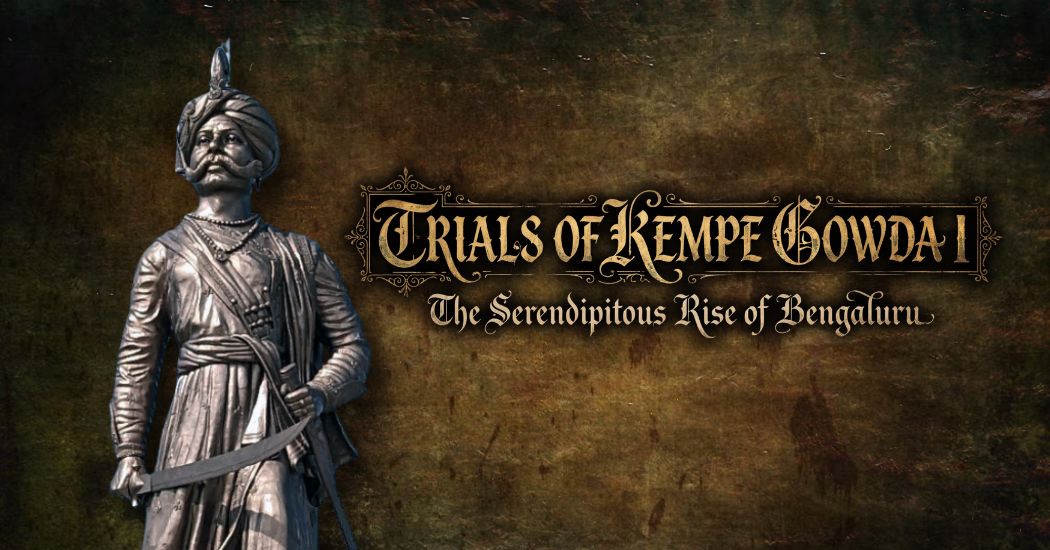
Here is a literary and evocative translation of the text, capturing the rich historical narrative and emotional depth of the original Kannada prose.
Kempe Gowda’s Bengaluru
The Elder Kempe Gowda (Kempe Gowda I) was born on June 27, 1510. Back in the 12th century, during the reign of the Ballala dynasty of the Hoysala Empire, "Chikka Ballalapura," "Dodda Ballalapura," and "Eache Pakkanadu" were prominent fiefs. By the time these territories transformed into Chikkaballapur, Doddaballapur, and Yelahanka, the sovereignty of the Karnataka land had transitioned from the Hoysala kings to the administrative fold of the Vijayanagara Empire.
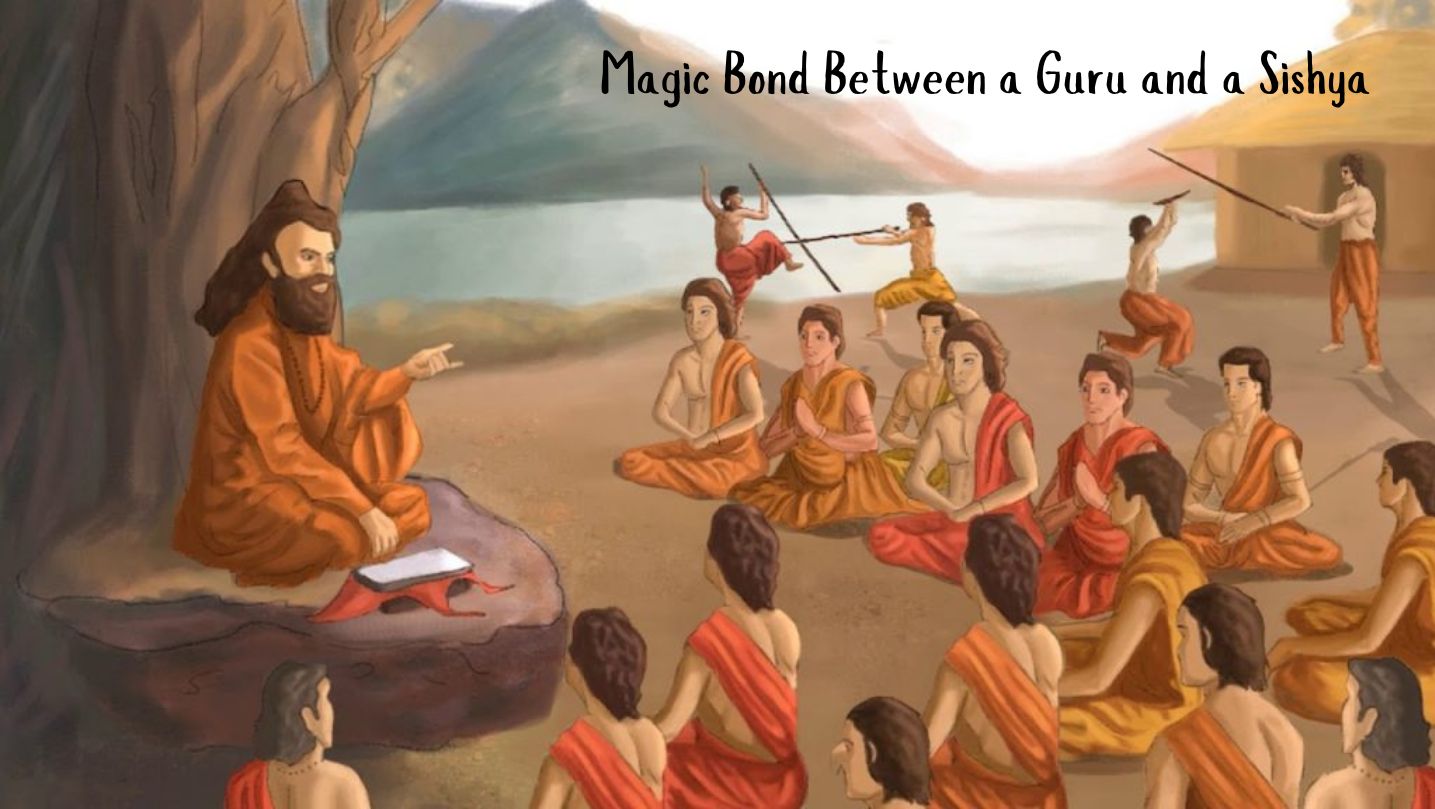
In 1509, the coronation of Emperor Krishnadevaraya took place. The descendants of Kempe Gowda ruled this territory as Nadaprabhus (regional lords), serving as vassals to the Vijayanagara Empire. At the time, Kempananje Gowda was the Nadaprabhu of Yelahanka; Kempe Gowda was his son. From a young age, Kempe Gowda accompanied his father every year to Hampi to witness the grand Dasara festivities. Captivated by the sheer grandeur, opulence, and prosperity of Hampi, the seed of a dream to build a similarly magnificent city one day was sown right there. After completing eight years of education at the Gurukula in Hesaraghatta, Kempe Gowda assumed the administrative responsibilities of the Yelahanka region. Keeping Krishnadevaraya's style of governance as his ideal, he was a mere youth of twenty when he took charge in 1530. His administrative efficiency was later highly praised by Achyutaraya, who succeeded Krishnadevaraya in Vijayanagara.
An incident occurred when Kempe Gowda, along with his close friend Gidde Gowda, went hunting in the forests of Kodigehalli—an event that would serendipitously lead to the creation of the city of Bengaluru. A wild hare turned around and aggressively chased away their hunting dog out of the forest. The onlookers were astonished by this bizarre sight. Though the incident was eventually forgotten by others, to Kempe Gowda and Gidde Gowda, it mirrored the historic omen that had inspired Sage Vidyaranya to establish the Karnataka (Vijayanagara) Empire. Inspired by the valour of Hakka and Bukka, a dream branched out in them to build a Gandu Nadu—a land of the brave. This dream grew so powerful and deep-rooted that Kempe Gowda travelled to Vijayanagara with a blueprint in hand to seek patronage and blessings. The Vijayanagara Emperor was so profoundly impressed by his vision of constructing a new city that he granted Kempe Gowda governance over six additional principalities and a massive fund of 50,000 gold Varahas. The Emperor, seasoned in building a wealthy empire, gave him just one piece of advice: The city you build must grow into a premier commercial hub, water resources must be given supreme importance, and above all, sacred spiritual centres must be established everywhere.
"Thy will be done, My Lord," replied Kempe Gowda, returning to Yelahanka with a bag full of gold Varahas and a heart full of grand dreams to build an extraordinary city.
The Infancy of Bengaluru
At the auspicious hour chosen by the council of priests, the Bhoomi Puja (groundbreaking ceremony) commenced in a selected spot amidst the forest between Domlur and Yelahanka. The entire Gurukula of Hesaraghatta arrived at the site; after all, it was no ordinary feat that their disciple Kempe Gowda was building a new city. Dense smoke from the sacred sacrificial fires (Yajna Havanas) filled the forest air. As Vedic chants resonated, four pairs of white oxen yoked to ploughs were driven in four different directions, drawing lines. It was decided that the East-West axis would form "Chikkapete," while the North-South axis would become "Doddapete" (the present-day Avenue Road).
The expertise gathered from studying the organised commercial hubs and marketplaces of Vijayanagara was implemented here. Doddapete was designated for wholesale trade, while Chikkapete was for retail. Specialised markets emerged: Akkipete (rice), Ragipete (finger millet), Aralepete (cotton), and Taragupete (grain) for agricultural produce; Ganigarapete for oil merchants; Uppararapete for salt traders; and Kumbarapete for potters. Tigalarapete became the flower market, Nagarthapete catered to gold and silver merchants, and Balepete was reserved for bangles and ornaments. In this manner, 64 distinct Petes (market localities) based on professions and communities were created.
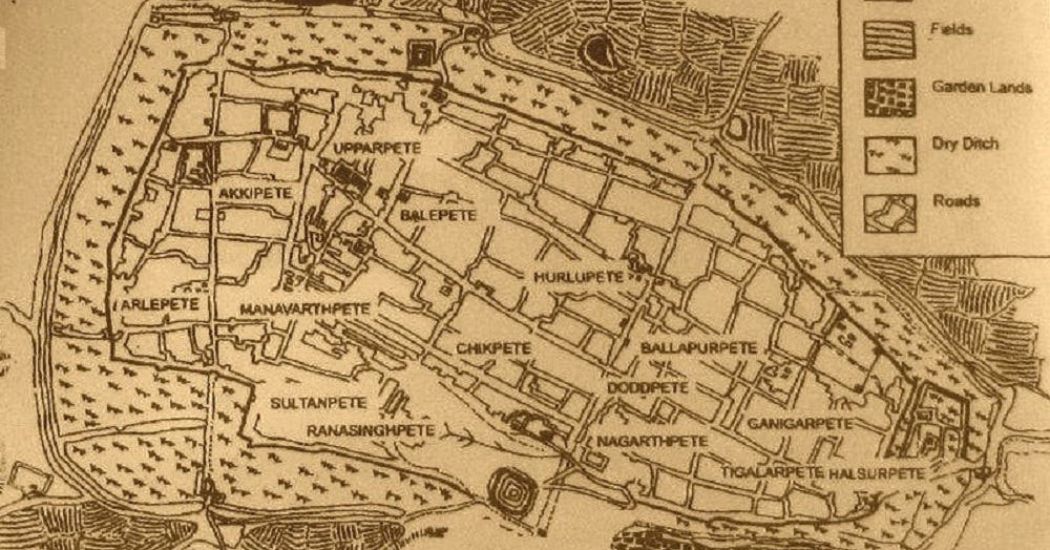
Most great cities in India have historically flourished on riverbanks or coastlines. Realising that a great city built in a region lacking both must create its own water resources, Kempe Gowda set out to construct a series of interconnected lakes at varying elevations. The crowning jewel of his urban planning was the integration of Rajakaluves (major stormwater canals). The moment a lake filled up with rainwater, the excess water would cascade through these Rajakaluves into another lake situated at a lower elevation. Expert water managers (Neerugantis) were brought in from Vijayanagara to oversee this system. Once all the internal lakes were full, the surplus water was channelled into the moats surrounding the fort's periphery—serving as a brilliant defence system to secure the fort, the city, and its citizens from enemy invasions.
Near the elevated terrains of Chikkapete and Doddapete, the Dharmambudhi lake (the present-day Majestic Bus Stand) was constructed. Arrangements were made so that when it overflowed, the surplus water would travel through a Rajakaluve to the distant Bellandur lake. Once Bellandur Lake filled, its excess water flowed into Domlur Lake. While Kempambudhi, Halasuru (Ulsoor), and Yediyur lakes were meant for public use, the Sampangi lake (the present-day Kanteerava Stadium) was built exclusively for irrigation. Thus, an ecosystem was engineered where numerous lakes filled sequentially through the natural valleys of Koramangala, Challaghatta, Hebbal, and Vrishabhavathi. Whenever the lakes overflowed, a festive atmosphere enveloped the land, celebrated with temple fairs (Jatres) and boat festivals (Teppotsava) dedicated to the reigning deities of those waters. Farmers, fishermen, washermen, and boatmen bowed in deep reverence to this bountiful gift of nature and the blessings of Varuna, the Rain God. The village elders and Neerugantis would then deliberate on systematically distributing and utilising the full lakes' water into residential areas via smaller distributary canals.
Having been raised as a student of the Gurukula, Kempe Gowda carried forward the ancient wisdom that temples are not just centres of devotion, but repositories of knowledge. He built the Gavi Gangadhareshwara Temple, an architectural and astronomical marvel that remains a subject of scientific study to this day. It is said that the Nandi Temple of Basavanagudi and the Anjaneya Temple of Doddapete mark the very spots where the initial Bhoomi Puja of Bengaluru was performed.
The construction of this new city, which began in 1532, transformed it into a premier trading hub in just five years. Well aware that Bengaluru's rising commercial prominence would naturally attract covetous eyes from outsiders, the military commander in Kempe Gowda built a formidable fort around the city. The massive gateways of this fort were constructed at Yelahanka, Kengeri, Halasuru, and Anekal. Yet, whether it was due to the rapid pace at which Bengaluru was growing, the rising wealth of its citizens, changing political dynamics in Vijayanagara, or simply Kempe Gowda's misfortune—the prison doors opened, waiting to lock away the very architect who created this magnificent city...
While Bengaluru was flourishing and growing wealthy under the patronage of the Vijayanagara monarchs, events were unfolding at the capital that shook the very foundations of the Empire. Around 1560, during the de facto rule of "Aliya Rama Raya" and Emperor Sadashiva Raya, several vassals were rebelling to claim independence, while internal conspiracies brewed within the imperial army. The Gilani brothers, who were generals in the army and had enjoyed the hospitality of Hampi, were plotting a deadly treason against the king.
In this climate of absolute paranoia, where it was impossible to distinguish friend from foe, Jagadeva Raya, the Chieftain of Channapatna, lodged a complaint against Kempe Gowda. He alleged that the Nadaprabhu of Bengaluru was independently minting and circulating coins bearing the Bhairava insignia, signalling an attempt to break away from the suzerainty of Vijayanagara.
Consumed by the anxieties plaguing the empire, the king arrested Kempe Gowda on charges of treason and imprisoned him in the fortress of Anegundi.
During this period of uncertainty, Kempe Gowda's sons stepped up, determined to protect Bengaluru from the predatory gaze of outsiders. Immadi Kempe Gowda’s (Kempe Gowda II) foremost priority was city security. He constructed high, strategic watchtowers at four elevated vantage points: Halasuru, the present-day Lalbagh, Sadashivanagar, and near the Kempambudhi lake. These watchtowers were built equidistant from the central axis of the Dharmaraya Swamy Temple in Tigalarapete. Every evening, from the high boulder at Basavanagudi, a horn (Kahale) would be blown to signal that 'all is well.' If the horn sounded at any irregular hour, it served as an alarm warning citizens of approaching enemies! This historic spot is what we know today as 'Bugle Rock.'
It took the Vijayanagara rulers a staggering five years to realise their mistake in imprisoning the elder Kempe Gowda. Filled with remorse, they released him from the Anegundi prison with full honours. A deeply spiritual man who had taken several vows to various deities during his captivity, Kempe Gowda desired to visit the Kadu Malleshwara Temple (in today's Malleshwaram suburb) upon his return to Yelahanka. This required a detour from the main route connecting Yelahanka to the market town (Pete). A messenger travelled through the night to inform the temple priest, and by dawn, word had spread to the neighbouring villages. Setting out early in the morning, Kempe Gowda reached the detour point near the Kadu Malleshwara Temple (present-day Cauvery Theatre junction) around noon. As he travelled a mile to the right, a veritable ocean of people had gathered to greet him! Renting the air with slogans of victory, the subjects escorted him with the highest honours, seated him on a swing decorated with silver plating, gently swayed it, and performed a ritualistic milk bath (Abhisheka). Accompanied by this massive congregation, Kempe Gowda went on to have a darshan of Lord Kadu Malleshwara. The meadow where the citizens honoured Kempe Gowda on a swing came to be known as "Uyyale Kavalu" (The Swing Meadow), which over time colloquially morphed into Vyalikaval.
This incident sends chills down one's spine even today. To think that after spending five years in the impenetrable Anegundi jail with no hope of survival, the citizens organised such a grand reception within just a few hours of notice—how deeply loved must Kempe Gowda have been by his people? One can only wonder how many thousands prayed and kept vows for his release during those five years. Despite being away from his people for so long, with his chances of return looking bleak, the people's trust and love for Kempe Gowda had not diminished by a fraction. If Kempe Gowda stands as a testament to how a leader should toil for the welfare of his people, his subjects demonstrated how a grateful populace treats such a leader.
In the year 1569, while returning from Kunigal, the elder Kempe Gowda passed away unexpectedly at Kempapura near Magadi. And so, the creator of this serendipitous city faded into the hazy pages of history.
Was Bengaluru Left Orphaned?
The city that three generations of the Kempe Gowda lineage built and nurtured over a long span of 101 years had seemingly repaid its debt to the dynasty. News of the city’s immense wealth, its brimming lakes, vibrant religious festivals, pleasant climate, and prosperous environment began spreading across the nation. Bengaluru offered shelter to anyone who came seeking trade, employment, a home, or land. From the elder Kempe Gowda to Kempe Gowda III, these Nadaprabhus ruled as architects of development for a whole century (1537–1638) without any bitter animosities or bloodshed. During the 16th and 17th centuries, Bengaluru was perhaps the only region to shine as such a peaceful sanctuary. In the backdrop of this success story, the unwavering trust and protective shield of the Vijayanagara Empire played an unforgettable role.
However, while Bengaluru’s development was reaching its zenith, the Vijayanagara Empire became a hotbed of instability. A coalition of Sultans, uniting with the singular motive of obliterating a grand Hindu empire, laid waste to Vijayanagara. In 1638, the predatory gaze of the Bijapur Sultan turned toward Bengaluru, marking the beginning of another chapter. Shahaji Bhonsle, a Maratha warrior fighting on behalf of the Bijapur Sultan, seized the city from Kempe Gowda III and received Bengaluru as his Jagir (fiefdom). Kempe Gowda III retreated to Magadi. With this came the influx of outsiders, and Bengaluru began to be treated like a commodity—bought, sold, gifted, and used as a bargaining chip in treaties.
And yet, this is the very history of our Bengaluru... a city born and raised with such unyielding, immense love by three generations of Kempe Gowdas.
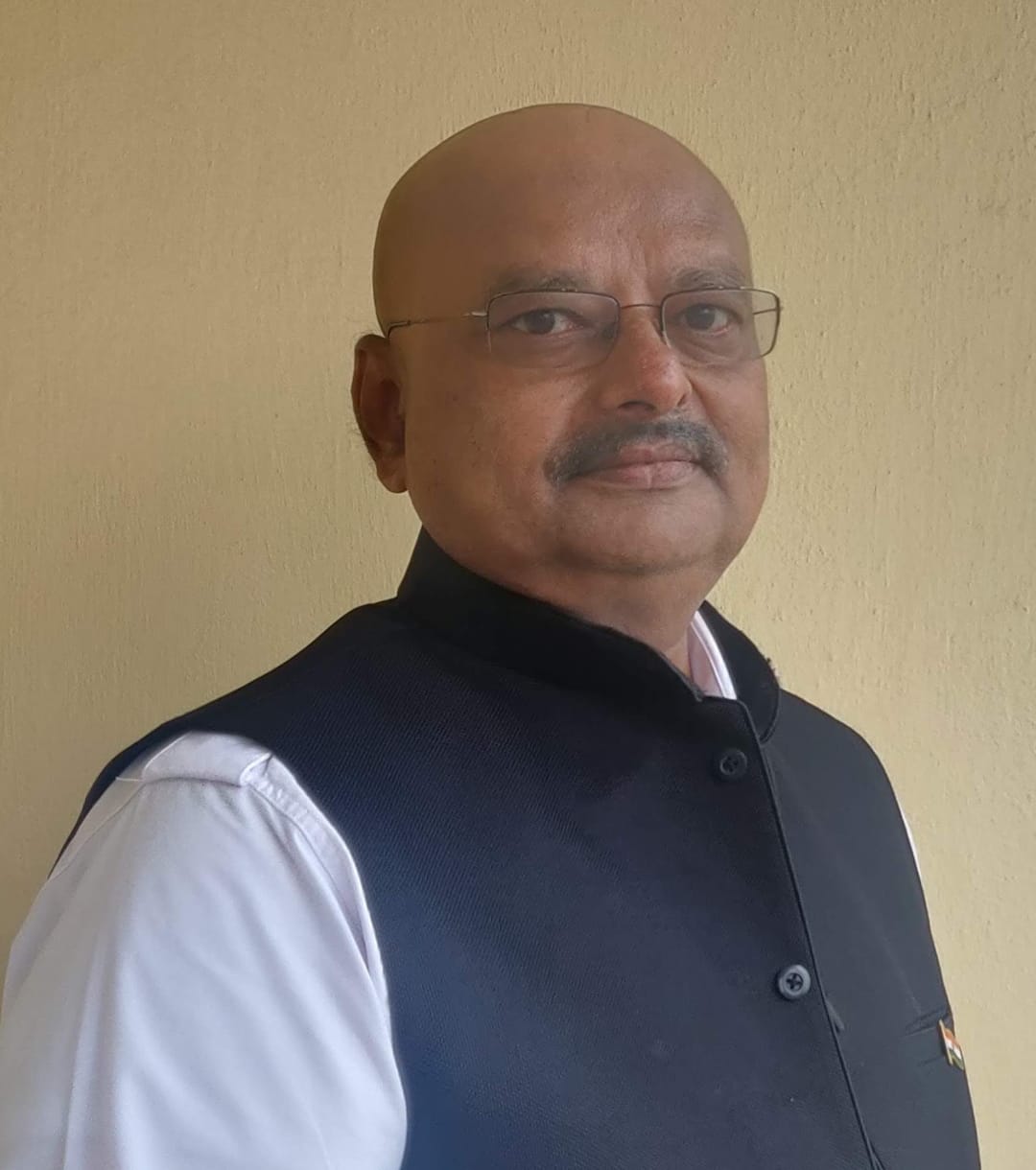 Wing Commander BS Sudarshan is a former Indian Air Force pilot with over 12,000 flying hours. He participated in Operation Pawan and Operation Cactus before he transitioned to civil aviation. A passionate writer, he has authored six books, including "Hasiru Hampe", appreciated by S L Bhyrappa, and the latest "Evergreen Hampi". He is a regular contributor to the Verandah Club.


Shri Ramachandra Prasad's captivating narrative and the hot chai that was served at the right time transported me to ancient Kerala, where the extraor...
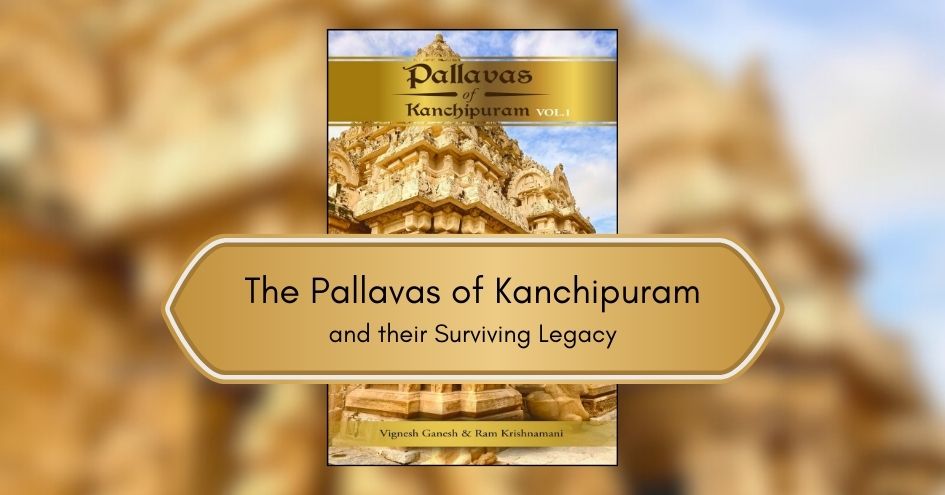
Introduction In Bharatvarsha, History is not the account narrated by victors. It is the record left behind by survivors. The study of Indian History...
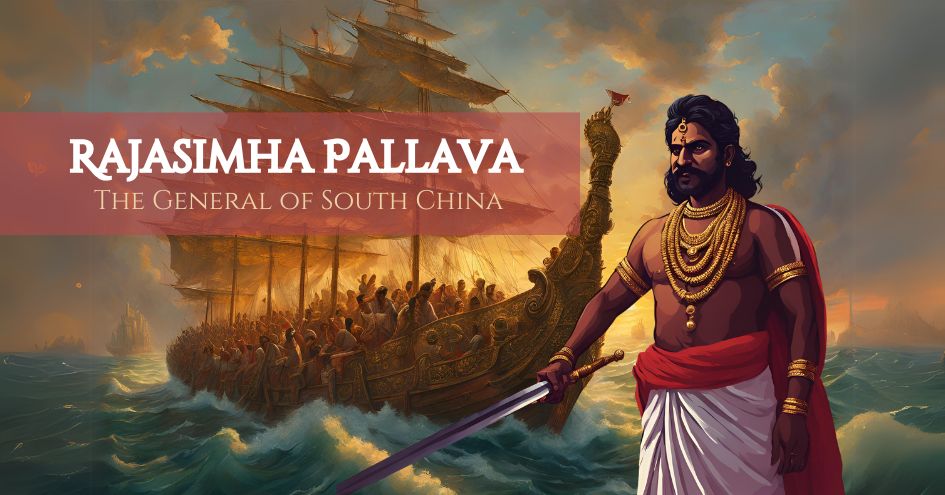
It is the first-half of the 8th Century C.E. in South India. The Pallava kingdom possesses strength and prosperity with some of the greatest monument...

Verandah Club is an initiative by few like-minds of Coimbatore who are interested to share information on various antiquities of Bharat.
Free download our iOS & Android app
© Copyright 2026, All Rights Reserved.