
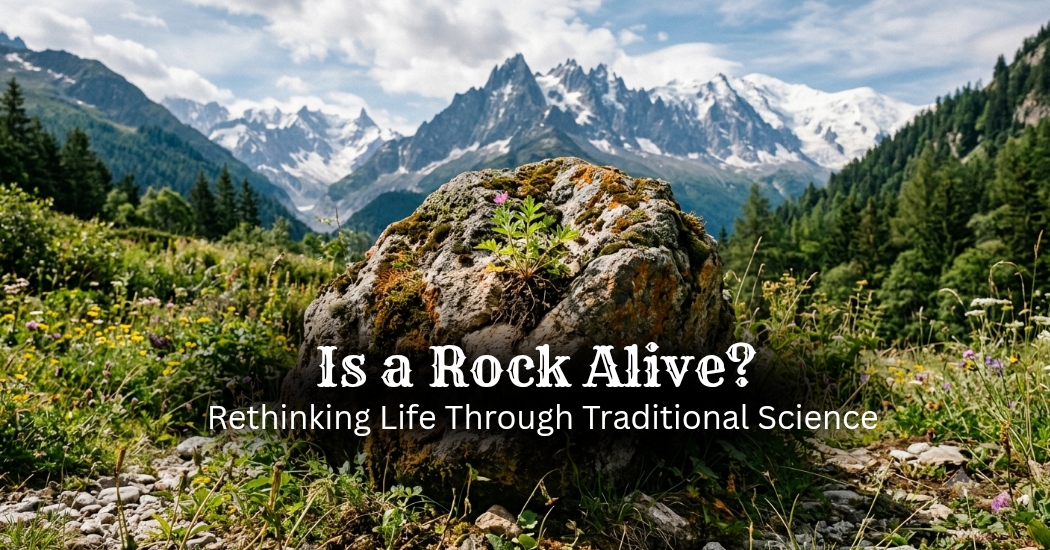
Modern biology likes clean categories. A bacterium is alive. A tree is alive. A corpse is dead. A rock is non-living. A virus sits awkwardly on the border, half-invited to the party and half-left out.
Traditional science, at least in the way I have been thinking through it, is far less interested in that neat sorting. It does not begin by asking, is this alive or not? It begins somewhere else entirely: what kind of being is this, what cycle is it in, and what sort of life-current moves through it?
That shift changes everything.
The modern biological view is not wrong within its own frame. It asks a practical and observable question: can this thing maintain itself, metabolize, respond to its environment, reproduce, and participate in evolution? That is why a single-celled bacterium is confidently classed as alive. It can take in nutrients, transform them, eliminate waste, divide, and continue its lineage. A virus, on the other hand, cannot do most of that on its own. It has to enter a host cell and use that host’s machinery. So biology hesitates with the virus. It is structurally active, genetically potent, but not fully self-sustaining in the way a cell is.
All of that is sensible. But it is only one way of looking at life.
Traditional systems, especially when read through ideas like Panchabhutas, prāṇa, karma, dharma, and moksha, ask a very different question. They are less interested in whether a being satisfies a laboratory checklist and more interested in the nature of its embodiment. They ask: what kind of form is this? What sort of karmic posting does it represent? What role does it play in the larger cosmic order? What kind of prāṇic expression does it hold?
That difference sounds abstract at first, but it becomes concrete very quickly if we take a few simple examples.
The first problem: if everything has Panchabhutas, is everything alive?
A common traditional instinct is to say that all material things are made of the five elements—earth, water, fire, air, and space. Fair enough. But if that alone is enough to define life, then we run into trouble immediately.
A corpse still has Panchabhutas. It still has flesh and bone, moisture, residual heat, air in its cavities, and space within its body. Yet no one treats a corpse as a living person. So clearly the mere presence of the five elements is not enough.
That is where the first important correction appears.
The question is not whether the elements are present. They are present in a corpse, in a stone, in a plant, in a pot, in a mountain, and in a human body. The real question is how those elements are organized and whether they are held together by a living current.
A living body is not just a collection of elements. It is a body in which the elements are in active coordination. It takes in, transforms, responds, repairs, and resists dissolution. A corpse still has the ingredients, but it has lost the living coordination.
That is a crucial distinction. Life, in this traditional sense, is not merely elemental composition. It is living elemental organization.
Single-celled life and the virus: a useful contrast
Once that distinction is clear, the comparison between a single-celled organism and a virus becomes much more interesting.
A single cell may be tiny, but it is a complete organism. It has a boundary. It takes in. It transforms. It expels. It responds. It divides. In both biological and traditional terms, it is easy to see why it counts as alive. Even if it is only one cell, it is still carrying out the full work of life.
A virus is different. It cannot stand on its own in the same way. It must enter another being in order to multiply. It lives through another body. It often harms the very host on which it depends. If it kills that host too effectively, it may also cut off its own support system. It is a strange, unstable, intense mode of existence.
At first, one might say: “Fine, then the virus is not alive because it lacks independence.” But that answer does not survive for long. A human is not independent either. Neither is a tree. Neither is a bacterium. All beings depend on something larger than themselves—air, water, food, soil, sunlight, Earth, and the wider ecological field.
So dependence alone cannot be the deciding factor.
That forced a second correction. The issue is not independence versus dependence, because no organism is truly independent. The better distinction is this: does the being possess its own active living organization, or does it only become active by borrowing another being’s life-system?
A single-celled organism clearly has its own living organization. A virus seems more like a being in a highly constrained karmic condition—one that can only continue by entering and using another being’s field.
This is where traditional thought can take a turn that modern biology usually does not. Instead of asking whether the virus is “properly alive,” one can ask what kind of karmic life it represents. A virus becomes not merely a biological particle, but a being in a harsh posting: dependent, unstable, forced to survive through another, often betraying the very host it needs.
That is not a scientific claim in the modern laboratory sense. It is a traditional philosophical reading. But it is a coherent one.
The corpse changes the whole discussion
If the virus complicates the idea of life, the corpse completely exposes the weakness of simplistic definitions.
A fresh corpse can look almost exactly like the living body it once was. The same organs are present. The same tissues are present. Many cells are still there. The same five elements are present. Yet something has undeniably gone.
What has gone?
Modern biology answers in terms of organismal coordination: the body as a whole can no longer maintain life, circulate, respond, regulate, or continue as an integrated organism. Some cells may survive for a while, but the person is gone as a living whole.
Traditional language would say something similar, but with a different emphasis. The corpse has not lost the five elements. It has lost prāṇa as individualized living coordination. The organismal life-current that held the body together as this person is no longer there.
That does not mean the corpse is “nothing.” In fact, it may be more accurate to say the corpse is not dead matter, but disassembled life. It is no longer a living person, but it has not left the larger field of life. It returns to soil, to microbes, to ash, to air, to plant, to food, to other bodies. Its form has collapsed, but its participation in the larger cycle has not ended.
And that realization leads to a much stranger question.
Can a rock be dead?
At first glance, the answer seems obvious. No. A rock is not dead. A corpse is dead because it was once alive. A rock is simply non-living.
But if we have already begun to think in terms of prāṇa, karma, and cycles rather than in terms of strict biological categories, that answer starts to feel incomplete. A corpse is not simply “gone”; it is in transition. A virus is not just an object; it is a being in a certain kind of dependent karmic state. A single cell is a complete living unit despite its tiny scale.
So what is a rock?
The most interesting traditional answer is not that the rock is alive in the same way a dog or a tree is alive. The more radical answer is that the rock is a being in a different kind of embodiment altogether.
This changes the language completely. The difference between rock, plant, virus, animal, and human is no longer the difference between life and non-life. It becomes the difference between forms of karmic posting.
A rock, in this view, is not lifeless matter. It is a being in a very long, slow, heavy state of endurance. It bears pressure, heat, erosion, fracture, rolling, weathering, and time. It is not “dead”; it is in a dense and prolonged karmic condition.
A corpse, by contrast, is a form that has just exited one organized birth and is about to re-enter other streams. It can return quickly to soil, to plant, to food, to another body. It is not inert; it is transitioning.
The rock and the corpse are therefore not opposites. They are simply different kinds of beings at different speeds of karmic movement.
Nested beings, hosted beings
Once that door opens, another one opens right behind it.
If a virus depends on a host, and a human depends entirely on Earth, then in what sense are humans “independent” either? Without Earth, we do not last long enough to even ask the question. Without air, water, food, microbes, gravity, and ecosystem, the human body is finished.
So perhaps all beings are hosted beings.
That idea becomes even more interesting when extended further. A mountain may be a being hosted by Earth. Rocks may be beings hosted by mountains. Minerals may be hosted within rocks. A human body may itself be a host-field containing countless smaller beings—microbes, cells, substances in transition, and even karmic streams moving through food and water.
The body, in that sense, is not a sealed object. It is a temporary meeting ground.
That line of thought leads to a powerful conclusion: one being can be a world for other beings. Earth can host mountains, mountains can host rocks, rocks can host other subtle forms of being, and the human body can host innumerable life-streams moving through their own cycles.
This is why I found it useful to use the word “parasite,” though not in the insulting biological sense. I used it provocatively, to make one point clear: nothing exists independently. Every being lives off a larger being. More precisely, these are not always parasites in the harmful sense; many are simply dependent beings, nested within larger fields of life.
One essence, many expressions
Once all these examples are placed next to each other—single cell, virus, corpse, rock, Earth—the traditional picture becomes much less about deciding what is alive and what is not, and much more about understanding how one essence appears in different conditions.
That, in fact, is the heart of the matter.
A rock, a plant, a virus, and a human are not different in essence. They are different expressions of the same underlying reality, taking different forms according to karma, dharma, and the requirements of the larger cycle.
Nothing fundamental changes from one to the other in the sense of essence. What changes is movement—the speed, density, mobility, burden, and possibility associated with that form.
The metaphor that emerged most naturally for me was financial. Karma is like a ledger. Each being occupies a posting that reflects the state of that account. A rock is not “lower” because it lacks essence; it is in a heavy and slow posting. A virus is in an intense and unstable posting. A human birth is special not because humans are made of better material, but because human birth offers a rare combination of awareness, mobility, and access to release.
That is where the hierarchy of life begins to make sense in traditional terms. Not as a hierarchy of value in the modern biological sense, but as a hierarchy of karmic opportunity.
Karma, dharma, and moksha are not the same thing
One of the clearest outcomes of this whole line of thinking was the need to separate three ideas that are often collapsed into one another: karma, dharma, and moksha.
Karma determines the posting—the form of embodiment, the conditions one must undergo, the kind of life one enters.
Dharma determines the function of that posting—how that being is meant to operate, what role it plays in the larger order, what lawful pattern belongs to that form.
Moksha is something else altogether. It is not merely a better posting within the cycle. It is escape from the posting system itself.
That distinction matters because it explains why a virus may still have karma and a dharmic place in the cosmic dance, even if it is not a being situated for liberation in the same way a human is. It also explains why human birth is considered precious. Not because the human is a different essence from the rock or the virus, but because this particular posting comes with the instruments necessary for release.
In modern language, one might say that the human has body, mind, and soul available in a uniquely integrated way. In Siddha language, one might speak of Annamaya Kosha, Prāṇamaya Kosha, and the higher sheaths of being. However one phrases it, the point is the same: the human form is a strategically important embodiment because it gives access to conscious practice.
A stone may become a Shiva Linga and, through that sacred placement, participate in a radically different destiny. A human, however, already carries within the very structure of life the possibility of consciously working toward liberation.
So what is life, then?
If one were forced to answer in one sentence, the answer would no longer be “life is what has cells” or even “life is what has Panchabhutas.”
A better answer would be this:
Life is not a simple category dividing the world into alive and non-alive. It is a spectrum of embodied participation in one underlying reality, expressed through different karmic postings, different prāṇic conditions, and different degrees of mobility within the cosmic cycle.
In that framework, a corpse is not merely dead matter. A virus is not merely a particle. A rock is not merely a geological object. Earth is not merely a planet. They are all forms within one larger process, one larger dance, one larger continuity.
Modern biology remains useful, precise, and necessary within its own field. It tells us how organisms function, how cells divide, how viruses replicate, how bodies fail. Traditional science is asking a different set of questions. It is asking what a being is in the deeper sense—what cycle it belongs to, what kind of posting it occupies, what sort of life-current moves through it, and whether that form is one of bondage, transition, or release.
That difference is not small. It is the difference between seeing a corpse as a failed body and seeing it as a body that has just left one arrangement and is entering another. It is the difference between seeing a virus as only a pathogen and seeing it also as a difficult karmic life. It is the difference between seeing a rock as inert matter and seeing it as a slow being in a long endurance-based embodiment.
And perhaps most importantly, it is the difference between asking “Is this alive?” and asking “What kind of life is this?”
The ancient Tamil and Sanskrit traditions preserve ideas that are at once subtle and universal. They invite us to look at the world through a different lens—to understand life not merely as something to be possessed or exploited, but as something to be observed, experienced, and respected. Perhaps this perspective was our ancestors' way of nurturing human beings who lived as gentle inhabitants of the Earth, rather than as mere consumers of its wealth. As we explore these philosophies in the articles ahead, we are not asking you to accept them as truth, but simply to consider them as another way of seeing reality - perhaps a better way of seeing reality.
 Vigneshvaran, Senior Correspondent of TheVerandahClub.com is a second generational acupuncture practitioner, a story teller, as well as an avid independent writer driven by his passion. His literary talents extend to crafting beautiful poems and captivating short stories including the Sehwag Tales series. In addition to these creative pursuits, he has also authored a book titled "Halahala," which can be found on Wattpad.

The Venkateshwara Swami Temple in Tirupati is among the holiest places in the world for Hindus. Millions of people throng the temple every year to get...
It is a sad reality that our Itihasa and Puranas have been subject to severe distortion over the years. This is not surprising considering how even th...
The holy land of Bharat follows Sanatana Dharma. The word Sanatana Dharma is a Sanskrit word meaning, “Eternal law”. It is the indestructible ultimate...
Verandah Club is an initiative by few like-minds of Coimbatore who are interested to share information on various antiquities of Bharat.
Free download our iOS & Android app
© Copyright 2026, All Rights Reserved.