
Introduction
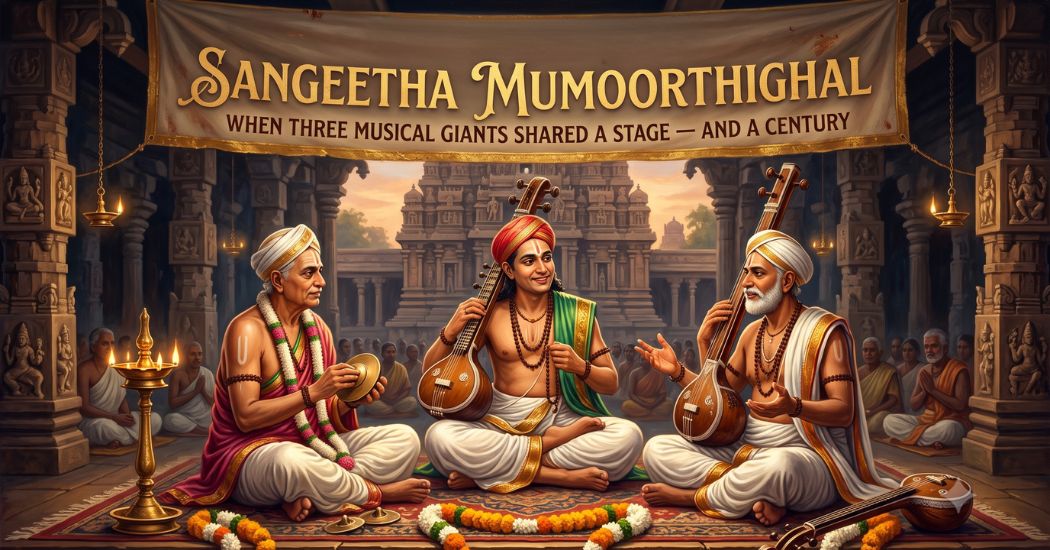
There is something poetic about Carnatic music's three greatest composers — Shri Syama Shastri, Shri Tyagaraja, and Shri Muthuswami Dikshitar — not only being near-contemporaries residing in the timeless district of Thanjavur, walking through the same ancient temple corridors, but by divine grace, meeting and developing a fateful camaraderie. This is what United Visuals' harmonious production — Sangeetha Mumoorthigal, staged at the sprawling Sivaswamy Auditorium located in Chembur, Mumbai, set out to explore. Conceived by writer Shri Venkatraman Srinivasan, directed by veteran theatre personality Shri. T.V. Varadarajan, scripted by Shri. Chandramohan, and anchored musically by Shrimati. Bombay Jayashree Ramnath, the play has ventured daringly to capture the soaring legacies of three musical masters equally into an eventful evening of theatre, without relegating any of them to a historical footnote.
An Improbable Coincidence of Genius
As is known, the three maestros hailed from the Thanjavur region and were, incredibly, composing during overlapping decades in the 18th and 19th Centuries C.E. Shri Syama Shastri was born in 1762, Shri Tyagaraja came forth into this world in 1767, followed by Muthuswami Dikshitar who was brought forth in 1775 — each separated only by a few years, and all three born in the temple town of Thiruvarur.
These extraordinarily talented vidwans emerged from the same janmabhoomi, within a single generation that reshaped the field of Carnatic music forever. Sangeetha Mumoorthigal treats the historical camaraderie between the musical trinity as the keynote where their individual brilliance was heightened by their companionship to each other and profound affinity to music.
The Play's Emotional Core: Camaraderie, Not Competition
Rather than conducting an intensive exploration into their respective biographies, given the mind-boggling legends associated with each composer, the play chooses to highlight the personal camaraderie among the three musical masters, focusing on certain significant events that capture critical moments in their lives. Popular retellings and accounts of the Trinity often depict them as a triad of revered composers with similar aptitudes, overlooking temperaments and musical philosophies. However, in reality, they were remarkably different, enjoying warmth yet encountering intellectual and spiritual friction that moved each of them to establish monumental legacies. It was their stimulating interaction that is the beating heart of this drama.
Traditional accounts, long treasured in Carnatic music circles, describe a relationship built on mutual appreciation rather than personal rivalry. Sri Syama Shastri, the eldest of the three, and Shri Tyagaraja were trained, at different periods, under the same esteemed Thanjavur court musician, Shri Adiappayya, a lineage that bound the two composers together from early on. Traditional accounts also state how the celebrated visiting musician Shri Bobbili Kesavayya arrived in the region and challenged the Thanjavur court's musicians after already being bested by Shri Tyagaraja at Tiruvaiyaru. Here it was Shri Syama Shastri who stepped forward to defend the honour of the court, matching Kesavayya's command over intricate talas and emerging victorious. Shri Tyagaraja, for his part, is said to have held Syama Shastri's mastery over rhythm in high regard, while his own compositions were Shri Rama-centric and intensively Vaishnavite in flavour, which were different from Shri Syama Shastri's intensively devotional Devi-focused Shyama kritis.
Shri Muthuswami Dikshitar arrived from a slightly different sphere where his years of travel around Bharatvarsha and his exposure to Hindustani music during his stay in Varanasi caused him to develop a Sanskritised and highly meditative style of composing music, differing from Shri Tyagaraja's emotionally moving Telugu kritis and Shri Syama Shastri's rhythmically refined compositions. However, it is documented that Shri Dikshitar and Shri Shastri were noticeably close friends, meeting often and spending hours singing together in jugalbandis. It was a friendship built on a shared devotion towards the divine and affinity for music that had them bond deeply. Therefore, this play built around "significant incidents" rather than a dry timeline gives room to dramatise these unexplored moments between the Carnatic greats and delve into their shared musical exchanges. Where the foundation was their mutual appreciation and respect for each other, the drama chooses to show us the respect they inspired for each other rather than displaying just another competitive tally of their composed ragas and listed kritis.
Music: the Real Protagonist in this Story
In a play about composers, the music inevitably takes center stage, stealing the show from the characters. Shrimati Bombay Jayashree Ramnath's involvement as music director demonstrates the production’s efforts to make Music the dramatic hero and central character of this play. Each of the Trinity left behind a compositional legacy so distinct and rich that Carnatic musicians can often identify the composer of a kriti within the first few phrases, before a single word of the sahitya is sung. Shri Tyagaraja is remembered above all for his Pancharatna Kritis — the five musical gems that still embellish every January of the new year — and he is known for having composed prolifically across ragas with deep emotional awareness. His songs function as spiritual conversations with Shri Rama, anchoring us spiritually to Maryada Purushottam through Shri Tyagaraja’s devotional verses.
Muthuswami Dikshitar, signing his compositions with the mudra "Guruguha," is celebrated for his Navagraha Kritis and for his majestic, architectural approach to raga elaboration, composing frequently in Sanskrit along with the sprinkling of Hindustani ragas and Western melodic elements picked up from military bands of his era.
Shri Syama Shastri, whose compositions carry the distinguished autograph of "Shyama Krishna," being best remembered for his masterful rendition of complex talas and for the Swarajati form, a genre he is credited with perfecting.
A theatrical production containing these distinctively flavourful moments in the lives of all three composers naturally has to draw on the shared vocabulary of ragas and talas that made each man's style so recognisable and legendary, using evocations of their kritis to connect the audience and make us feel the differences between Shri Tyagaraja's devotional yearning, Shri Dikshitar's meditative intensity, and Shri Syama Shastri's rhythmic mastery. Words cannot even be used to describe the relationship these men shared with music, but the excerpts of their kritis are enough to make us feel the profound connection they felt to music that moved them to compose.
Why Such a Play Matters Now
Productions like Sangeetha Mumoorthigal go beyond the dictates of nostalgia. They evoke the Bhakti bhava in a younger generation that has never experienced the temple-town culture that produced musical geniuses like the Carnatic Trinity. Theatre is a time portal that allows us to access the musical inheritance and legacy of these Sangeetha Mahans. By humanising Shri Syama Shastri, Shri Tyagaraja, and Shri Muthuswami Dikshitar by showing us the faces behind the talas, ragas, and kritis, the play makes us think about these men beyond their compositions. We are made to see their human interactions, appreciations, musical and spiritual exchanges, their friction, their shared warmth and belief towards the Divine — facets of their unseen relationships that will open our minds and hearts to perceive their music in a new light.
That, ultimately, may be the highest compliment one can pay a production built around the Great Trinity of Carnatic music — that it sends its audience back to the kritis themselves, curious once more to learn the men behind the music.
 Vignesh Ganesh is a lawyer and writer. He is interested in ancient history and Itihasa and this interest culminated in his first book, "The Pallavas of Kanchipuram: Volume 1", which he co-authored with Mr. K. Ram, a fellow enthusiast of Indian history and culture.

Shri Ramachandra Prasad's captivating narrative and the hot chai that was served at the right time transported me to ancient Kerala, where the extraor...
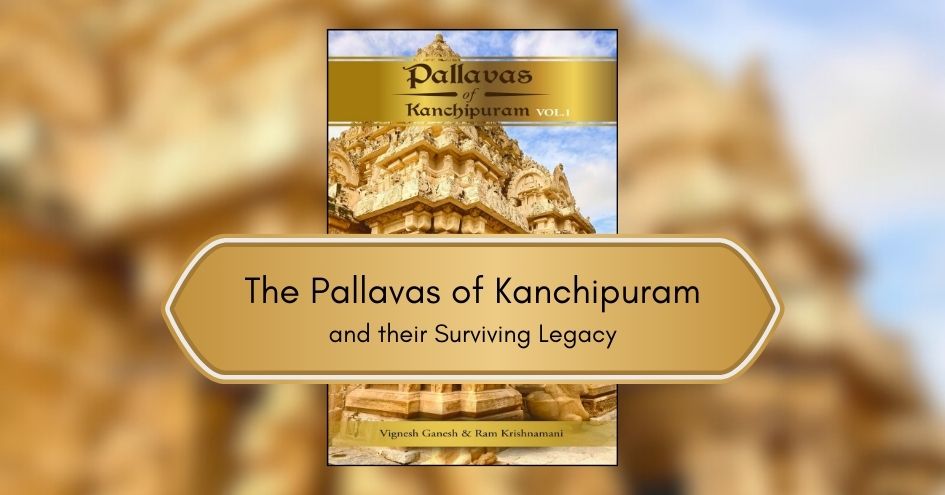
Introduction In Bharatvarsha, History is not the account narrated by victors. It is the record left behind by survivors. The study of Indian History...
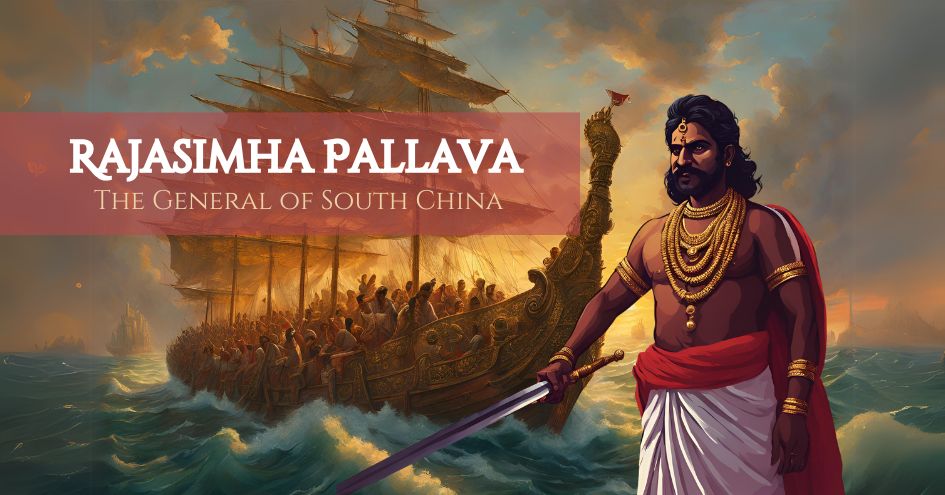
It is the first-half of the 8th Century C.E. in South India. The Pallava kingdom possesses strength and prosperity with some of the greatest monument...

Verandah Club is an initiative by few like-minds of Coimbatore who are interested to share information on various antiquities of Bharat.
Free download our iOS & Android app
© Copyright 2026, All Rights Reserved.