
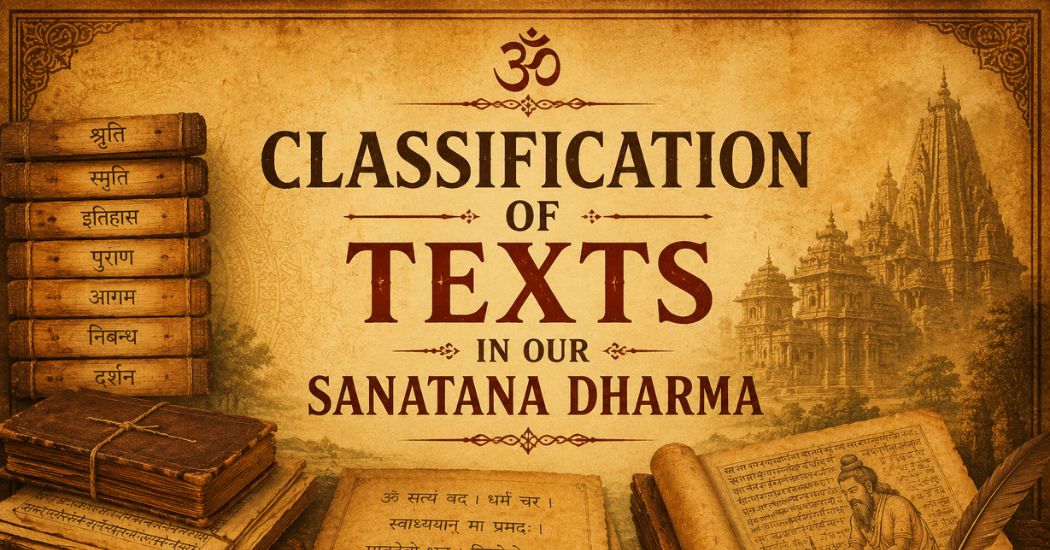
Unlike in the Western world, where the various scriptures are wrapped up in one general term called Mythology, in Sanatana Dharma, Shruti, Smriti, Itihasa, and Purana are foundational classifications of sacred texts and traditions. Each serves a specific purpose in preserving and transmitting spiritual, moral, and historical knowledge.
Here's an explanation of each:
1. Shruti (श्रुति) – "That Which Is Heard"
Shruti refers to the most sacred and authoritative texts in Hinduism. These are considered divine revelations, directly heard by ancient sages (Rishis) during deep meditation. Shruti texts form the foundation of Hindu philosophy and rituals. These are eternal and hence unchangeable. They are also considered apaurusheya (not of human origin).
Examples:
The Vedas (Rigveda, Yajurveda, Samaveda, Atharvaveda): Hymns, mantras, and rituals.
The Brahmanas: Prose texts explaining Vedic rituals.
The Aranyakas: Philosophical interpretations of rituals.
The Upanishads: Spiritual teachings and philosophical discussions.
Shruti texts primarily deal with metaphysical truths, cosmic laws (dharma), and rituals, forming the spiritual core of Hinduism.
2. Smriti (स्मृति) – "That Which Is Remembered"
Smriti texts are secondary to Shruti and are considered human compositions based on divine truths. They interpret, explain, and adapt Shruti for practical application in daily life. They are not eternal or fixed; they evolve to suit changing times and contexts. Sages and scholars write these to guide moral, social, and legal practices.
Examples:
Dharma Shastras: Texts on ethics and law, e.g., Manusmriti, Yajnavalkya Smriti.
Grihya Sutras and Shrauta Sutras: Manuals for household and public rituals.
Arthashastra: Text on governance and economics by Kautilya (Chanakya).
Smriti provides practical guidelines for living in accordance with dharma and for adapting spiritual principles to daily life and society.
3. Itihasa (इतिहास) – "History" or "Epic Narratives"
Itihasa refers to historical narratives that combine mythological, philosophical, and moral teachings. These texts are a blend of fact and allegory, aiming to inspire and guide individuals in their spiritual and ethical journey. These narratives are intertwined with moral lessons, dharma, and devotion. They serve as records of ancient dynasties and legendary heroes.
Examples:
Ramayana: The story of Lord Rama, emphasising dharma, virtue, and devotion.
Mahabharata: A vast epic that includes the Bhagavad Gita, focusing on dharma, karma, and the struggles of life.
Itihasa teaches moral lessons through engaging stories, illustrating how to uphold dharma even in challenging circumstances.
4. Purana (पुराण) – "Ancient Stories"
Puranas are collections of mythological stories, genealogies, cosmology, and devotional hymns. They aim to make spiritual knowledge accessible to the common people. These are written in simple language, often in the form of stories. They contain legends of gods, demons, saints, and kings.
Include instructions for rituals, festivals, and pilgrimages.
Examples:
18 Major Puranas: Vishnu Purana, Shiva Purana, Bhagavata Purana, etc.
Upa-Puranas: Minor Puranas supplement the major ones.
Puranas popularise complex philosophical ideas and rituals through relatable narratives, making them approachable to all.
Other Categories in Hindu Scriptures:
Vedanga (वेदांग): Six auxiliary disciplines (e.g., grammar, astronomy) to aid in understanding the Vedas.
Agamas and Tantras: Texts focusing on temple construction, rituals, and esoteric practices.
Upavedas: Secondary texts dealing with sciences like medicine (Ayurveda) and music (Gandharva Veda).
Together, Shruti, Smriti, Itihasa, and Purana encompass the spiritual, philosophical, practical, and cultural dimensions of Hinduism. They ensure the preservation of eternal truths while adapting them to the changing needs of society, forming a comprehensive framework for understanding the divine, the cosmos, and human existence.
The Unique Status of the Gita
The Bhagavad Gita is considered part of Itihasa, specifically as a section of the Mahabharata, which is classified as a historical epic. While the Mahabharata is a Smriti text (composed by Sage Vyasa), the Bhagavad Gita is often regarded with reverence akin to Shruti due to its profound spiritual and philosophical teachings. Here's an explanation:
Why is the Bhagavad Gita called Itihasa?
The Bhagavad Gita is a conversation between Lord Krishna and Arjuna, set on the battlefield of Kurukshetra, and forms part of the Bhishma Parva (Book of Bhishma) in the Mahabharata. As the Mahabharata is an Itihasa, the Bhagavad Gita is technically part of the same classification. It addresses themes like dharma, karma, yoga, and devotion, making it an inspirational and moral guide within a historical narrative.
Reverence as Shruti
While technically Smriti (like the Mahabharata), the Bhagavad Gita is often revered as equivalent to Shruti because:
Its teachings are considered timeless truths, akin to the divine revelations of the Upanishads (which are part of Shruti). Lord Krishna’s words in the Gita are viewed as the direct voice of the Divine, much like the revelations in Shruti texts. The Gita synthesises Vedic teachings, aligning them closely with the philosophy of the Upanishads. For this reason, the Gita is often called the "Gitopanishad," and some schools of thought treat it as a Shruti-like text for its spiritual authority.
The Bhagavad Gita holds a unique position because it blends the practicality of Smriti with the eternal wisdom of Shruti. While being part of the Mahabharata’s Itihasa, it is a standalone text studied for its universal teachings and deep philosophical insights. Its teachings transcend its classification, making it a cornerstone of Sanatana philosophy.
 Wing Commander BS Sudarshan is a former Indian Air Force pilot with over 12,000 flying hours. He participated in Operation Pawan and Operation Cactus before he transitioned to civil aviation. A passionate writer, he has authored six books, including "Hasiru Hampe", appreciated by S L Bhyrappa, and the latest "Evergreen Hampi". He is a regular contributor to the Verandah Club.


Over the past couple of years, I have had the opportunity to attend several family weddings, both in India and the United States. The experience has b...

Let's take a moment to revisit the meaning of the term “Vivāha”. At its core, it represents the idea of sharing a burden and carrying the weight of li...

After reviewing the different kinds of weddings, we see why ancient texts felt the need to clearly distinguish between forms that upheld social order...

Verandah Club is an initiative by few like-minds of Coimbatore who are interested to share information on various antiquities of Bharat.
Free download our iOS & Android app
© Copyright 2026, All Rights Reserved.