
Summer this year is harsher than usual. By noon, the streets fall silent. Even the wind seems to have withdrawn, conversations become shorter, movements become fewer, and life, without announcement, begins to slow down. But why? Is it just another course of nature’s behaviour, or does it have a deep physiological meaning? What is nature and panchabhutas trying to communicate with us? What does our ancient wisdom teach us?
As on April 14, 2026, we are entering the 40th Tamil year “Prabhavu” of the 60 year cycle.
“மிக்க பராபவத்தின் மேதினியிற், பின் மழையாம்”
describes the Panchanga Venba of this year. It says that this year is expected to have patchy or delayed rains, resulting in one of the hottest years in recent times. On top of this the Agni Nakshatra aka Kathiri Veyyil begins from May 4 and stretches until May 28 - the period marked as the heat within the heat phase of the hottest year. I’m probably not the first person to warn you about the Agni Nakshatra. But how do we survive this?
Understanding Agni Nakshatra
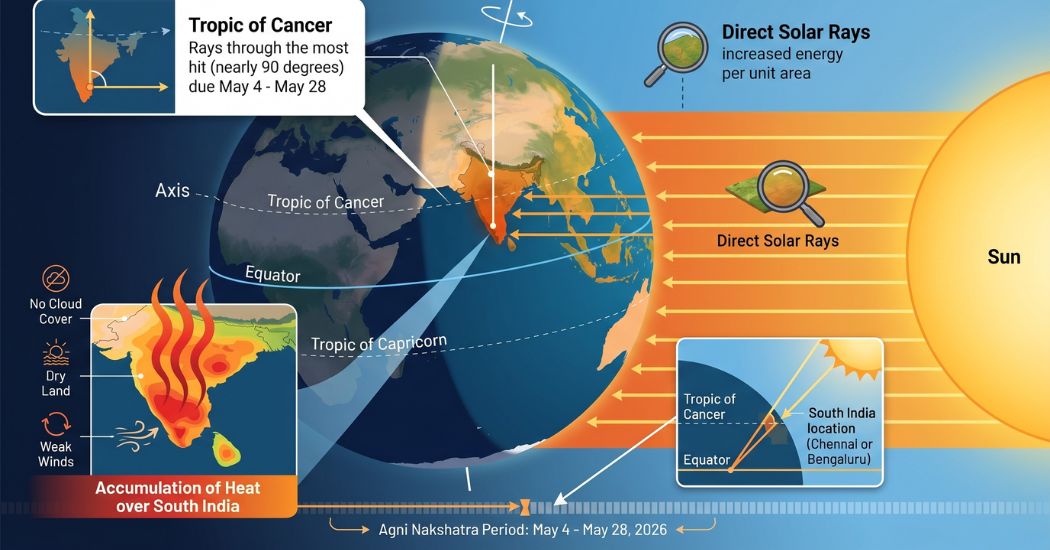
As a starter, let's understand Agni nakshatra. Agni Nakshatra is not just a name given to a hot period. It is a precise window in the year when the Sun’s intensity over the Indian subcontinent reaches a critical point. The Sun appears to move northward (Tropic of Cancer), its rays falling more directly on South India, the land that has already been heating for weeks. It is not the beginning of heat—it is the accumulation of heat.
The Earth is tilted, not straight. Because of this, sunlight hits different regions at different angles across the year. During this period, the Sun is nearly overhead at noon in our region. Rays are more direct, hence, more energy per unit area. The Sun is not closer—but it is more direct.
So, Dry Land + No Cloud Cover + Weak Winds = Heat doesn’t escape.
It is different from the early summer between March to April. The difference is like the contrast of a sauna to a hot shower. You are not being showered with heat, but are being suffocated by heat.
In this period, we are not actually trying to reduce heat. The strategy is to preserve the energy and survive the heat. But how?
Slow is the Key
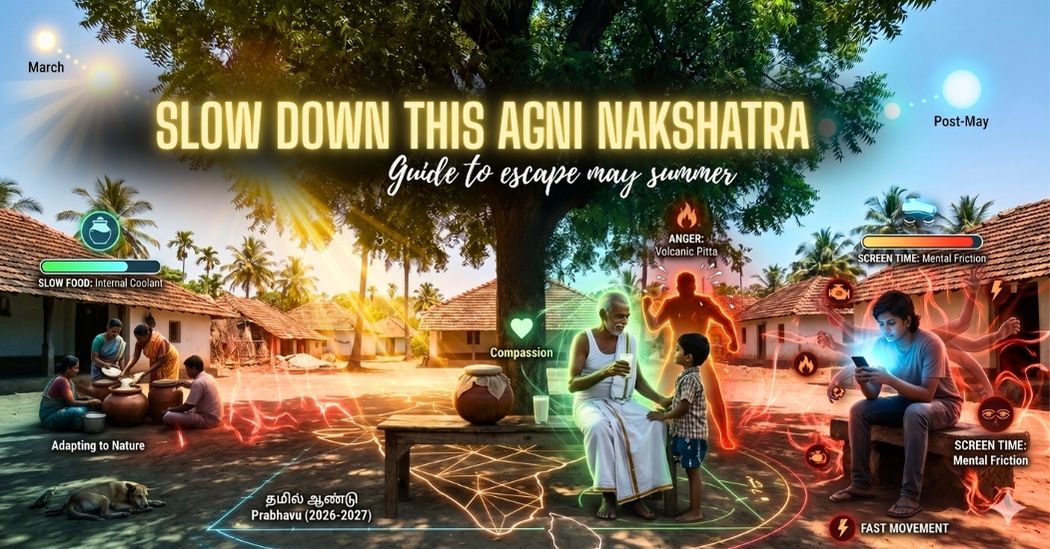
Understand that every movement is a combustion engine. To move is to burn, and to burn is to create internal friction. During Agni Nakshatra, your Pitta—the fire element—is already at its peak. When you rush, shout, or move with frantic energy, you are essentially pouring ghee onto an existing forest fire.
By consciously choosing to walk slow and talk slow, you are practicing a form of "thermal conservation." A low voice profile isn't just about etiquette; it’s about reducing the vibration and effort of the vocal cords, which keeps the upper respiratory tract cool. Think of yourself as a meditative practitioner this month. By slowing your cadence, you lower your heart rate and metabolic heat production. You aren't just saving time; you are saving your internal moisture.
Slow Food vs. Fast Food
The "speed" of food isn't just about how fast it arrives at your table, but how long it took to reach its final form. Slow food like fermented rice or traditional buttermilk has undergone a slow, cool transformation over hours. This fermentation introduces cooling probiotics that settle the gut's "digestive fire" (Agni) when it threatens to overheat.

Conversely, "Fast Food"—highly processed, fried, or microwave-heated—is "high-velocity" energy. It hits the system like a lightning bolt, demanding instant, intense metabolic labor to break down, which generates massive internal heat. To survive the heat of this 24 days, opt for foods that have "rested." If you must eat something heavy, convert it into slow food by eating mindfully and chewing thoroughly. Saliva is your body's natural cooling lubricant; use it to pre-digest your meal and take the load off your internal furnace.
Reduce Screen Time
We often forget that our eyes are the windows through which heat enters and exits the brain. In Acupuncture, the eyes are closely linked to the Liver meridian, which is highly sensitive to heat. Constant scrolling and the blue light of screens act as a micro-stimulant, keeping your brain in a state of "high-frequency" vibration.
Every minute of screen time is a minute of mental friction. This heat doesn't stay in your head; it radiates through the nervous system. During this Agni Nakshatra, give your eyes a "cold compress" by looking at the horizon or closing them for ten minutes every hour. If the screen is unavoidable for work, remember that the heat you feel in your eyes is a signal from your body that your "coolant" levels are running low.
Do not get Angry
In traditional healing, anger is considered "volcanic pitta." It is the most rapid way to spike your internal temperature. When you lose your temper, your blood pressure rises, your pores constrict, and your body’s ability to thermoregulate vanishes.
In this period of extreme external heat, an outburst of anger isn't just a social lapse—it’s a physiological risk. It can lead to "heat strokes of the soul," manifesting as severe headaches, acidity, or skin eruptions. Be gentle with your loved ones, not just for their sake, but as a form of self-preservation. Compassion is, quite literally, a cooling mechanism.

Avoid unnecessary sun exposure
Look at the street dog or the bird in the neem tree; they are the true masters of Nature. Between 11:00 AM and 4:00 PM, they find the deepest shade and remain motionless. They know what we often forget: you cannot fight the Sun.
The Sun during Agni Nakshatra is a primal force. By staying indoors during the peak, you are respecting the boundaries of the Panchabhutas. Schedule your life around the Sun’s arc—finish your chores in the "silver hours" of the early morning or the "copper hours" of the evening. Respecting the shade is not laziness; it is biological wisdom.
Follow the Pattern of Nature
Nature never struggles; it adapts. During the peak of summer, the wind doesn't howl; it whispers. The ocean waves lose their winter aggression and roll softly onto the shore. Even the trees seem to hold their breath.
“Yat Pinde Tat Brahmande"
Translation: "As is the individual body, so is the universe.”
When you align your rhythm with this seasonal silence, you stop being a victim of the heat and start becoming a part of the landscape. Listen to the stillness of the afternoon. If the entire world is taking a collective sigh, why are you trying to shout? By mirroring the slow pulse of the earth, you find a pocket of peace within the fire.
Conclusion
Agni Nakshatra is not an enemy to be conquered, but a season to be endured with grace. Our ancestors didn't see this period as a curse, but as a time for "Mauna" (silence) and "Oivu" (rest). It is a reminder from the universe that we are not separate from the elements.
As the heat peaks over us, remember that survival is found in the shadows, in the fermented pot of rice, and in the quiet spaces between our words. Slow down, Boss. The rains will come in their own time; until then, let the heat teach you the art of being still.
"Om Shanti, Shanti, Shantihi”
 Dr. Vigneshvaran, Senior Correspondent of TheVerandahClub.com is a second generational acupuncture practitioner, a story teller, as well as an avid independent writer driven by his passion. His literary talents extend to crafting beautiful poems and captivating short stories including the Sehwag Tales series. In addition to these creative pursuits, he has also authored a book titled "Halahala," which can be found on Wattpad.
PREVIOUS ARTICLE



Verandah Club is an initiative by few like-minds of Coimbatore who are interested to share information on various antiquities of Bharat.
Free download our iOS & Android app
© Copyright 2026, All Rights Reserved.