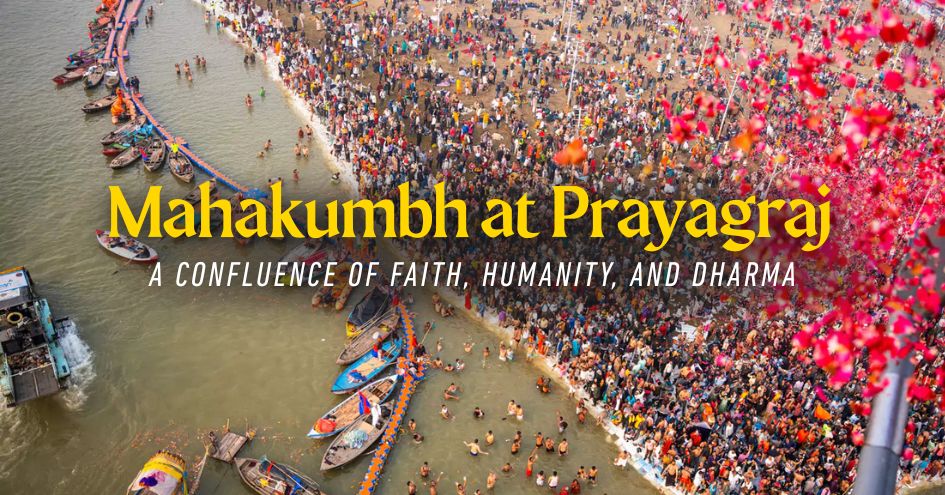

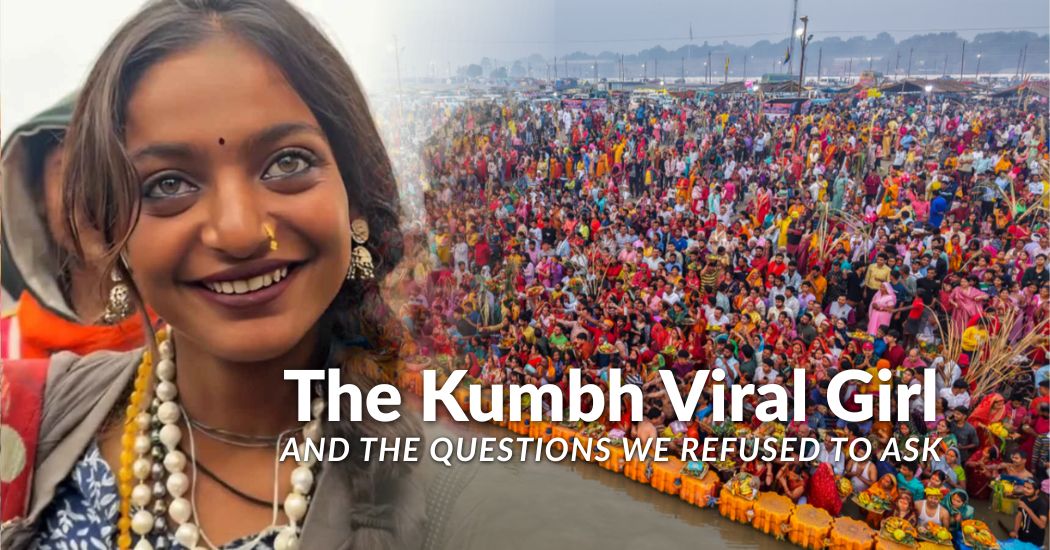
The story of Monalisa Bhosle became one of the most discussed human-interest narratives to emerge from the 2025 Maha Kumbh at Prayagraj.
A 16-year-old girl from Maheshwar, Madhya Pradesh belonging to the nomadic Pardhi community, she had come with her family to sell Rudraksha malas during the Kumbh. Then, within days, videos of her began circulating widely across social media. Her a natural beauty, and simple presence captured attention. What followed was predictable in today’s digital age but deeply disturbing in the context of the Kumbh.
Her videos reportedly crossed millions of views. Crowds gathered. Influencers surrounded her for selfies and content creation. What had begun as a family’s participation in a sacred civilisational gathering to sell some products for their livelihood turned into a spectacle of viral consumption. The disruption became so intense that her family sent her back to their hometown.
Later came reports of her marriage to Farman Khan in Kerala.
And that is where uncomfortable questions begin.
Was she the only beautiful young girl present at the Kumbh selling products?
How did someone from Kerala encounter, connect with, and eventually marry a girl from a small Madhya Pradesh town who had become visible only because of sudden viral fame?
Was this simply an accidental sequence of events born out of internet visibility?
Or was there planning behind it?
These are not questions of gossip. They are questions about how we understand what happened at one of the world’s largest spiritual congregations.
The Kumbh Mela is not a carnival. It is not a tourism fair. It is not a backdrop for reels.
It is one of the most profound civilisational gatherings on earth — an extraordinary confluence of tradition, astronomy, cosmology, jyotisha, ritual discipline, tapasya, and bhakti. For millions, it is a journey of spiritual renewal. Its purpose is inner elevation.
Yet the 2025 Kumbh was discussed in strikingly different terms.
Much of the public discourse reduced it to economics. Headlines and conversations focused on revenue generated, tourist footfall, business opportunities, infrastructure spending, and the scale of monetary transactions. Hindus themselves became engrossed in discussing how much money had been made.
How many conversations centred on spiritual upliftment?
How many reflected on inner transformation?
The Kumbh was also an unprecedented opportunity to reshape perceptions of Uttar Pradesh and its people. For decades, residents of the state have often been casually stereotyped through the term “Bhaiya.” Though bhaiya literally means elder brother — a word of respect and affection in Bhartiya languages — in popular urban discourse it has frequently been reduced to a dismissive, class-coded slur directed at people from Uttar Pradesh and Bihar. A flawlessly organised Kumbh, marked by dignity, discipline, hospitality, and spiritual seriousness, could have challenged these prejudices and restored respect for the cultural sophistication of the region. The real success of such a gathering should not only be measured in revenue generated, but also in whether it elevated the social and civilisational image of the land that hosted it.
How many asked whether the event strengthened Hindu civilisational consciousness?
The Kumbh welcomed millions, including countless non-Hindu visitors, influencers, observers, and content creators. But how many came away with deeper respect for Sanatana Dharma? How many sought to understand its philosophical depth? How many engaged with its spiritual framework beyond visual consumption? How many converted to Hindutava?
And perhaps the most painful question: did Hindus themselves benefit spiritually?
If a sacred gathering of this magnitude becomes remembered primarily for economic statistics, viral personalities, and social-media spectacle, then something essential has been lost.
The Monalisa episode symbolises that loss.
A space meant for spiritual immersion became a stage for algorithmic distraction. A young Hindu girl, who should have remained simply another participant in a sacred gathering, became an object of digital fascination.
The Kumbh’s objective is spiritual awakening.
If amidst crores of pilgrims, endless discourses, rituals, and sacred bathing, the dominant takeaway became commerce and virality — and if even within that environment a vulnerable young participant could not remain protected from the distortions of modern spectacle — then serious introspection is necessary.
The question is not about one girl alone.
The question is whether we still understand what the Kumbh is for or for that matter our other mela and Puja.
If Hindus cannot preserve the sanctity of their greatest spiritual congregation from being converted into content, commerce, and distraction, then the challenge before us is not organisational.
It is civilisational.
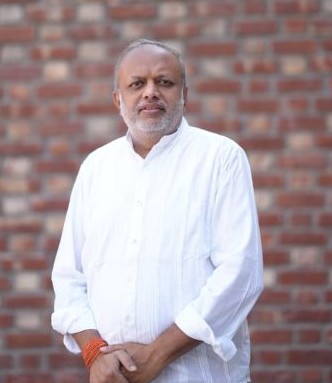 Sandeep Singh is author of Temple Economics Vol I and A Decade for Mandir Vol II. He can be reached at [email protected]
PREVIOUS ARTICLE
NEXT ARTICLE

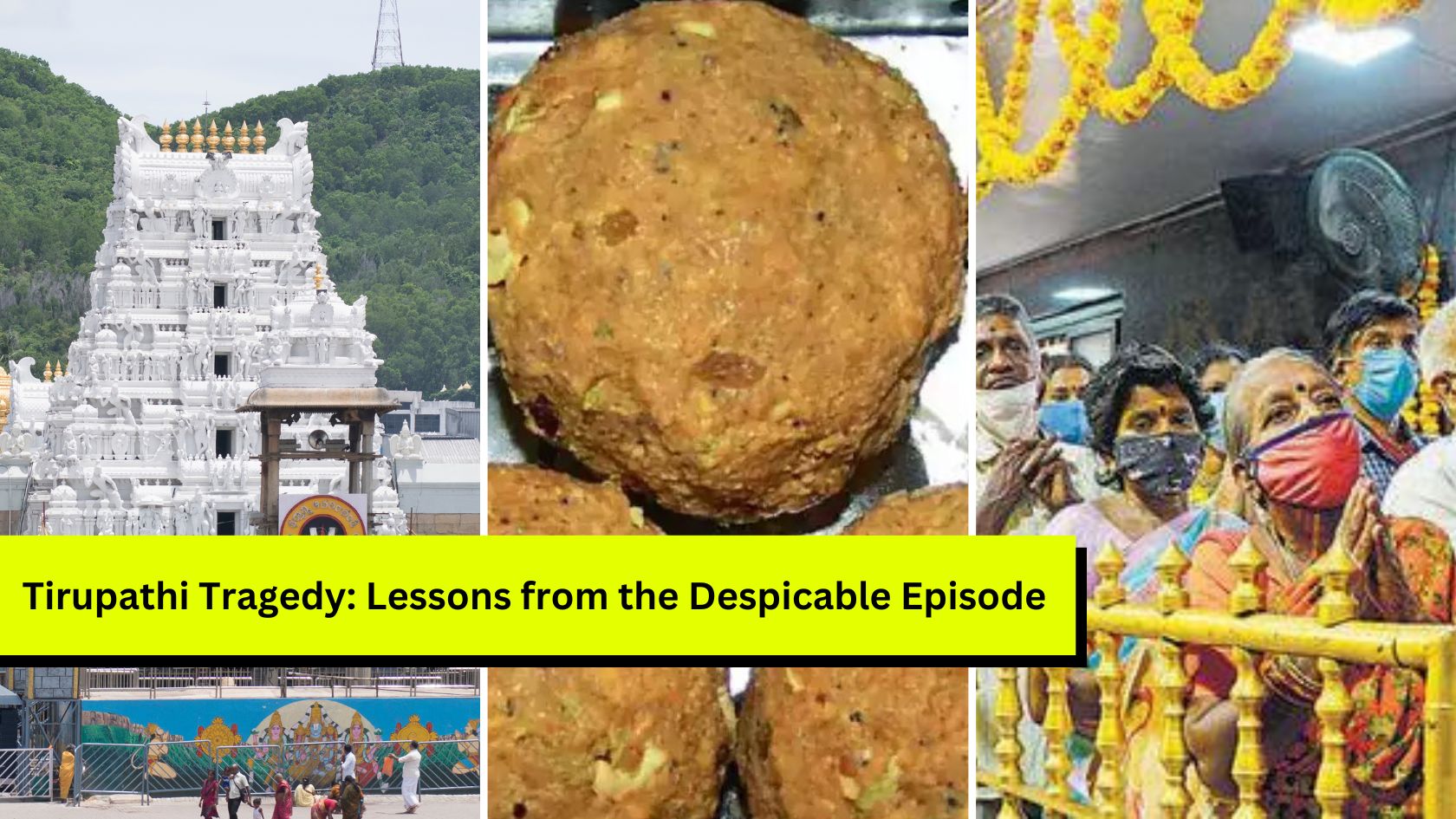
The Venkateshwara Swami Temple in Tirupati is among the holiest places in the world for Hindus. Millions of people throng the temple every year to get...

It is a sad reality that our Itihasa and Puranas have been subject to severe distortion over the years. This is not surprising considering how even th...
The holy land of Bharat follows Sanatana Dharma. The word Sanatana Dharma is a Sanskrit word meaning, “Eternal law”. It is the indestructible ultimate...

Verandah Club is an initiative by few like-minds of Coimbatore who are interested to share information on various antiquities of Bharat.
Free download our iOS & Android app
© Copyright 2026, All Rights Reserved.