
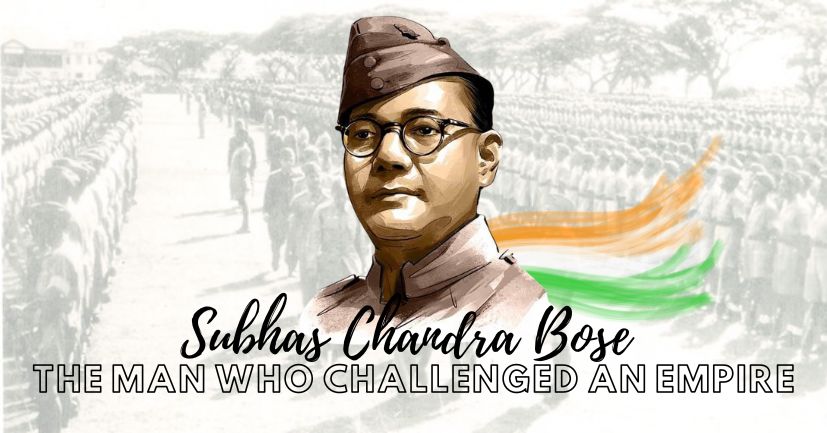
On the 23rd of January, 1897,
In the ancient city of Cuttack, where the winds of Odisha carry both prayer and rebellion, a child was born who would one day unsettle an empire—
Subhas Chandra Bose.
His father, Janakinath Bose, a man of law and reason, dreamed of shaping his son through the finest English education. His mother, Prabhavati Devi, quietly did something greater—she anchored his soul in Sanatana Dharma,
in discipline, sacrifice, and an unshakeable sense of duty to the motherland.
Thus grew Subhas—a mind sharpened by the West, a heart bound forever to India.
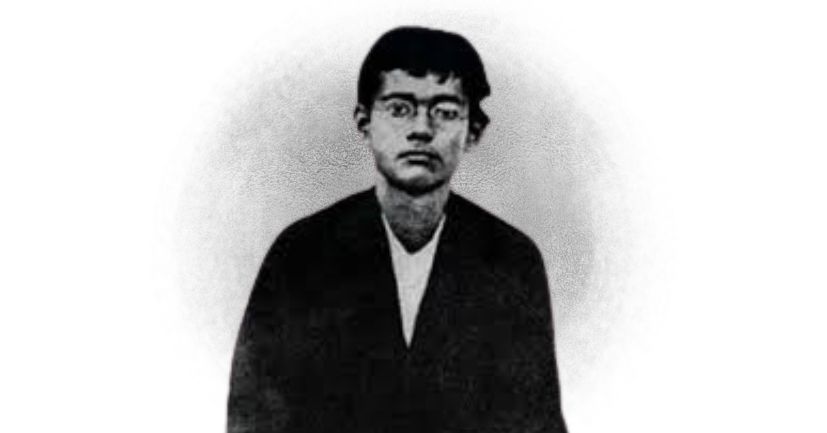
At Presidency College, Calcutta, the fire within him found its voice. When British professors mocked Indian students with racial contempt,
Subhas did not bow, did not retreat. He rose—again and again—challenging insult with defiance, humiliation with dignity. Authority frowned, files were opened, warnings were issued—but the young lion would not be caged.
To fulfil his father’s wish, he crossed the seas to England, to sit for the Indian Civil Services—the steel frame of the Empire. He passed the first hurdle with ease. But by then, destiny had already whispered his true calling.
Through Deshbandhu Chittaranjan Das, the pulse of India’s freedom struggle thundered in his veins.
And so—at just twenty-four—he turned his back on power, prestige, and comfort, and returned to India in June 1921, choosing chains with his people over crowns from his rulers. He entered the Indian National Congress like a storm. When he met Mahatma Gandhi, the Mahatma admired the fire—but Subhas questioned the path. Could non-violence alone shatter an empire built on bayonets? Could softness defeat steel?
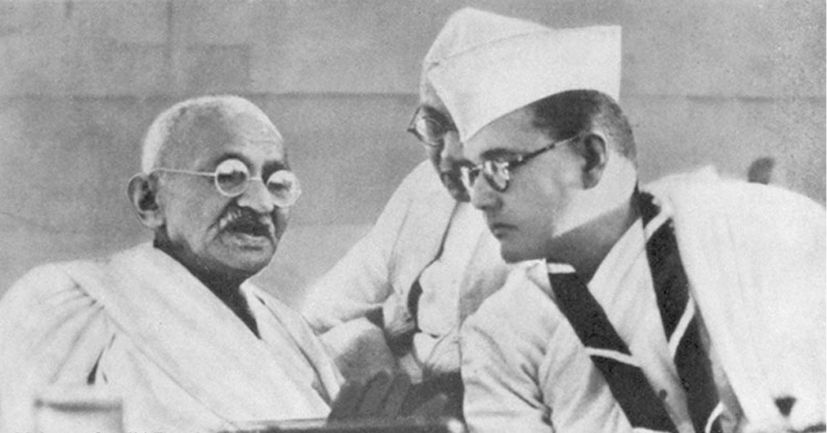
Gandhi’s patience troubled him. British civility unsettled him. And so Subhas spoke—boldly, openly—
through his newspaper Swaraj. As President of the Youth Congress, his words ignited crowds,
his voice carried a new salute into history—“Jai Hind.” The British responded as empires do—with prisons.
Burma swallowed him into its jails. Two years later, the disease gnawed at his body, but could not touch his will. Released, weakened—yet unbroken—he returned stronger in resolve.
In 1927, he became General Secretary of the Congress. Once more he demanded complete independence and dared to say aloud what others feared to whisper—if freedom demands force, force must answer.
This was too much—for the British, and for the cautious within his own ranks.
Subhas went further. He formed a volunteer army, trained them like soldiers,
and dressed them in uniform. In letters to the British,
he signed without irony or fear: General Officer Commanding — GOC.
Then came September 1939. War engulfed the world. Without India’s consent, Viceroy Linlithgow hurled Indian soldiers into distant battlefields. India erupted in protest. Leaders were arrested. Prisons filled once more.
Subhas too was seized. As illness returned, the British locked him inside his own home—house arrest in Calcutta. While Congress leaders languished behind bars, history shifted its weight.
Muhammad Ali Jinnah and the Muslim League seized the moment. The cry for partition grew louder. Confined, watched, weakened—yet Subhas planned the unthinkable. If Britain ruled by war, Britain would be answered by war. He would seek aid from Britain’s enemies—Germany, Russia, and Japan. Silently, a circle of trusted allies formed. Subhas vanished from public life.
He grew a beard, changed his face, and became a Pathan in disguise. One winter night, he slipped past British guards and disappeared into legend.
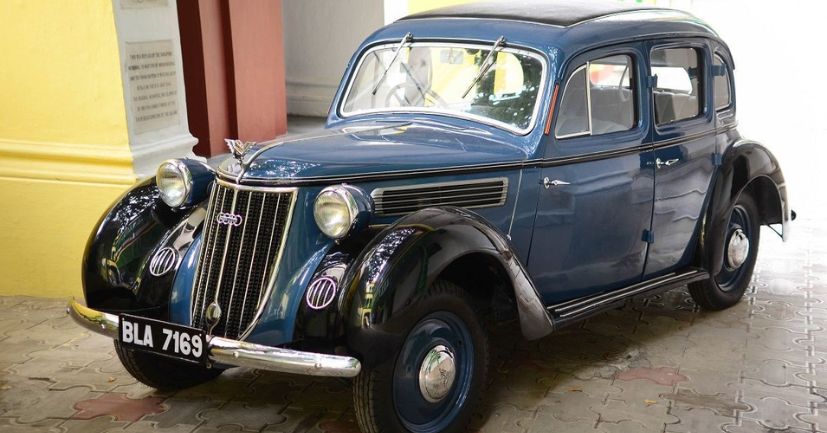
Through Afghanistan, through Moscow, he reached Germany. There, he stood before Hitler himself, not as a supplicant, but as the representative of a future India. From German radio waves, his voice thundered across continents, calling Indian youth to arms. London was shaken. Netaji had escaped—and now spoke from the heart of enemy territory. He freed 3,500 Indian soldiers captured in Africa and forged them into a fighting force.
Across Burma, Thailand, Singapore, Indian prisoners and expatriates rose together as the Indian National Army. In Japan, Rash Behari Bose had already laid the foundation. Together, they struck the British in Singapore and Burma—and won. To lead the eastern front himself, Subhas undertook a journey almost mythic—a German submarine to Madagascar, then a Japanese submarine to Singapore. There, he gave a call that would echo through time:
“Give me blood, and I will give you freedom.”
Women marched beside men. The Rani of Jhansi Regiment was born. From radios, forests, plantations, and ports, young Indians answered.
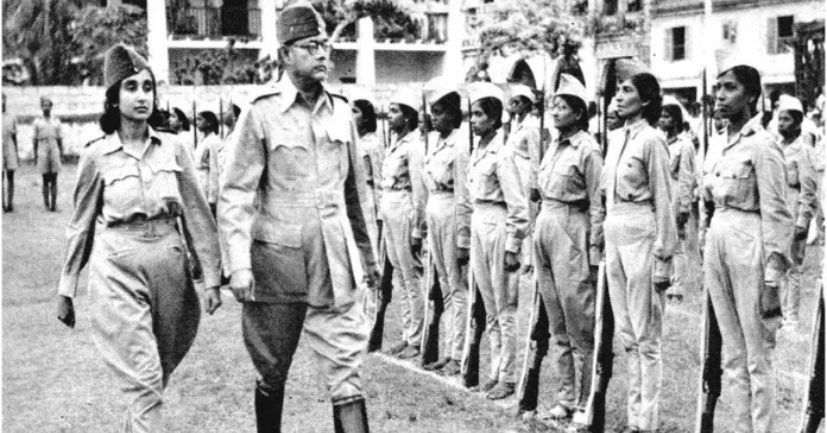
On 21 October 1943, the Provisional Government of Azad Hind rose in Singapore. Subhas Chandra Bose took the oath as Prime Minister, leading an eleven-member cabinet. Nine nations recognised this new India—free in spirit, fighting in flesh. The Andaman and Nicobar Islands were handed over.
They were renamed—Shaheed and Swaraj. In 1944, INA and Japanese forces marched into Manipur and Nagaland. Twenty thousand Azad Hind soldiers advanced. They fought fiercely—but Kohima and Imphal became crucibles of death. Hunger, disease, and exhaustion broke ranks.
The tide turned. Rangoon fell. Retreat followed. Captured INA soldiers were tortured—the British were desperate to find Netaji. They feared him. Because he was everywhere and nowhere. Russia today. Germany yesterday. Singapore last week. Andamans tomorrow. What would he do next?
The Empire never knew.
And in that uncertainty—Netaji Subhas Chandra Bose remained an iron enigma, a storm the British Empire could never contain.
 Wing Commander BS Sudarshan is a former Indian Air Force pilot with over 12,000 flying hours. He participated in Operation Pawan and Operation Cactus before he transitioned to civil aviation. A passionate writer, he has authored six books, including "Hasiru Hampe", appreciated by S L Bhyrappa, and the latest "Evergreen Hampi". He is a regular contributor to the Verandah Club.
PREVIOUS ARTICLE
NEXT ARTICLE

Shri Ramachandra Prasad's captivating narrative and the hot chai that was served at the right time transported me to ancient Kerala, where the extraor...
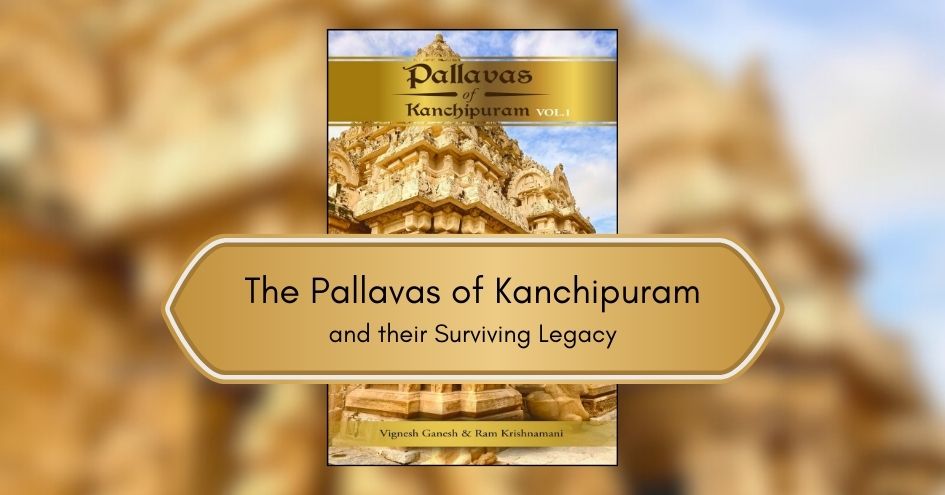
Introduction In Bharatvarsha, History is not the account narrated by victors. It is the record left behind by survivors. The study of Indian History...
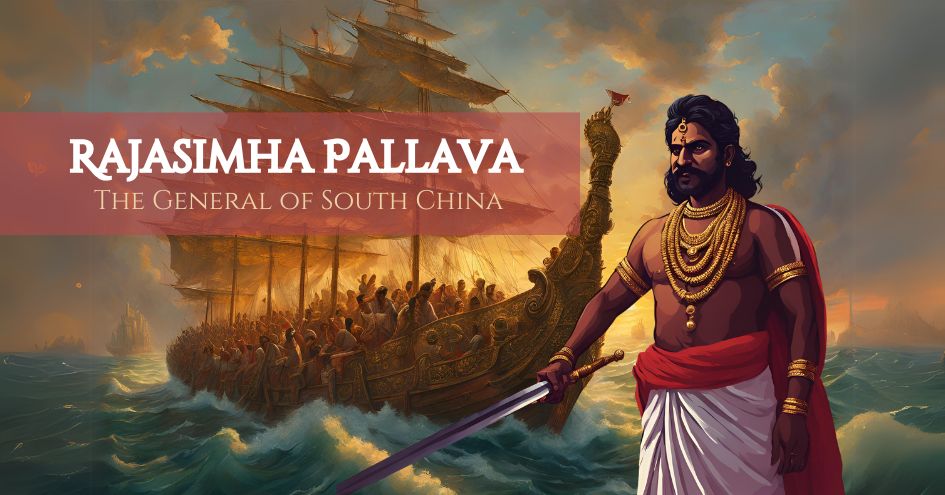
It is the first-half of the 8th Century C.E. in South India. The Pallava kingdom possesses strength and prosperity with some of the greatest monument...

Verandah Club is an initiative by few like-minds of Coimbatore who are interested to share information on various antiquities of Bharat.
Free download our iOS & Android app
© Copyright 2026, All Rights Reserved.