
विद्यां ददाति विनयं विनयाद् याति पात्रताम् ।
पात्रत्वात् धनमाप्नोति धनात् धर्मं ततः सुखम् ॥
- Vidya Dadati Vinayam (Hitopadesha)
Meaning:
Knowledge builds humility, humility creates worthiness, worthiness brings wealth, wealth enables dharma, and that righteousness leads to true happiness.
Recently, the Indian Education System has been rocked by several controversies with major examination paper leaks like the NEET-UG '24 paper leak, an illegal nexus between unregulated coaching institutes and "education mafias," systemic policy changes that are yet to be completely absorbed and implemented, phantom institutions distributing fake degrees, and admission and seat barriers to meritorious students... you get the idea. Profiting from education has displaced the pursuit of knowledge and the realization of the holistic development of the student. Today, education has become a narrow-minded race in a fiercely competitive atmosphere to achieve high marks and good grades to gain access to high-paying jobs that meet our materialistic needs, without addressing our spiritual deficiencies. With brokers and middlemen commercializing access to higher and premier education in nexus with unregulated coaching classes and profit-minded private institutions, meritorious students are helpless as privilege and wealth are used to grab seats and secure the futures of affluent and advantaged youth.
The Indian Educational System has long been a field of intellectual contradictions and spirited conundrums. It is precisely these contradictions that allowed it to endure and flourish as one of, if not the oldest, body of knowledge processes and practices in the world. The Indian traditional education system, long since believed to only peddle religion, was one of the most comprehensive and wholesome systems in the world, teaching Science, Mathematics, Linguistics, Logic, Ayurveda, Sculpture & Architecture, Yoga, and philosophy, among others. These subjects, unlike today's subjects, were not mutually exclusive, but deeply interconnected, which allowed for the all-around development of the mind and body of the pupil.
Critics constantly point out that the Guru-Shishya Parampara favored rote memorization, relying on heavy repetition to spread knowledge without encouraging creative and original thinking. What critics seem to forget is that India, i.e., Bharat, had a tradition of open and rigorous debating that allowed students to demonstrate not only what they had learnt, but what they had intellectually and emotionally digested and understood, and then apply that understanding to a debate against their opponents. This gave rise to numerous schools of thought in India, each having their own marga or path to the Ultimate Truth. Had the Indian traditional education system only encouraged students to memorize sutras, shlokas, mantras, and stotras, the system would have simply stagnated and died out eons ago instead of evolving into one of the richest and most diverse repositories of knowledge in the world.
In this article, I merely wish to explore how our ancient gurus pursued knowledge in search of higher truths in the Universe and structured their teachings according to a student's strengths and weaknesses, while ensuring that the shishyas appreciated this pursuit of knowledge and furthered the intellectual legacy of the guru. India today can take a leaf out of ancient Bharat's book to tackle the issues that afflict our modern education system by reorienting ourselves from our profit-oriented mindset to an inquisitiveness-oriented one.
Life and Nature as Gurus in ancient India
India's traditional education system has visibly deep roots going all the way to the Vedic Age in the 15th century B.C.E. with the oral Gurukul system—and I use the word "visibly" because we are yet to figure out the script of the Indus-Saraswati Civilization, which goes back at least 5,000 years!
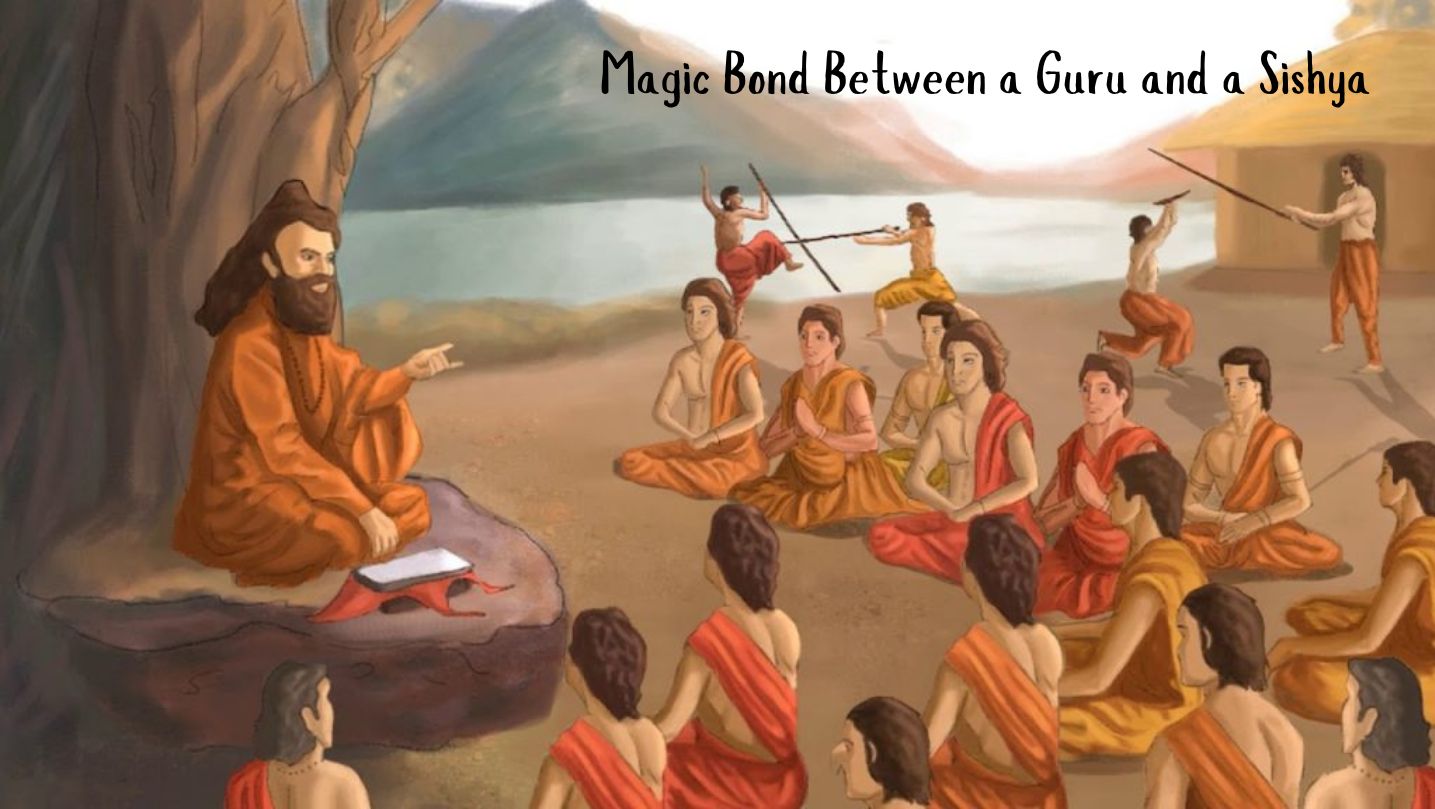
For long we believed that our knowledge traditions focused on pushing Hindu theology, but we could not be more mistaken. Knowledge in ancient India was largely about gleaning spiritual and worldly truths from observing nature and civilization. What we believe to be repetitive transmission of rote knowledge from Gurus to Shishyas is far more nuanced than that. A study of the Upanishads, especially the Chhandogya Upanishad, reveals that shishyas were made to sit in the midst of nature to observe it and glean the fundamental truths of life, for Mother Nature was the source of Vedic knowledge and wisdom. Author Sahana Singh, in her book Revisiting The Educational Heritage Of India, explains this aspect of Indian traditional education by penning the story of Satyakama Jabala, a Vedic student of Haridumata Gautama, who was sent to the forest with 400 cows and a quest to return only when those four hundred cows multiplied to 1,000. On this quest, he learnt the Ultimate Truth of Brahman from Nature by observing and understanding that Nature, the World, and the Universe were all a part of and in fact—Brahman.
Another story from the Vana Parva of the Mahabharata is recited by Sage Markandeya to the eldest Pandava Yuddhishthira about Sage Kausika, who, despite his dedicated learning of the Vedas, developed arrogance after gaining the power of burning a crane with an angry glance through his austerities. However, when he encountered a devoted homemaker who kept him waiting for alms while she was in the service of her husband, and he was angered by her behavior, she humbled him by displaying her yogic powers and correctly pointing out that she was not a mere bird to be incinerated by the newfound powers of his austerities. She pointed him in the direction of an enlightened meat vendor named Dharmavyadha. Dharmavyadha was no ascetic or sage like Kausika. Dharmavyadha, like the dutiful homemaker, had attained the knowledge of Brahman and Dharma in the course of practicing his Svadharma as a meat vendor, just as the homemaker had attained knowledge by carrying out her duties towards her household. Dharmavyadha taught Kausika the intricacies of Dharma and the open secrets of Brahman. He made Kausika, who had left his parents behind in his quest to attain the knowledge of Brahman, realize that anyone who practiced their Svadharma with pure consciousness and was of service to another wholeheartedly would attain the knowledge of Brahman, and that the Seva and Karma margas were better than empty asceticism.
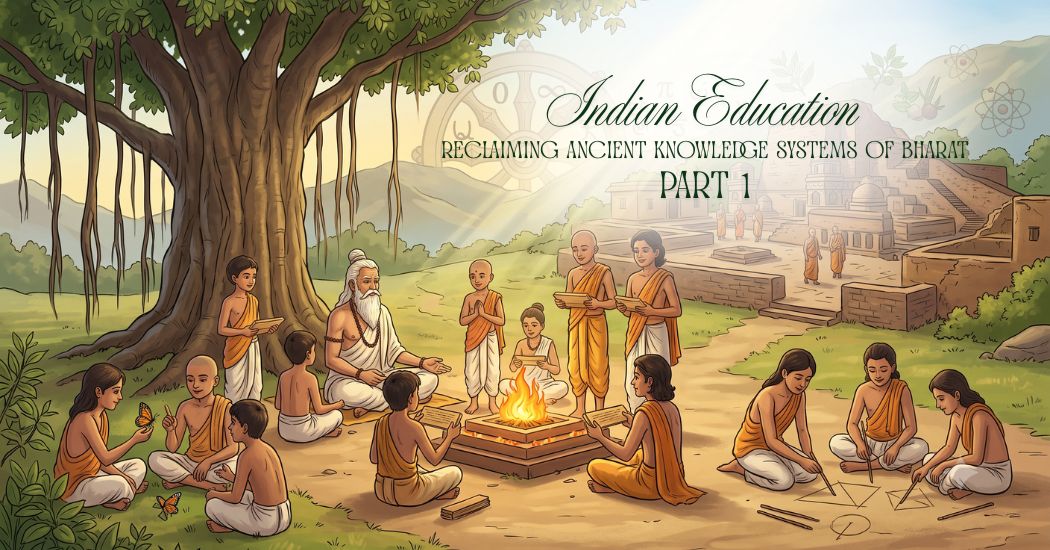
These two tales demonstrate that knowledge in ancient India was not restricted to the four walls known as schools, but treated Life, Nature, and Civilization as great Gurus which taught people the Ultimate Truth while they lived as students, householders, or sanyasis. While gurukuls and ashrams abounded in forests, villages, and cities—depending on who the guru was, for gurus could either be ascetics or householders—these systems remained holistic.
But you may raise doubts as to what these metaphysical teachings have to do with subjects like science, language, commerce, mathematics, medicine, social sciences, and the whole lot of academic fields that are distinctly seen as modern in nature.
Let me give you a glimpse of how these metaphysical teachings gave rise to advancements in science, mathematics and linguistics in ancient India.
The inter-relationship between Metaphysics and the Sciences, Linguistics and Mathematics of Ancient India
With the advent of Buddhism and Jainism in India (the ancient Sramana sects), a new exploration into the knowledge of life and the universe was undertaken. Buddhism under Shakyamuni Gautama Buddha propagated the doctrine of Anattā i.e., the Doctrine of Non-Self or that the whole of existence is impermanent and therefore we should not get attached to it, while being largely silent on the concept of Atma and Brahman. Jainism, on the other hand, propagated the Doctrine of Jiva, while rejecting the existence of Brahman. Both the Sramana sects placed strong emphasis on the Doctrine of Karma stating that moral responsibility lay entirely with the individual through the absolute natural law of cause and effect, rejecting that a universal force judged and granted people liberation or salvation from the cycle of births and deaths. There were subtle psychological differences and distinct philosophical approaches to this doctrine as to how Karma binds and affects a person’s mind, body and atma or jiva (depending on the Sramana belief system in question).
Now, how did these metaphysical teachings affect the sciences, mathematics and linguistics of ancient India?
This is how these metaphysical teachings led to some of the most profound breakthroughs in Indian science, mathematics and linguistics, transforming the world forever.
I. Mathematics and the Discovery of Zero
The conceptualization of numbers in India was deeply tied to the ontological concepts of existence and non-existence. The Buddhist doctrine of Anatta (non-self or emptiness) states that things lack an inherent, permanent essence and are therefore temporary. This philosophical thought process directly led to the creation of Sunya (void or emptiness), which became the mathematical concept of zero. Zero in India was not merely the absence of value; it was a potent structural placeholder that allowed for the positional decimal system. Aryabhata, the man who invented the concept of zero, studied in the city of Kusumapura in the 5th century C.E., which was earlier known as Pataliputra during Mauryan times. This city had a deep-rooted history with Buddhism, which may have inspired him in the conceptualization of zero. An academic successor of Aryabhata, Bhaskara I, was the first to use the symbol of a circle for the numerical zero in the 7th century C.E. that we use even today.
Further, the concept of Brahman as an infinite, unchanging, and all-pervading reality led to the early mathematical understanding of infinity (Ananta), which led mathematicians like Bhāskara II to recognize that dividing a number by zero creates an infinite value in the 12th century C.E., reflecting the metaphysical idea that adding to or subtracting from the ultimate reality does not alter its totality.
Additionally, Jain metaphysics posited an infinite universe filled with an infinite number of Jivas (living souls), and to classify these jivas, Jain mathematicians developed remarkably sophisticated theories on the concepts of infinity and set theory. They rejected the idea that all infinities are equal, classifying infinity into different types (e.g., infinite in one dimension, infinite in two dimensions, infinite everywhere), thereby anticipating modern transfinite mathematics by centuries before Western Civilization.
II. Linguistics and Grammar
In Hindu philosophy, particularly through grammarians like Bhartṛhari, language was believed to be divine. The concept of Bāg-Brahman (the absolute entity manifested as speech) led to the Theory of Sphota. This theory suggested that a sentence's whole meaning bursts into the mind of a listener instantly, rather than being a mere sum of its letters, mirroring how Brahman is a singular, indivisible reality behind diverse cosmic appearances. This would also explain why Indians have so many Ishtadevatas, Ishtadevis, Kuladevatas, and Kuldevis. The Bhakti towards these deities is a path towards the ultimate realization that these deities are all one and the same—the Ultimate Reality known as Para Brahman or Adi Parashakti, according to the Shakta traditions of India.
Further and conversely, Buddhist philosophy and linguistics aligned with Anatta, where they argued that words do not correspond to permanent, real essences. Hence, language was viewed as a functional construct (Apoha theory), where a word defines an object only by systematically excluding what it is not (e.g., a "cow" is defined as "not a horse, not a rock"). This led to highly analytical, nominalist traditions in Indian logic. Think of it loosely as Sherlock Holmes's deduction but for linguistics.
III. Philosophy and Formal Logic
The clashing of the above three metaphysical systems of Brahman, Anatta and Jiva created a fiercely competitive intellectual environment that led to the evolution of formal Indian logic (Nyāya and Pramāṇa-śāstra) where logicians established the strict rules of providing evidence known as Pramana to support their arguments, which in turn led to the evolution of their respective intellectual and metaphysical systems of study.
Scholars could not simply claim divine revelation as today's Babas do—they had to provide evidence and win public debates using perception, inference, and analogy. This forced Indian philosophy to disentangle itself from blind faith, turning logic into a secular, rigorous science used to test psychological, physical, and metaphysical hypotheses.
IV. Physics and Other Material Sciences
The Hindu school of Vaiśeṣika developed an indigenous atomic theory where it was theorized that atoms are guided by an unseen force (Adṛṣṭa) to fulfill cosmic order. Because everything ultimately emanates from or rests within Brahman, physical laws were viewed as unified and interconnected, leading to early systemic classifications of substances, qualities, and motions.
Additionally, since Jainism views the universe as crowded with Jivas trapped in matter, Jain physics developed a highly detailed atomic theory. Matter (Pudgala) was studied extensively because its interaction with the Jiva causes karma. Jains proposed that atoms have qualities of attraction and repulsion, combining to create the physical world based on their inherent "degrees of moistness or dryness."
Buddhist physics, governed by Anatta and Pratītyasamutpāda (dependent origination), viewed the physical world not as solid matter but as a series of rapidly flashing flashes of energy or moments (Kṣaṇavāda). Matter was seen as a process rather than a static substance, mirroring something of modern quantum field theory where it is postulated that particles are viewed as dynamic excitations rather than solid spherical structures.
These were some of the contributions to the Indian knowledge systems that Indian metaphysical thought inspired which led to some of the most groundbreaking works in science, mathematics and linguistics that this world has seen.
Some of the other contributions are as follows
I. Works like Panini's Ashtadhyayi (around the 4th century BCE) formalized Sanskrit linguistics and grammar, with the underlying motivation rooted in the Vedic concept of Brahman—the idea that the universe operates on an eternal, flawless, and interconnected network of laws all originating from the Ultimate Existence known as Brahman. To reflect this, he treated language not as a loose collection of words but as a rigid, generative machine.
In 1965, when computer scientist John Backus developed a formal notation to describe the syntax of programming languages, which was later refined by Peter Naur into Backus-Naur Form (BNF), linguists and computer scientists later on looked back at Panini's work, having realized he had invented this exact system over 2,000 years earlier, relevant to modern computer coding even today.
II. Standard Western logic has descended from Aristotle, relying heavily on a binary system where a statement is either True (1) or False (0). However, due to Jain philosophy asserting that the individual soul (Jiva) perceives a material universe of infinite, overlapping attributes (Anekantavada), Jains realized that a simple binary system could never capture reality perceived by the Jiva, and hence to solve this, they created Syadvada, a seven-conditioned logic system (Saptabhangi).
The 7 Logical States of Jainism:
1. Syād-asti: Perhaps it is.
2. Syād-nāsti: Perhaps it is not.
3. Syād-asti-nāsti: Perhaps it is and is not. (Like a quantum superposition).
4. Syād-avaktavyam: Perhaps it is inexpressible. (Like a state that cannot be measured).
5. Syād-asti-avaktavyam: Perhaps it is and is inexpressible.
6. Syād-nāsti-avaktavyam: Perhaps it is not and is inexpressible.
7. Syād-asti-nāsti-avaktavyam: Perhaps it is, is not, and is inexpressible.
(Can you imagine the sheer sophistication of such thought traced all the way back to Tirthankara Mahavira in the 6th century B.C.E.!)
III. Establishment of Global Residential Universities
Before the advent of Buddhist monastic centers, education in South Asia was predominantly structured around individual teacher-disciple relationships (Gurukulas).
However, Buddhism introduced the concept of organized, multi-disciplinary residential universities like Nalanda, Vikramashila, Taxila, and Somapura which housed tens of thousands of international students and faculty, with acclaimed travellers and scholars like Fa Hien, Xuan Tsuang, Yijing, Apollonius of Tyana (allegedly) visiting these acclaimed institutions. In fact, when Muslims encountered these monastic universities in the northwest of India and along the western arm of the Silk Route, they ironically carried the concept of these universities further west to Europe and that is how universities like Oxford and Cambridge were eventually established in Great Britain. It was all inspired by the Buddhist universities in the Indian subcontinent.
Open Debate Culture: Admission to Nalanda required passing rigorous oral entrance examinations administered by "gatekeepers" (Dvārapāla). These universities maintained massive libraries (like Nalanda’s Dharmaganja) containing works not only on Buddhist philosophy, but on the Vedas, medicine, astronomy, mathematics, and urban planning.
These are merely some of the contributions of India i.e., Bharat to the world, all in genuine pursuit of knowledge and in that pursuit, India ended up revolutionising the world and how the world viewed India as the intellectual centre of the world.
Conclusion: Reclaiming the Inquisitive Spirit
While researching for this write up, I understood a fundamental truth: that education, in ancient India was a guide to figure out human life and its relationship to the vast Universe. Nature as the ultimate Guru inspired our ancestors to establish a fluid system where metaphysical inquiry and scientific rigor were melded together as two sides of the same coin. This holistic exercise did not merely produce scholars — it encouraged students to pursue enlightenment and see the interconnectedness of and interplay among the elements of existence. Today, as we deal with the erosion of academic integrity and the blatant commercialization of learning and education, the move to reclaim our legitimate heritage is a necessity to clean up our educational system and secure the intellectual development and future of our children and youth.
To resolve the systemic crises afflicting our modern education, we must shift our focus from the transactional nature of pursuing degrees to the transformative pursuit of vidya. Shifting the paradigm from a profit-oriented race to an inquisitiveness-oriented approach will ensure that the next generation is not merely "job-ready," but "life-ready." By re-orienting the student’s innate curiosity and fostering an atmosphere of open and rigorous debate, we can revive the spirit of Bharat—a spirit that seeks the truth and, in doing so, paves the way for a truly happy and highly educated society. The evolution of our nation depends on our ability to look back at our ancient knowledge and wisdom systems and repurpose them to move forward and arm our National Education Policy.
 Vignesh Ganesh is a lawyer and writer. He is interested in ancient history and Itihasa and this interest culminated in his first book, "The Pallavas of Kanchipuram: Volume 1", which he co-authored with Mr. K. Ram, a fellow enthusiast of Indian history and culture.
PREVIOUS ARTICLE
NEXT ARTICLE


At the southernmost tip of this mesmerising ensemble lies the majestic Great Nicobar Island, boasting an impressive landmass of about 910 square kilom...
Bharath has always been a land traversed by spiritual masters/ Guru since time immemorial. These spiritual masters have always upheld the core princip...

South India contains its fair share of unique pilgrimage centres. These divine places of worship have a prominent Sthala Purana, devoted followers, di...

Verandah Club is an initiative by few like-minds of Coimbatore who are interested to share information on various antiquities of Bharat.
Free download our iOS & Android app
© Copyright 2026, All Rights Reserved.