

14, Sept 2026
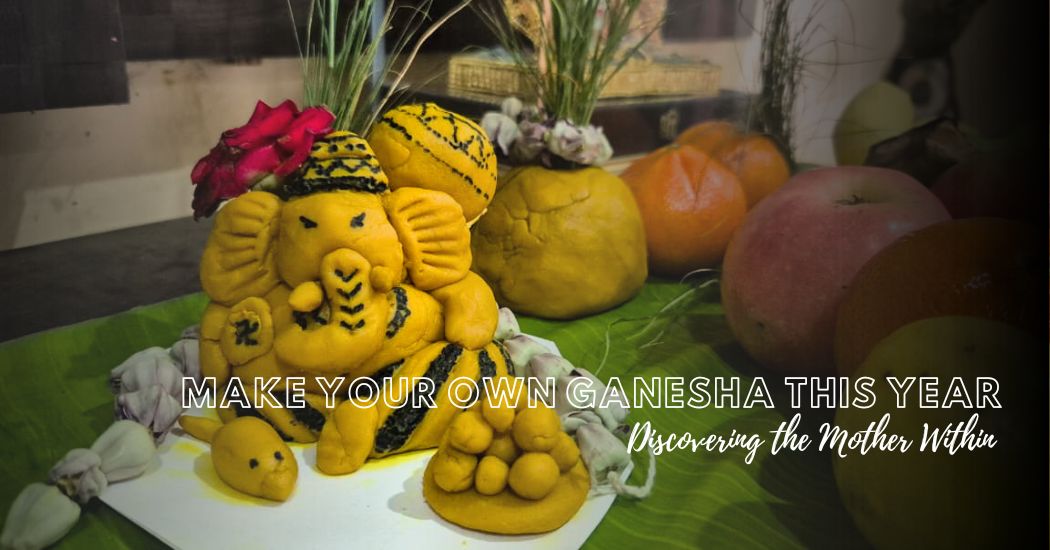
An ear is larger than the other. The trunk refuses to stay in place. The little belly has come out rather well, though you are not entirely sure how to make him sit.
You adjust him carefully. Support his head. Press the clay/turmeric gently around the trunk so that it does not fall again.
Somewhere in those few minutes, you have begun to care for him.
This Ganesh Chaturthi, I would like to suggest something simple. Like every year, buy a Ganesha from a local artisan. Support the hands that have spent weeks preparing for our celebration. Bring home the beautifully made idol that caught your eye.
And then, make a small Ganesha yourself too.
A handful of clay will do. Or a little turmeric mixed with just enough water to hold a simple form. He need not be large. He need not look like the one in the shop. Give him a place beside the idol you have bought.
Why should we do this?
Because making Ganesha might help us discover something we rarely think of looking for within ourselves: the mother.
We remember the story of Parvati creating Vinayaka. Many of us grew up hearing it told with turmeric or clay. The Shiva Purana describes her forming him from material taken from her own body, then clothing him, embracing him and calling him her son. The telling varies, but that image of the Divine Mother lovingly making a child remains deeply personal.
We usually hurry through this part. We are waiting for Shiva to arrive, for the confrontation, for the elephant’s head and the Ganesha we recognise.
But stay with Parvati for a moment.
Stay with the act of making. With the affection that follows. With the extraordinary intimacy of looking at a form you have shaped and feeling that it belongs with you.
What would happen if we entered the festival through that feeling?
Motherhood has a bodily reality, with experiences and demands that an afternoon of clay modelling cannot reproduce. Yet the capacity to nurture reaches beyond those who have given birth. A man can be tender. A child can be protective. Someone who has never been a parent can care patiently for something entrusted to them.
It is this motherliness that I am speaking of: the willingness to give attention, to handle gently, to make room for another.
Our little Ganesha offers a place to practise it.
When his trunk slips, we hold it. When his body leans, we support it. We begin to accommodate his imperfections. That uneven ear, which would have seemed a flaw in the shop, becomes rather endearing at home.
We know how it happened. Our fingers were there.
Where Labor Leads to Love
Psychology offers an interesting parallel. It talks about the “IKEA effect”: people can place greater value on things they have helped to make. In experiments involving assembled boxes, origami and other constructions, successfully completing the task mattered to that increased valuation. Even amateur creations could become surprisingly precious to their makers.
The experiments were about ordinary objects. Applying the idea to a handmade Ganesha is a reflection, rather than a finding from that research. Still, the connection is easy to recognise. Our effort gives us a personal history with what we have made.
That history begins before the first flower is offered.
You remember adding too much water. You remember starting the head again. Perhaps someone beside you laughed, then helped you fix it. By the time Ganesha reaches the puja shelf, your time with him has already begun.
There is another reason to sit down with that handful of clay.
Try shaping a small trunk while thinking about ten different things. Sooner or later, the clay asks you to return. It needs a lighter touch here, a little support there. Your attention has somewhere definite to rest.
Meditation to Mahabala
We often approach meditation with the instruction to sit still, then discover how restless we are. Making something offers a way to begin with movement. The hands work, the eyes follow, and each small adjustment invites us back to what is happening now.
In that sense, the activity can become meditative. We can return to the feel of the clay as we might return to the breath.
There is some modest scientific support for the calming possibilities of art. In a small 2016 study, Girija Kaimal and colleagues measured salivary cortisol before and after 45 minutes of art making in 39 adults. Levels fell in about three-quarters of the participants. The study had no control group, so it cannot establish that art alone caused the change, or promise the same experience for everyone. It does, however, offer a reason to take the quiet pleasure of making seriously. Kaimal, Ray and Muniz, Reduction of Cortisol Levels and Participants’ Responses Following Art Making
A family celebration
For our festival, the possibility is beautifully simple. We can spend a little time attending to one thing with care.
Put the phone aside. Let the clay occupy your hands. If a prayer comes naturally, say it. If silence feels right, allow it. Let the making have its own pace.
And if children join you, allow their Ganeshas to look like their Ganeshas. Resist correcting every ear and smoothing every mark. There is something touching about a child explaining why Ganesha needs such a large stomach, while an adult nearby struggles to attach a second arm.
A family can spend that time laughing, helping and telling the story of Parvati. The festival becomes something they have participated in together.
This is where the spiritual invitation deepens.
Much of our prayer begins with a need. Remove this obstacle. Protect my family. Help this work succeed. These are honest prayers; there is nothing strange about taking our worries to Ganesha.
But while making him, another feeling may appear. For a little while, we are occupied with what we can give: our attention, our patience, the care of our hands.
We look at the One we ask to protect us, and find ourselves protecting his little clay trunk.
There is a lovely tenderness in that reversal.
The Divine becomes close enough to care for. We can approach him with the affection of a parent, allowing reverence and intimacy to sit together. Parvati’s story becomes something we contemplate through a small action of our own.
For me, that makes creating a Ganesha one of the most personal ways of entering the festival. The hands have taken part. The mind has lingered. The heart has found a relationship. It is something I am doing for last 4 years and it brings me immense joy. I have shared the image of my Ganesha for this year.
So this Ganesh Chaturthi, honour the artisan and bring home their work. Then sit down with a little clay or turmeric and make a Ganesha of your own.
Let the ears be uneven. Help the trunk stay in place. Give him the time he needs.
And before you ask him for anything, notice the affection with which you lift him.
Perhaps Parvati’s story will feel a little closer then.
One final tip : Add a little maida to turmeric to avoid cracks, avoid artifical colors as much as possible.
 Vigneshvaran, Senior Correspondent of TheVerandahClub.com is a second generational acupuncture practitioner, a story teller, as well as an avid independent writer driven by his passion. His literary talents extend to crafting beautiful poems and captivating short stories including the Sehwag Tales series. In addition to these creative pursuits, he has also authored a book titled "Halahala," which can be found on Wattpad.


Ashadhi Ekadashi, also known as Shayani Ekadashi, falls on the 11th lunar day (Ekadashi) of the bright fortnight (Shukla Paksha) of the Hindu month of...
Every year, as the monsoon rains dance on the fields of India, an ancient story unfolds in the hearts of millions. It is the story of Krishna, the bel...
Ganesh Chaturthi, also known as Vinayaka Chaturthi, is a significant Hindu festival that honors Lord Ganesha, the deity revered as the remover of obst...

Verandah Club is an initiative by few like-minds of Coimbatore who are interested to share information on various antiquities of Bharat.
Free download our iOS & Android app
© Copyright 2026, All Rights Reserved.