
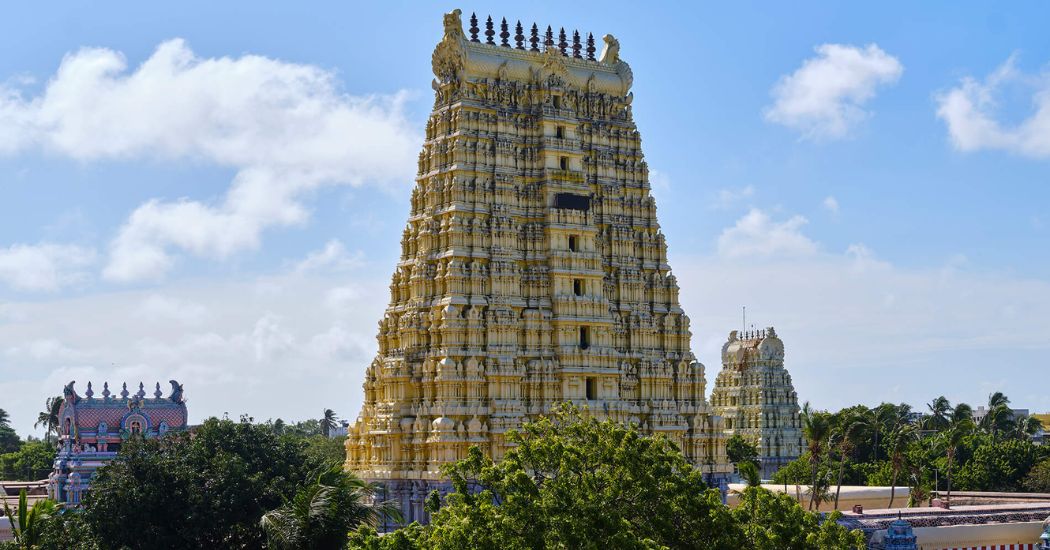
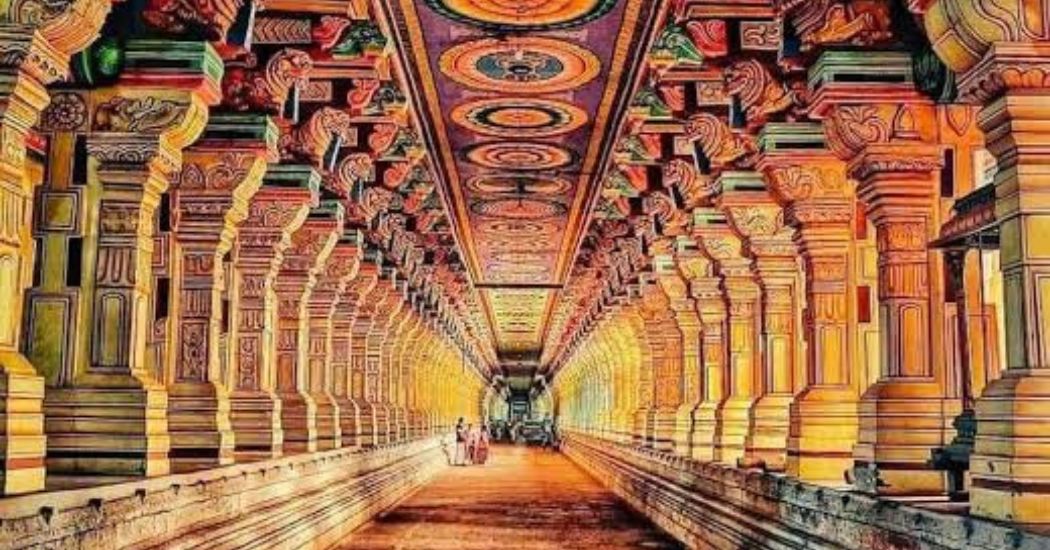
Visitors describe a particular kind of vertigo when they first step into the Third Corridor of the Ramanathaswamy Temple. Row after row of granite pillars stretch away in perfect alignment until the human eye gives up trying to count them, and the corridor seems to fold into a single vanishing point somewhere beyond comprehension. What makes this moment strange, once you know the history, is that none of the stone forming that endless perspective belongs to the island it stands on. Every pillar, every lintel, every carved yali was born somewhere else, on the mainland, and had to be persuaded — block by impossible block — to cross the sea.
A Shrine Built on Repentance
The story begins not with architecture but with myth. The Ramayana tells that Rama, having defeated Ravana in Lanka, returned to Indian soil carrying the weight of having killed a Brahmin, however justified the war. To atone, he sought to worship Shiva at Rameswaram, and the ritual demanded precision of timing that could not wait. Sita is said to have shaped a lingam from the sand itself — the Ramalingam — while Hanuman raced to Mount Kailash to bring back a second, the Vishwalingam. Both remain enshrined at the temple's heart today, a quiet reminder that the entire vast complex grew outward from an act of urgent devotion rather than a grand architectural plan.
Centuries of Accretion
What exists today did not arrive at once. It grew the way coral reefs grow — slowly, through the additions of successive builders, each layering their own ambitions onto what came before. The Chola dynasty raised the first stone sanctum in the 12th century, with help from King Parakramabahu I across the strait in Polonnaruwa. Two centuries later, the Pandya rulers and then the Vijayanagara Empire pushed the temple outward, adding enclosures and pillared halls.
The Vijayanagara contribution deserves particular attention, because it set the stage for everything that followed. After Kumara Kampana's campaigns broke the Madurai Sultanate's hold on the Tamil country, his wife, Empress Gangadevi, worked to restore temple worship and secure the pilgrimage routes leading south. Decades later, Krishnadevaraya — arguably the most celebrated of all Vijayanagara emperors — made his own pilgrimage to Rameswaram in 1513, and did not arrive empty-handed. Land grants, gold, and jewels followed his visit, funding expansions to the temple's inner mandapams.
It was during this Vijayanagara-Nayaka period that the temple acquired much of its sculptural vocabulary: the towering monolithic Nandi, carved whole from a single block of dark granite; the Sukrawara Mandapam with its Friday procession pillars; and the astonishing "music pillars," clustered sub-shafts carved from one stone that ring with different tones when struck. The Nayakas, ruling as Vijayanagara viceroys, also made a decision whose consequences would dwarf everything they built themselves — they formally appointed the Sethupathi chieftains of Ramnad as hereditary guardians of the temple and of the Setu, the mythical bridge to Lanka.
The Guardians of the Bridge
The Sethupathis took their title literally. "Guardian of the Bridge" was not ceremonial language — it was a job description, and for nearly two centuries they treated the Ramanathaswamy Temple as both a sacred trust and a dynastic legacy project. Sadaikka Thevar II began serious structural renovation in the mid-1600s. Raghunatha Sethupathi, known as Kilavan Sethupathi, went further: he broke Ramnad free from Madurai's authority entirely, turning it into a sovereign kingdom, and used its independence and revenues to complete the temple's Second Corridor.
But it was Muthuramalinga Sethupathi, in the closing decades of the 18th century, who attempted something on an entirely different scale — the Third Corridor, the one visitors now find themselves lost inside.
Building the Impossible on an Island of Sand
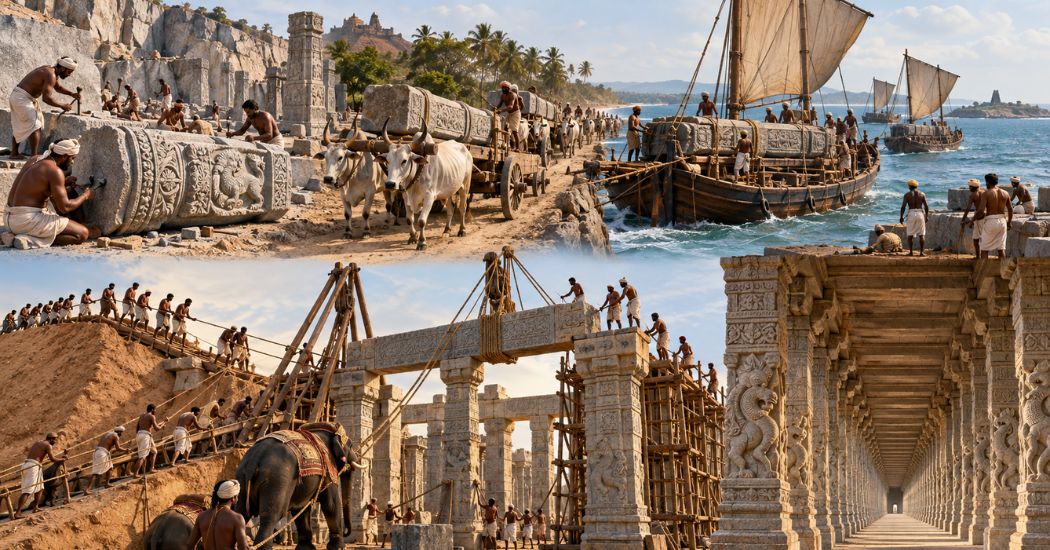
Here the story stops being about kings and becomes a story about logistics. Rameswaram is a coral sand island. It has no quarries, no bedrock, nothing resembling the dark granite that the project demanded. Every one of the 1,212 pillars — each nearly seven meters tall, each individually carved with floral motifs and mythical yali creatures — had to be sourced from quarries around Ambasamudram in Tirunelveli and near Tiruchirappalli, forty to sixty kilometres from the coast.
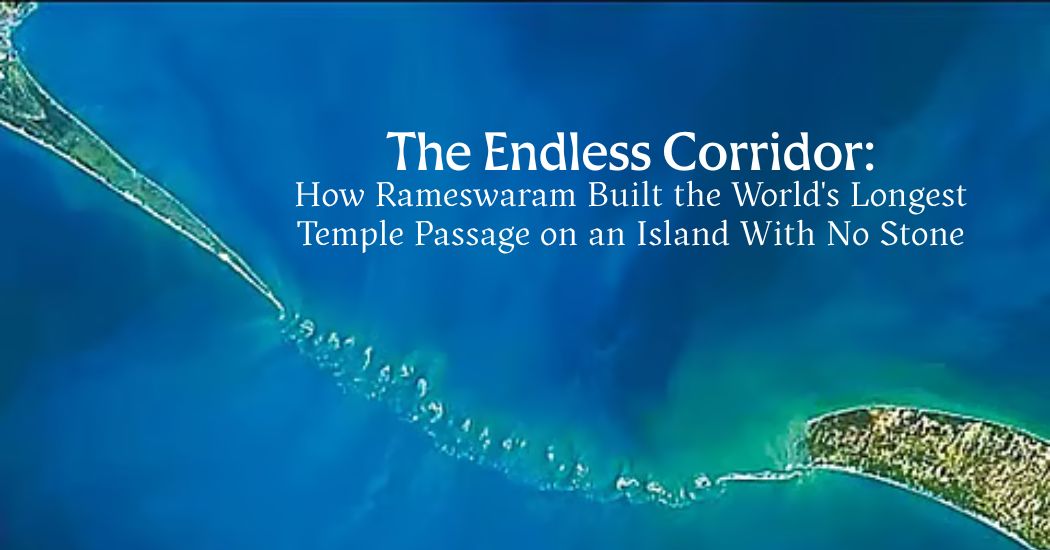
The solution was a supply chain that stretched across land and open water. Stonemasons did as much carving as possible at the quarries themselves, shaping columns, brackets, and the massive lintel beams before transport, if only to shave away every unnecessary kilogram. From there, bullock carts and wooden rollers dragged the finished stones to coastal ports. Since the Pamban Bridge would not exist for another century, the Sethupathis had to commission entire fleets of cargo boats and barges simply to ferry granite across the notoriously difficult currents of the Pamban Channel — a strait that has swallowed far lighter cargo than dressed stone columns.
Once on the island, the real engineering challenge began: how do you lift a stone lintel forty feet long onto pillars already standing more than twenty-two feet tall, using no cranes, no engines, nothing but human ingenuity? The answer was earthen ramps built up alongside the rising structure, wooden pulley systems, and the muscle of trained elephants, all working in coordination to inch the ceiling slabs into place. The pillars themselves were locked together using mortarless tongue-and-groove joints, an interlocking technique that relies entirely on the precise distribution of dead weight rather than any adhesive — a method that has kept the corridor standing for well over two centuries.
The final result, completed and finalised around 1795, forms a rectangular loop roughly 690 feet by 435 feet, containing 1,212 pillars arranged in a grid so mathematically exact that it produces the famous illusion of infinite recession. At approximately 1.17 kilometres in total length, it remains, to this day, the longest temple corridor in the world.
Stone Memory
The Sethupathis did not build anonymously. On the western side of the Third Corridor, statues of the Sethupathi kings and their ministers — figures like Muthuirullappa Pillai — stand carved directly into the architecture, a permanent roll call of the dynasty responsible. Even after the British Raj absorbed Ramnad as a zamindari estate and stripped the Sethupathis of sovereign power, the family retained their original role: hereditary trustees of the temple they had spent generations building.
What makes the Third Corridor remarkable, in the end, isn't only its scale or its symmetry. It's the sheer stubbornness embedded in every pillar — the decision, made and remade across generations, to solve an engineering problem that modern logistics would find nontrivial, using bullock carts, wooden barges, and elephants, on an island that offered its builders nothing to work with except the will to bring the mainland to the sea.
 Wing Commander BS Sudarshan is a former Indian Air Force pilot with over 12,000 flying hours. He participated in Operation Pawan and Operation Cactus before he transitioned to civil aviation. A passionate writer, he has authored six books, including "Hasiru Hampe", appreciated by S L Bhyrappa, and the latest "Evergreen Hampi". He is a regular contributor to the Verandah Club.



Shri Ramachandra Prasad's captivating narrative and the hot chai that was served at the right time transported me to ancient Kerala, where the extraor...

The Venkateshwara Swami Temple in Tirupati is among the holiest places in the world for Hindus. Millions of people throng the temple every year to get...

It is a sad reality that our Itihasa and Puranas have been subject to severe distortion over the years. This is not surprising considering how even th...

Verandah Club is an initiative by few like-minds of Coimbatore who are interested to share information on various antiquities of Bharat.
Free download our iOS & Android app
© Copyright 2026, All Rights Reserved.