
Rāmāyanā, the story of Shri Rāma, was composed during the lifetime of Shri Rāma by his contemporary, Rishi Vālmīki who is referred to as ‘Ādi Kavi’ – the first poet. Rāmāyanā is referred to as ‘Ādi Kāvya’ (the first poem). This mammoth work of Rishi Vālmīki containing 24000 verses narrates the biography and life of Shri Rāma and so it is referred to as Itihāsa (as it happened).
Did Vālmīki know Shri Rāma’s story? What was the trigger for him to write the Rāmāyanā? These are the questions which arise in some of our minds. Let us see how it happened.
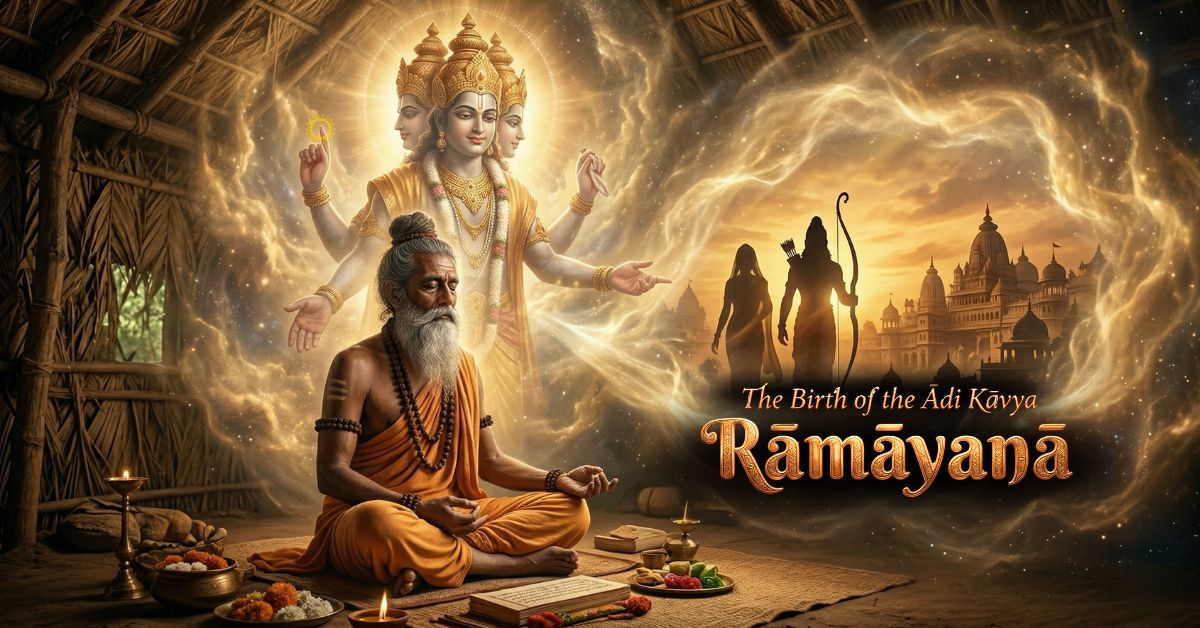
Vālmīki was living with his pupils at his Ashram near the River Tamasā, a tributary of River Ganga, which flows through the states of Madhya Pradesh and Uttar Pradesh. One day Rishi Nārāda happened to visit this Ashram. There he observed that Vālmīki was absorbed in deep thought. Nārāda asked him what he was thinking about.
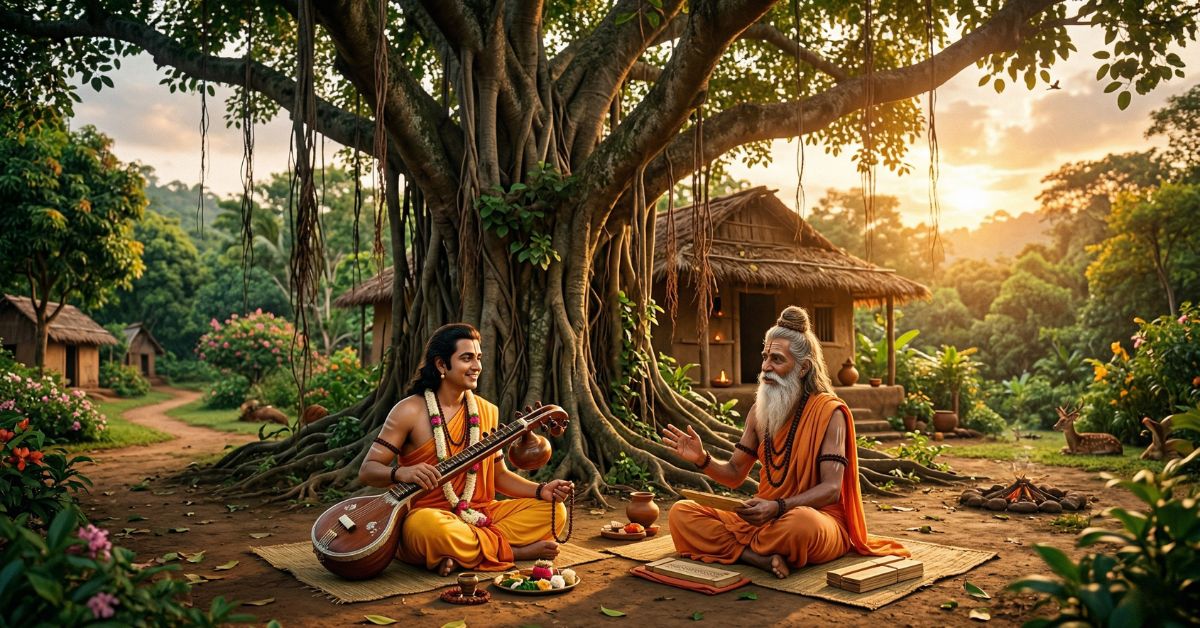
Vālmīki replied, “O Maharishi, I am very eager to know something. Is there a person in the contemporary world who possesses virtuousness, bravery, righteousness and gratitude, and is truthful and principled? One who possesses blemish-less character, concern for all living beings, who is scholarly, competent and whose appearance is delightful to the eyes? One who has control over his own self and has won over anger, exudes radiance, always free from envy and spite and whose wrath is dreaded even by the divine beings?”
Vālmīki paused for a moment and continued. “Is it even possible for a single individual to possess all these qualities I have listed? This is the curious thought which has been in my mind for many days now. You, being a visitor to all three worlds, are capable of knowing if such a person exists”.
Nārāda was thrilled by this question of Vālmīki for he knew of such a hero having all these qualities and more.
“Sure, I know of such a man who possesses all the qualities you mentioned and more” he said with a smile. “He is none other than King Rāma of the Ikshvaku clan, who rules from Ayodhya”. He then proceeded to describe Rāma’s exceptional qualities to Vālmīki.
Vālmīki was greatly enthused at this reply of Nārāda. Nārāda then gave a brief summary of Rāma’s story much to the delight of Vālmīki. He narrated it all, right from Shri Rāma’s birth, his wedding to Sita, his exile in the forest, Sita’s abduction, his friendship with Vanaras, his going to Lanka and killing Ravana until his coronation at Ayodhya as the King.
Nārāda then took leave of Vālmīki and went his way.
After Nārāda left, Vālmīki proceeded to the river Tamasa to offer his afternoon prayers, accompanied by his pupil named Bhāradwāja. He chose a beautiful spot where the water was as clear as glass. As Bhāradwāja made preparations for his Guru’s prayers, Vālmīki looked around, enjoying the surroundings blissfully.
The beautiful trees heavily laden with fruits and flowers, the thick canopy of their leaves, the streaks of sunlight illuminating the place through the leaves when they moved now and then, the grass spread like a jade carpet, the little white flowers in the plants around bobbing in the gentle breeze and the beautiful rippling sound of the Tamasā flowing interspersed with the soft chirping of birds, made the atmosphere so serene.
While the Rishi was adoring the abundance of Mother Earth, his inner mind had however, immersed itself in the story of Rāma as narrated by Nārāda.
Vālmīki then noticed a pair of Krauncha birds (a type of crane) on a branch of a tree - a male and female bird apparently deeply in love with each other. He watched them with amusement as they were playing with each other in the most charming manner. Suddenly, the male bird was hit by a sharp arrow which came flying from somewhere and the next moment, he fell dead. The sweet song of the female bird turned into a wail, traumatised as she was, seeing her mate fall dead. The ambience had completely changed in just a moment.
Vālmīki then saw a Nishāda (hunter) coming from behind a tree who had committed this heinous act. Though hunting is the profession of the hunter, to kill a living being when it is deeply in love was unpardonable. Vālmīki could not control his emotions and out came some words from his mouth cursing the hunter.
मा निषाद प्रतिष्ठां त्वमगमः शाश्वतीः समाः।
यत्क्रौञ्चमिथुनादेकमवधीः काममोहितम्॥
MA NishAda PratishthAm Tvamagamah ShashwatIh SamAh
YatkraunchamithunA dekamavadhIh KAmamOhitam ॥
Meaning: O Hunter! May you permanently have no peace of mind for you have mercilessly killed a crane when it was in love with its partner.
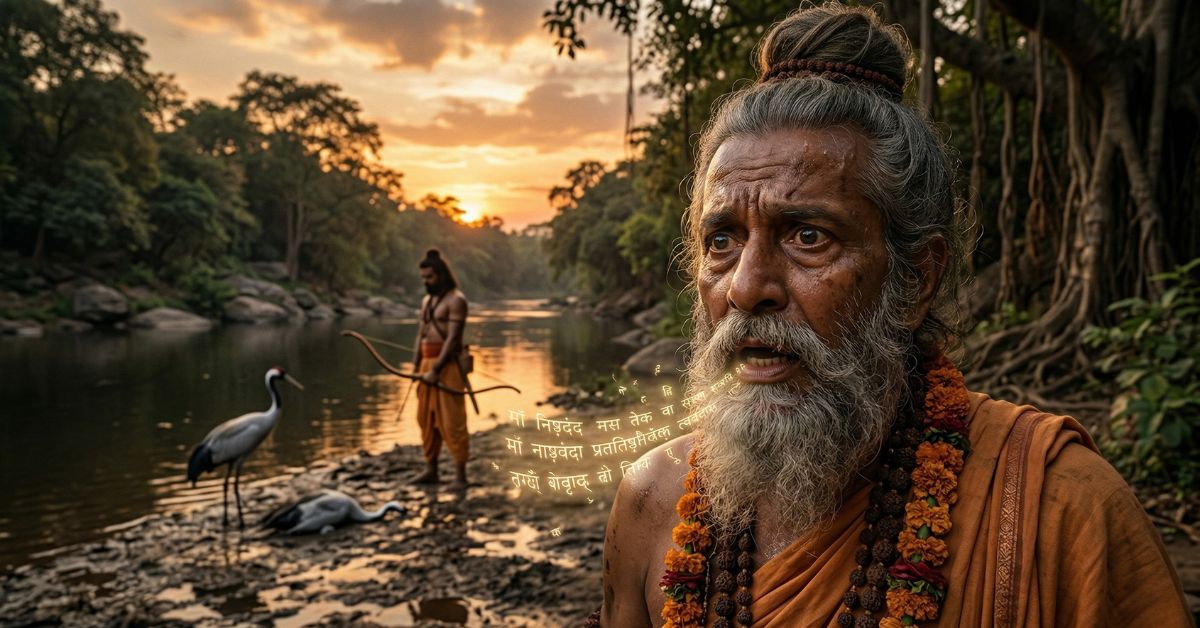
Vālmīki was himself surprised at his utterance and that too, that the words were arranged in a particular order of four verses with eight syllables each, like a rhyme. His disciple Bhāradwāja was also taken by surprise, for he had never heard such a beautiful arrangement of words. He immediately memorised the verse. But the Rishi was feeling uneasy that being a realised soul, he had still given into his emotions and unnecessarily cursed a person, thereby reducing the power of his penances.
Finishing their prayers, the Rishi with Bhāradwāja returned to the Ashram, but with the feeling of uneasiness, still persisting in Vālmīki’s mind.
In a while, Vālmīki was surprised to see Lord Brahma entering his Ashram. Feeling greatly honoured, he offered Him a suitable seat and offered his respects as per protocol. However, the incident of his cursing the hunter was on the top of his mind and he couldn’t stop muttering to himself in Brahma’s presence, of how he had lost control over his emotions and cursed someone.
Brahma smiled and said “It is my will that it had to be uttered by you. So do not dwell upon this anymore. Instead use the same metrical structure to narrate the entire story of Shri Rāma as you have heard from Nārāda. The entire story in detail, of what was spoken by all the characters and even their thoughts, including that of the Rakshasas will all be revealed to you by my grace. No description or words of yours in this work of yours will be false. So go ahead and render the beautiful story of Rāma”. Brahma then conferred on Vālmīki the yogic power to ‘see’ in his mind’s eye the entire story of Shri Rāma as it had happened.
He further said, “As long as mountains stand on the surface of the earth and rivers flow on the earth, this story of Rāma composed by you in beautiful verses shall continue to be popular and be sung.”
Vālmīki, with Brahma’s blessings, sat with a pure mind in deep meditation and sang the entire Rāmāyanā as he saw it happen.
True to Brahma’s words, even to this day, this beautiful narration of Vālmīki, of Rāma’s journey, which we know as the Rāmāyanā, continues to be evergreen and appeal to people of all ages, young and old. And certainly, it will continue to do so forever.
Replete with incidents of separations bringing sorrow and followed by reunions bringing joy the Rāmāyanā teaches us that this is what life is all about!
Jai Shri Rām!
 Vidhyaa K R is a storyteller based in Chennai. Trained by Kathalaya, Bengaluru, she specialises in stories from Indian culture and heritage. After a long stint in the corporate world, she now enjoys following her passion. She has a website www.storibuzz.in where she has narrated over 200 stories. She is also associated with Anaadi Foundation Palani in their IKS activities.
PREVIOUS ARTICLE
NEXT ARTICLE

In the lush, green heart of Kerala lived an elephant who became a living legend - a tale of an elephant turned into a bakth. His name was Keshavan, bu...

Bharat has exploded onto the world scene and made global news with its hard-hitting “Operation Sindoor” that struck at the heart of terrorism and laun...
In the bustling age of global trade, Boston—a thriving port city on America’s eastern coast—stood tall as a beacon of commerce. In the early 18th cent...

Verandah Club is an initiative by few like-minds of Coimbatore who are interested to share information on various antiquities of Bharat.
Free download our iOS & Android app
© Copyright 2026, All Rights Reserved.