
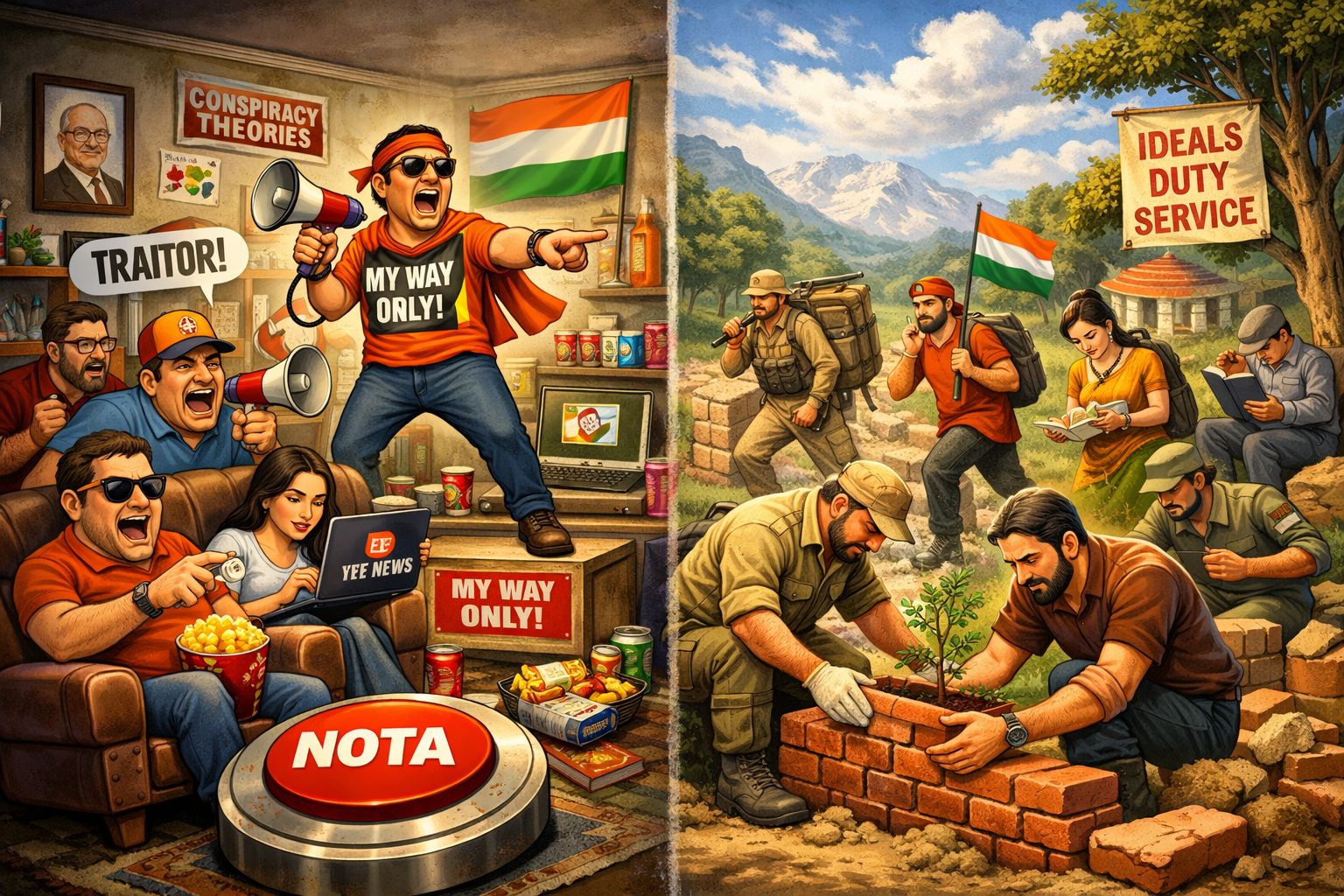
They were not born in the heat of struggle, nor in the dust of the street, nor in the long, patient grind of ideological work. They were born in lockdown.
When the world shut its doors and nations retreated indoors, a new tribe emerged from sofas, smartphones and self-certainty. They had Wi-Fi as their weapon, outrage as their fuel, and a dangerous surplus of half-digested information. They called themselves nationalists. But they were something else entirely.
They were the NOTA Nationalists.
Like the voting button they resembled, they stood for None of the Above—never fully with anyone, never loyal for long, never rooted enough to build, but always loud enough to disrupt. They mistook impulse for conviction, volume for clarity, and self-importance for ideological purity.
In every political season, they appeared suddenly, like seasonal warriors of convenience. One day they would declare total devotion to a national cause, the next they would turn on the very movement they claimed to defend because one local decision did not suit their ego. Their nationalism was not forged in discipline but in dopamine. It was not shaped by study, sacrifice or service, but by forwarding messages, recording angry videos and delivering verdicts from plastic chairs in air-conditioned rooms.
They often floated around parties like the BJP, drawn not by commitment to organisation, but by the glamour of proximity to power and the thrill of borrowed relevance. Yet they never understood the first principle of any serious movement: Ideology is larger than individual whim.
But the NOTA Nationalist believed only in one doctrine—my way or the highway.
If denied attention, they cried betrayal. If ignored, they screamed conspiracy. If corrected, they declared moral war. They crowned themselves custodians of nationalism without ever enduring the burden of nation-building. In their own imagination, they were the final guardians of ideology. In reality, they were tourists in a civilisation-sized struggle.
They did not build cadres. They did not strengthen institutions. They did not persuade society. They merely hovered over movements like self-appointed referees, blowing whistles from the sidelines, convinced the match could not proceed without their approval.
Their loyalty was short-lived because it was never loyalty at all. It was transaction dressed up as principle. They stayed only as long as the applause lasted. The moment discipline was demanded, or patience required, or collective interest placed above personal ego, they drifted into sulking, sabotage, or self-righteous monologues.
And yet, the tragedy was not that they were loud. Democracies always produce noise. The tragedy was that some mistook noise for nationalist passion.
Real nationalism is not impulsive. It is patient. It studies. It organises. It absorbs insult. It works without spotlight. It knows that parties, movements and nations cannot be run like social media comment sections. It understands that conviction without discipline is chaos, and ego masquerading as patriotism is only vanity wrapped in the flag.
So the story of the NOTA Nationalists is ultimately the story of a generation of political spectators mistaking themselves for statesmen. They wanted the prestige of being called ideological warriors, but not the humility of being foot soldiers. They wanted influence without accountability, prominence without perseverance, and authority without structure.
They are still around, of course—restless, reactive, perpetually dissatisfied. Forever announcing loyalty, forever threatening withdrawal, forever confusing disruption with courage.
But history is rarely written by the armchair.
It is written by those who stay the course when the applause fades.
 Author of Operation Phoenix: Bharat Protocol. Grandson, Husband and Father of Two, S Jaganathan - is the Founder of The Verandah Club. Convenor INTACH Coimbatore Chapter. He is an avid traveller, interested in trendspotting and a firm believer in the philosophy - Dharmo Rakshati Rakshitah.
PREVIOUS ARTICLE
NEXT ARTICLE

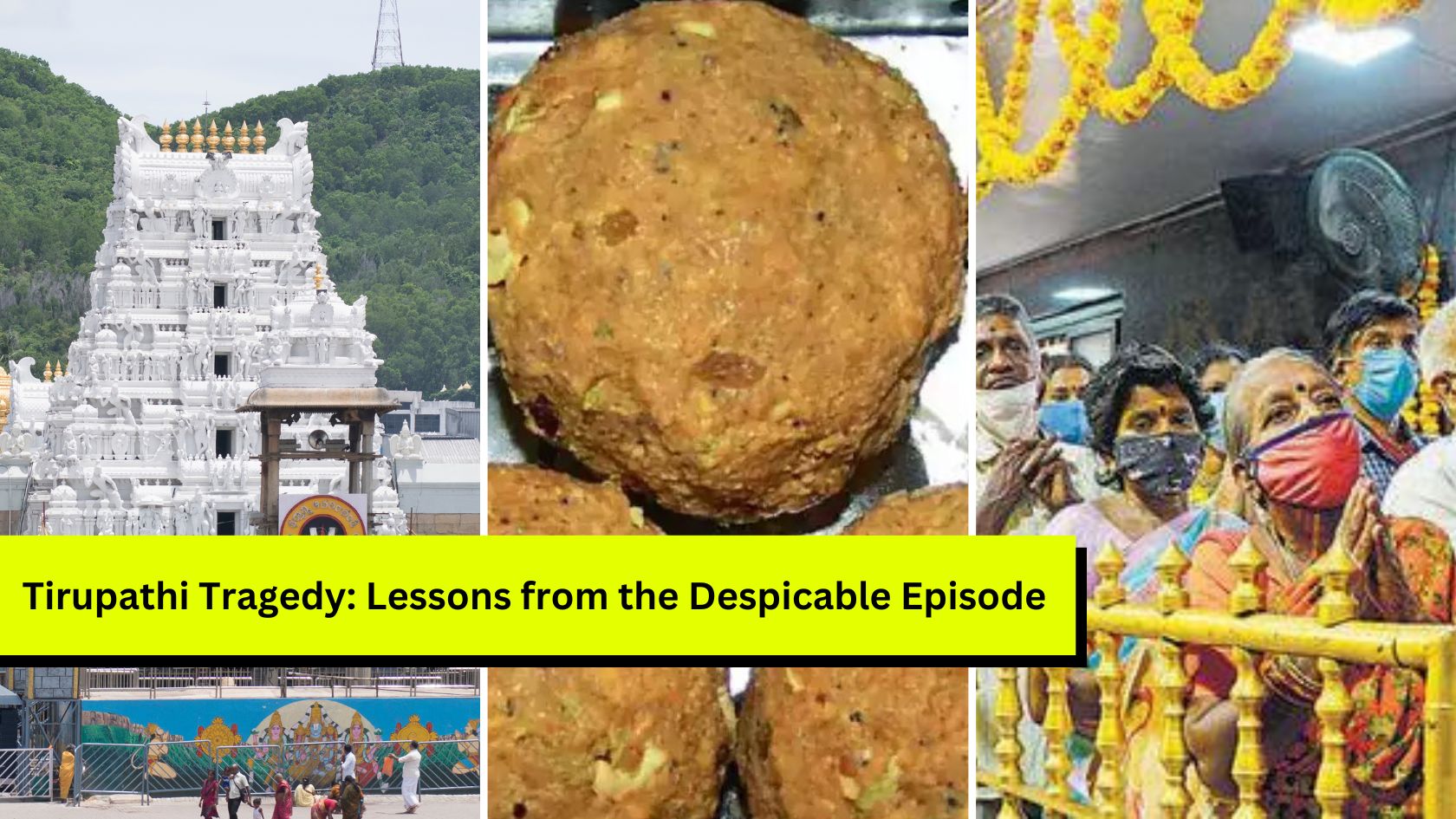
The Venkateshwara Swami Temple in Tirupati is among the holiest places in the world for Hindus. Millions of people throng the temple every year to get...
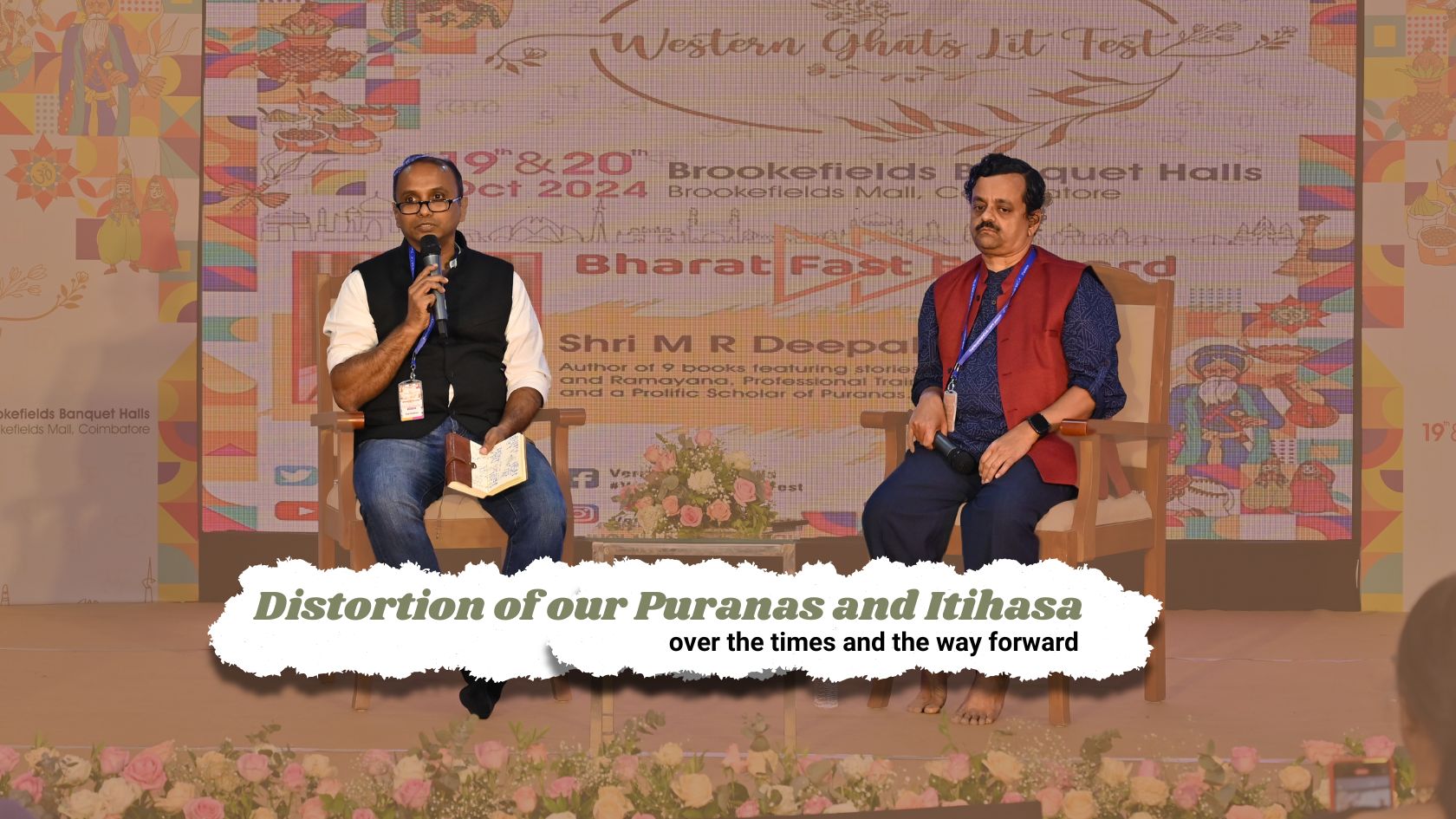
It is a sad reality that our Itihasa and Puranas have been subject to severe distortion over the years. This is not surprising considering how even th...
The holy land of Bharat follows Sanatana Dharma. The word Sanatana Dharma is a Sanskrit word meaning, “Eternal law”. It is the indestructible ultimate...

Verandah Club is an initiative by few like-minds of Coimbatore who are interested to share information on various antiquities of Bharat.
Free download our iOS & Android app
© Copyright 2026, All Rights Reserved.