
Before or after every Hindu festival, it has now become fashionable to circulate social media posts calculating how much money was “generated” because of the festival. Each time, I feel the urge to respond—to question the very premise of such claims—but I usually stop myself, assuming it is a passing fad that will soon fade.
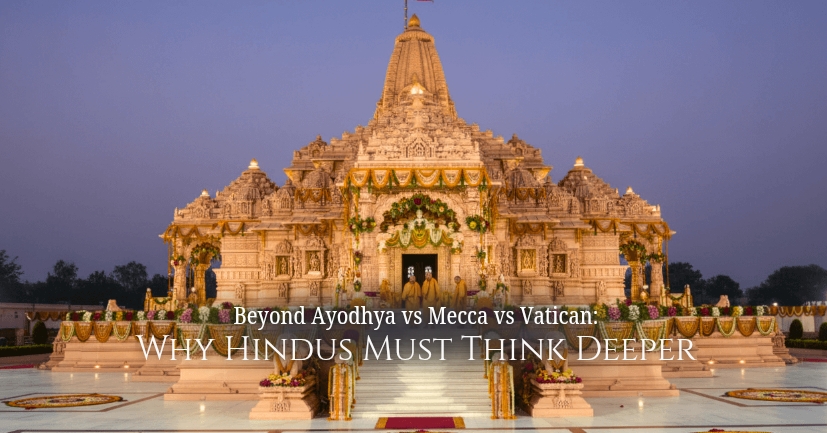
Recently, however, several friends shared a post titled Ayodhya vs Vatican vs Mecca. This time, restraint felt dishonest. What was being circulated was not merely celebratory data, but a deeper ideological shift—one that risks redefining Mandirs through a purely economic and comparative lens. Below is the message (in italics) that is being widely circulated.
________________________________________
Ayodhya vs Vatican vs Mecca:
India’s ₹4 lakh crore answer to the world!
Remember the day of 22 January two years ago. When the consecration (Pran Pratishtha) of Ram Lalla took place in Ayodhya, the country was divided into two groups. One group was overwhelmed with emotion and shed tears, while the other so-called “intellectual” group questioned: “How will a temple feed people? Why not build schools or hospitals instead?”
At that time, we only had emotion, but no answer. Today, exactly two years later, Ayodhya itself has answered that question. This answer is not made of words, but of numbers—data.
Today, we are comparing Ayodhya with two of the world’s largest religious power centers—Vatican City and Mecca. Reading these facts will fill every Indian’s chest with pride:
1. The Numbers Game:
The massive scale of Ayodhya
The success of any tourist destination worldwide is measured by the number of visitors.
Vatican City: The center of the Christian world receives around 9 million visitors per year.
Mecca (Saudi Arabia): Around 20 million devotees visit annually for Hajj and Umrah.
Ayodhya (India): According to official data, over 160 million devotees visited Ayodhya in 2024. In just the first six months of 2025, this number has already crossed 230 million.
Analysis:
The number of visitors to Ayodhya is 8 to 10 times higher than the combined total of Mecca and Vatican City.
2. The ₹4 Lakh Crore “Temple Economy”:
According to reports by global brokerage firm Jefferies and SBI Research, the Ram Temple has generated an additional ₹25,000 crore in tax revenue for Uttar Pradesh’s economy in just one year.
Just as Saudi Arabia earns its second-largest income—after oil—from Mecca tourism (about $12 billion), India has built a “recession-proof” economic model through Ayodhya.
3. Soft Power:
This is the most crucial point on India’s path to becoming a “Vishwaguru”. What is soft power? It is the ability to influence the world without using weapons.
Because of the Ram Temple, India’s influence over the Global South and Eastern civilizations has increased. Today, countries like Nepal, Thailand, Cambodia, and Mauritius do not look at India merely as a friend, but as a cultural leader.
4. Land Prices:
Competing with Mumbai
After the 2019 verdict, land prices in Ayodhya have increased by 900% to 1000%. Five years ago, land that was available for a few lakhs is today being bid for in crores. Major corporate groups are building 7-star hotels and townships there.
Conclusion:
Two years ago, we saw only God in the temple. Today, the world sees the nation’s progress in it. Ayodhya has proved that culture and development are not enemies, but partners. When faith and economics come together, that is when true Ram Rajya manifests!
________________________________________
I received this message from six different friends. Two versions mentioned an author’s name—each with a different attribution. Four had no author at all. The anonymity itself is telling, because what is being circulated is not scholarship or even journalism, but a viral civilisational claim that demands scrutiny.
Let me address some of the key claims made in the article before stepping back to present the larger concern.
“How will a temple feed people? Why not build schools or hospitals instead?” At that time, we only had emotion, but no answer.
The claim that “we had no answer” is simply incorrect. Many people did respond—clearly, consistently, and historically.
Mandirs have always fed people. Not metaphorically, but literally. Across centuries, mandirs sustained annadāna traditions, temple lands supported agriculture, temple guilds funded education, and temple trusts-built hospitals, pathshalas, and rest houses. Even today, large parts of India’s charitable food ecosystem—especially in pilgrim towns—rests on mandirs, not the state. More than this, India’s food traditions themselves have survived because they remained anchored to the mandir ecosystem. Crops, fruits, animals, and even birds that found ritual, seasonal, or symbolic association with mandirs were preserved, protected, and regenerated across generations. What was offered, consumed, celebrated, or sanctified was never random; it was woven into a living cultural memory that ensured continuity.
Conversely, elements of the natural world that lost their place within mandir-centered practices—those no longer linked to ritual cycles, festivals, or sacred geography—gradually faded from cultivation, protection, or everyday use. This was not accidental. Mandirs functioned as ecological and economic regulators long before modern conservation language existed. The intimate relationship between Dharma, Artha, and Bhojana ensured that sustenance was never divorced from sanctity.
This dynamic has been examined in detail in Temple Economics, Volume I, where the mandir is shown not merely as a site of worship, but as a civilisational institution that safeguarded food systems, biodiversity, and local economies simultaneously. Once this link is broken, food becomes a commodity alone—and when food loses its dharmic anchoring, both culture and ecology begin to erode.
The problem was never the absence of answers. The problem was that Hindu civilisational logic was being forced to defend itself using a Western NGO framework—where every institution must justify its existence by immediate utilitarian output. Dharma does not function on that axis.
The Numbers Game: The success of any tourist destination worldwide is measured by the number of visitors.
This is the first conceptual error that Hindus themselves must stop making.
Ayodhya is not a tourist destination. A mandir does not require “visitors”; it draws bhaktas. Tourism is incidental. Tirthyatra is primary. When we adopt tourism metrics to evaluate mandirs, we unconsciously accept a framework where sacred geography is reduced to footfall analytics.
Measuring a mandir’s significance by crowd numbers is as flawed as assessing a river solely by how many people bathe in it, ignoring the life it sustains across centuries. When mandirs are evaluated through footfall and revenue, they cease to be civilisational anchors and are reduced to cultural infrastructure—profitable, visible, and ultimately replaceable.
The ₹4 Lakh Crore “Temple Economy”: According to reports by global brokerage firm Jefferies and SBI Research, the Ram Temple has generated an additional ₹25,000 crore in tax revenue for Uttar Pradesh’s economy in just one year.
This raises an uncomfortable but necessary question:
Has this additional ₹25,000 crore tangibly improved the lives of Hindus in Uttar Pradesh?
Is there a disaggregated study showing:
If such a study exists, it should be cited. If it does not, the claim remains an accounting figure—not a civilisational achievement.
Soft Power: Because of the Ram Temple, India’s influence over the Global South and Eastern civilizations has increased.
Soft power cannot be asserted; it must be demonstrated.
In December 2025 and January 2026, the Thai military removed a Hindu deity—Lord Vishnu—from a disputed border area with Cambodia and replaced it with a Buddha statue. This incident alone should caution us against simplistic claims of civilisational leadership.
Cultural influence is not measured by tourist arrivals or symbolic gestures alone. It is measured by continuity, protection, and respect for shared heritage. If Hindu symbols remain politically negotiable even in culturally linked regions, then our soft power narrative needs humility, not triumphalism.
Land Prices: Five years ago, land that was available for a few lakhs is today being bid for in crores.
Since when did rising land prices become a civilisational success metric?
Who benefits from this appreciation—the original residents of Ayodhya or external real estate interests? Will long-standing inhabitants be able to remain, or will they be slowly priced out of their own sacred geography?
More importantly:
If Ayodhya becomes another commercialised pilgrimage town stripped of its spiritual ecology, then rising land prices are not progress—they are warning signs.
When faith and economics come together, that is when true Ram Rajya manifests!
Nothing could be further from the truth.
Ram Rajya is not an economic model. It is a moral and ethical ideal—rooted in righteousness (Dharma), justice, compassion, restraint, and responsibility. Economics (Artha) operates within Dharma, not alongside it as an equal partner. Ram Rajya was never about spectacle, scale, or numbers; it was about maryada—the quiet, uncompromising commitment to Dharma in governance, society, and personal conduct. Where Dharma governs Artha, prosperity follows naturally; where numbers govern Dharma, the civilisational core begins to erode.
When faith is forced to justify itself through revenue generation, Dharma is already compromised.
Ayodhya vs Vatican vs Mecca
The very framing of this comparison reveals a deep insecurity.
Two points are sufficient:
And further:
The comparison ultimately collapses for a more uncomfortable reason. Hindu civilisation has not yet evolved a unified civilisational voice comparable to Vatican City or Mecca. While Christianity and Islam possess centralised authority structures capable of coordinated global response, Hindu society remains fragmented—socially, institutionally, and organisationally. This fragmentation has come at a cost. Hindus face persecution and cultural erasure in many parts of the world, and increasingly, within India itself, yet collective response remains hesitant and inconsistent.
Unity, however, cannot emerge from economic triumphalism or symbolic spectacles alone. It must be consciously cultivated. The responsibility lies both with Hindu society at large and with the custodians of major mandirs—including Ayodhya—to think beyond footfall, revenue, and global comparison. Mandirs were never meant to be passive monuments or revenue generators; they were meant to be civilisational nerve centres.
If any metric must matter, it is not monetary accumulation but Hindu unity—intellectual, cultural, and moral. Dharma sustains civilisation; Artha merely serves it. When Artha is mistaken for the foundation rather than the instrument, civilisation weakens even as balance sheets grow. A unified Hindu society anchored in Dharma, not dazzled by numbers, is the only meaningful answer to the challenges it faces today.
The Larger Point
It is time Hindus move beyond shallow chauvinism.
We must understand:
Reducing a Mandir to an economic entity harms it more deeply than physical destruction ever could. Once a Mandir is justified only by revenue, it loses its civilisational immunity.
Let us not do intellectually what invaders once tried to do physically.
Let us avoid it.
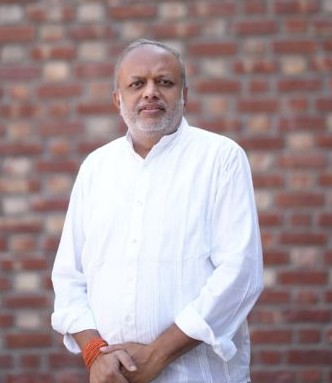 Sandeep Singh is author of Temple Economics Volume I and A Decade for Mandirs Volume II. He can be reached at [email protected]


The Venkateshwara Swami Temple in Tirupati is among the holiest places in the world for Hindus. Millions of people throng the temple every year to get...

It is a sad reality that our Itihasa and Puranas have been subject to severe distortion over the years. This is not surprising considering how even th...
The holy land of Bharat follows Sanatana Dharma. The word Sanatana Dharma is a Sanskrit word meaning, “Eternal law”. It is the indestructible ultimate...

Verandah Club is an initiative by few like-minds of Coimbatore who are interested to share information on various antiquities of Bharat.
Free download our iOS & Android app
© Copyright 2026, All Rights Reserved.