
Imagine walking through a forest after a heavy rain.
You notice a delicate spider's web stretched between two branches, each strand carefully woven into a near-perfect geometric pattern. Nearby, a bird patiently gathers twigs and leaves, building a nest that will one day protect its young. Beneath a fallen log, thousands of ants move in organized lines, each carrying food, each somehow knowing exactly where to go.
None of these creatures attended school. None learnt mathematics, architecture, or engineering. Yet they perform tasks that often leave us astonished. Now consider something even more surprising.
A slime mould—a tiny organism without a brain or nervous system—has been shown in scientific experiments conducted by Toshiyuki Nakagaki, a Japanese biologist, to solve maze-like problems in search of food. Plants, though rooted to the ground, grow towards light, communicate chemical signals to neighbouring plants, respond to touch, and adapt remarkably to changes in their environment.
They have no brain. Yet they perceive. They respond. They adapt. This raises an intriguing question — If behaviour that appears intelligent can exist without a brain, then what exactly is the role of the brain?“Can our consciousness exist without a brain?” Or to phrase it better, “Is our consciousness independent of the brain?”
For centuries, we have often used the words brain and mind almost interchangeably. Damage the brain, and memory changes. Stimulate certain regions, and emotions change. Alter brain chemistry, and personality itself may seem different.
It is therefore natural to assume that the brain and the mind are one and the same. But are they? Or is the brain the physical organ through which something we call the mind is expressed? Or perhaps through evolution this mind has developed a sophisticated centralized organ called the brain to perform its duties better and autonomously.
Modern neuroscience continues to investigate this fascinating question, uncovering extraordinary insights into how the brain gives rise to thought, emotion, memory, and behaviour. Yet the relationship between the brain and the subjective experience of the mind remains one of the deepest mysteries in science and philosophy.
And the mystery deepens further.
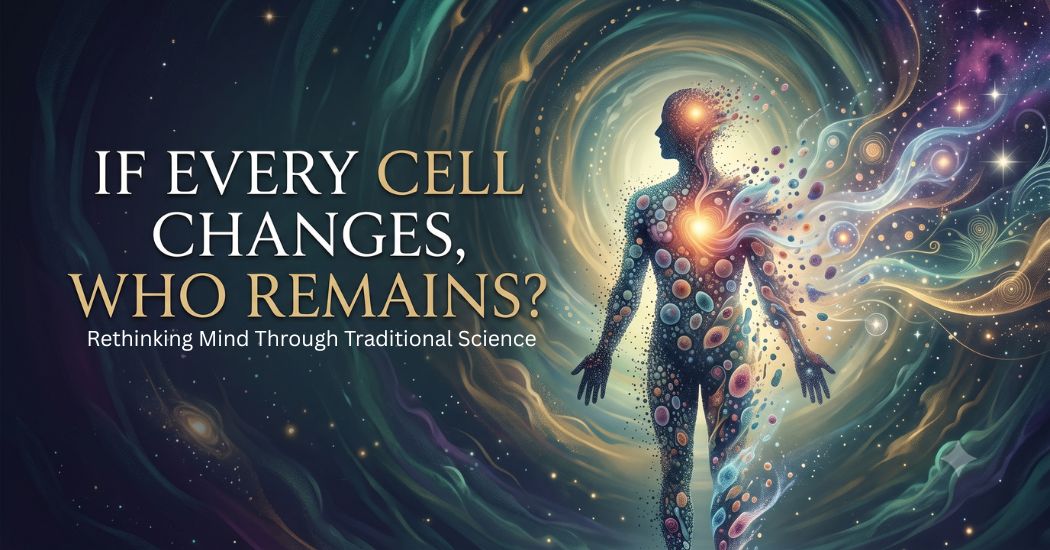
Throughout our lives, much of our body is constantly renewing itself. Cells die, new cells are formed, and even within the hippocampus—a region of the brain closely associated with learning and memory—new neurons can continue to be generated while others are lost. The physical brain is not the unchanging structure we often imagine it to be.
Yet, despite this constant renewal, most of us never feel that we have become someone else. Perhaps the catalyst of consciousness, or the master of the physical organ brain —mind, could still be intact. Because Brain can be observed but manam can only be experienced.
Long before modern neuroscience existed, philosophers across the world wrestled with this same mystery. Among them, the thinkers of ancient India—whose ideas are preserved across numerous Tamil and Sanskrit texts—approached the question from a unique perspective. Rather than asking what the brain is made of, they asked something far more immediate:
What is it that we actually experience when we say, "my mind"? Perhaps that is where our own inquiry should begin.
We use the word mind almost every day.
"I changed my mind."
"Keep it in mind."
"You have a sharp mind."
"My mind is racing."
"Peace of mind."
The word feels so familiar that we rarely stop to ask what it actually means.
When we say mind, are we talking about our thoughts? Our emotions? Our memories? Our imagination? Our ability to make decisions? Or the silent awareness that notices all of these?
The more closely we look, the more elusive the word becomes.
Suppose someone offers you a cup of coffee. Before you even take a sip, your mind has already begun working. You notice its colour. You recognize its aroma. Perhaps you remember the first time you tasted coffee. You decide whether you like it or not. You wonder if it's too hot. You choose whether to drink it now or later.
All of this happens within moments, so effortlessly that we seldom notice the remarkable complexity unfolding within us. Yet we casually describe all of these different processes using a single word: Mind.
Perhaps what we call the mind in english is not one thing at all, but a collection of different faculties working together so seamlessly that they appear to be a single entity. But we see an old indian man sitting across temple hall using words like manam, sittam, buddhi in appropriate sense without confusion. We lose our language, we lose our meanings.
This was precisely the direction taken by many ancient Indian philosophers. Rather than treating the mind as a single, indivisible phenomenon, they carefully observed its different functions and described them individually. Before we explore those ideas, however, let us first observe something much closer to home.
Let us watch our own experience unfold.
Take a moment to imagine that someone suddenly calls your name from across the room. Before you decide who it is, Before you wonder why they are calling you, Before you choose whether to respond, Something else has already happened —You heard the sound.
Or imagine walking past a bakery. The aroma of freshly baked bread reaches you, Before you decide whether you like it, Before you remember the last time you ate freshly baked bread, Before you choose whether to walk in—You first become aware of the smell.
The same happens when you accidentally touch a hot surface.Or when you hear a sudden clap of thunder. Or when you notice a familiar face in a crowded street.
Every experience seems to unfold in stages. First, there is perception. Only afterwards comes interpretation. Our senses bring us information about the world, but they do not immediately tell us what that information means. Somewhere within us, something first receives the experience. Only then does something else begin comparing, remembering, judging, and deciding how to respond.
This distinction is so immediate that we rarely notice it. We experience it as one seamless event. Yet, if we pay careful attention, we find that perception and judgement are not quite the same.
Ancient Indian philosophers noticed this distinction long before the language of neuroscience existed. Across many Tamil and Sanskrit philosophical traditions, the faculty that first receives sensory experience was called manam (or manas in Sanskrit). It is not the faculty that decides. It does not conclude whether something is good or bad, true or false. Its role is much simpler. It receives. It notices. It directs attention.
If manam is the faculty that first receives the world, then another question naturally follows. Who makes sense of what has been received? Ancient Indian philosophers called this faculty buddhi.
Unlike manam, which simply receives experience, buddhi seeks to understand it. It distinguishes. It reasons. It questions. It concludes.
It is this faculty that helps us separate truth from falsehood, right from wrong, beneficial from harmful. It allows us to learn from experience, solve problems, plan for the future, and exercise judgement. Much of what we consider wisdom depends upon the refinement of buddhi.
Yet a curious question remains.
If buddhi is the faculty of reason, why do reasonable people sometimes make unreasonable decisions? Why do intelligent people repeat the same mistakes? Why do we often know what is right, yet choose otherwise? Why does one person see an opportunity where another sees only danger?
Clearly, buddhi does not make decisions in isolation.
Like a judge listening to evidence in a courtroom, it can only decide based on what is presented before it. But where does that evidence come from?
Could it be that every judgement we make is quietly influenced by the countless experiences we have accumulated throughout our lives? Ancient Indian philosophy answered this question with another remarkable idea. It called these lingering impressions vasanas.
Have you ever opened an old wooden box that once held sandalwood? Even after the sandalwood has long been removed, the fragrance often remains. The box is empty. Yet something of what it once contained continues to linger. The wood has quietly absorbed it.
Human experience may be much the same. Every conversation we have, every book we read, every place we visit, every person we meet, every joy we celebrate, and every sorrow we endure leaves behind something subtle within us. The moment passes. The event is over. Yet its influence remains.
A child who grows up surrounded by encouragement may naturally develop confidence. Another who repeatedly encounters fear or rejection may begin to view the world with greater caution. Neither consciously chooses these tendencies.
They quietly develop over time, shaped by countless experiences, often without our awareness. These subtle impressions are vasanas. The word is often translated as impressions, tendencies, or conditioning, but none of these English words fully capture its meaning.
A vasana is not simply a memory. Many memories fade with time. A vasana is what remains even after the memory itself has become blurred. It is the quiet influence that continues to shape the way we perceive, think, feel, and respond. This idea may not be as unfamiliar as it first appears.
Modern psychology speaks of conditioning, learned behaviour, implicit memory, habits, cognitive biases, and the lasting influence of childhood experiences. Though described in different ways, these ideas point toward a similar observation—that our past does not simply disappear. It leaves traces that continue to influence our present.
Perhaps that is why two people witnessing the same event may experience entirely different realities. Not because the world is different. But because each person carries a different fragrance from the life they have lived.
This raises another fascinating question. If these subtle impressions accumulate throughout our lives, where are they preserved? Ancient Indians called this layer Sittam.
Yet sittam is more than a library of memories. A library simply stores books. It does not influence the reader. But the impressions preserved within sittam quietly colour the way we see the world. Every new experience is interpreted through the countless impressions already accumulated within us.
This is why the same words can inspire one person and offend another, why the same failure can motivate one individual but discourage someone else, why the same opportunity fills one person with excitement and another with fear.
The world enters through manam.
It is interpreted by buddhi.
But both are continually shaped by what already resides within sittam.
This observation leads to a profound philosophical possibility.
If every experience is filtered through vasanas in our sittam—then do we ever encounter the world as it truly is? Or do we only encounter the version of the world that our own inner landscape allows us to perceive?
If every person's inner landscape is different, then every person's world is different.
This is one of the reasons many philosophical traditions speak of maya, often translated as illusion. Not because the universe necessarily does not exist, but because whatever reality may exist, we never encounter it untouched. Every experience reaches us only after passing through the countless impressions that shape our perception.
If that is true, then an intriguing question emerges. If an objective reality exists, yet every experience of it is conditioned by the mind, how could we ever know it as it truly is?
Perhaps the answer does not lie in studying the world alone. Perhaps it begins with understanding the one who experiences it.
After all, we casually say,
“My name.”
"My body."
"My thoughts."
"My memories."
"My emotions."
Sometimes we even say,
"My soul."
But if all of these are mine, then who—or what—is this "my" that claims them?
Ancient Indian philosophers believed this question was the turning point of the entire inquiry. To understand reality, they first sought to understand the experiencer. And that journey begins with another fascinating faculty of the inner world—ahamkaram.
In everyday conversation, the word ego often carries a negative meaning. We describe someone as having "a big ego" when they are arrogant, proud, or self-centred. But this is not the sense in which ancient Indian philosophers used the word ahamkaram (or ahamkara in Sanskrit).
Quite literally, aham means "I." Ahamkaram is the faculty that gives rise to the sense of "I" and "mine."
When you say,
"My body hurts."
There is a body.
And there is someone who calls it my body.
When you say,
"My thoughts are disturbing me."
There are thoughts.
And there is someone who claims them as my thoughts.
When you say,
"I remember my childhood."
There are memories.
Yet there also seems to be someone who remembers them. This simple observation raises a remarkable possibility. If we can observe our body, perhaps we are not merely the body. If we can observe our thoughts, perhaps we are not merely our thoughts. If we can observe our emotions rising and falling, perhaps we are not merely our emotions either.
Then who is the observer?
Ancient Indian philosophy suggested that ahamkaram is the principle that gathers together the countless experiences of life and weaves them into the feeling of a single personal identity.
Without this sense of "I," life would still unfold, but there would be no centre around which experiences are organised into a personal story. It is this faculty that allows us to recognise ourselves as the same individual across childhood, adolescence, and adulthood, despite the body changing, memories fading, and opinions evolving. Yet the philosophers asked an even bolder question.
Is ahamkaram itself the true experiencer? Or is even this sense of "I" something that can be observed?
After all, there are moments in life when our identity itself changes. A parent discovers a new identity after the birth of a child. A soldier returns from war a different person. A spiritual seeker may say, "I am not the same person I used to be." If even our sense of "I" can evolve, deepen, or transform… Then perhaps it, too, is not the final destination of the inquiry.
Perhaps ahamkaram is not the end of the journey. Perhaps it is only the last doorway before an even deeper question.
Who is aware of the "I"?
 Dr. Vigneshvaran, Senior Correspondent of TheVerandahClub.com is a second generational acupuncture practitioner, a story teller, as well as an avid independent writer driven by his passion. His literary talents extend to crafting beautiful poems and captivating short stories including the Sehwag Tales series. In addition to these creative pursuits, he has also authored a book titled "Halahala," which can be found on Wattpad.
PREVIOUS ARTICLE
NEXT ARTICLE



The Venkateshwara Swami Temple in Tirupati is among the holiest places in the world for Hindus. Millions of people throng the temple every year to get...

It is a sad reality that our Itihasa and Puranas have been subject to severe distortion over the years. This is not surprising considering how even th...

The holy land of Bharat follows Sanatana Dharma. The word Sanatana Dharma is a Sanskrit word meaning, “Eternal law”. It is the indestructible ultimate...

Verandah Club is an initiative by few like-minds of Coimbatore who are interested to share information on various antiquities of Bharat.
Free download our iOS & Android app
© Copyright 2026, All Rights Reserved.